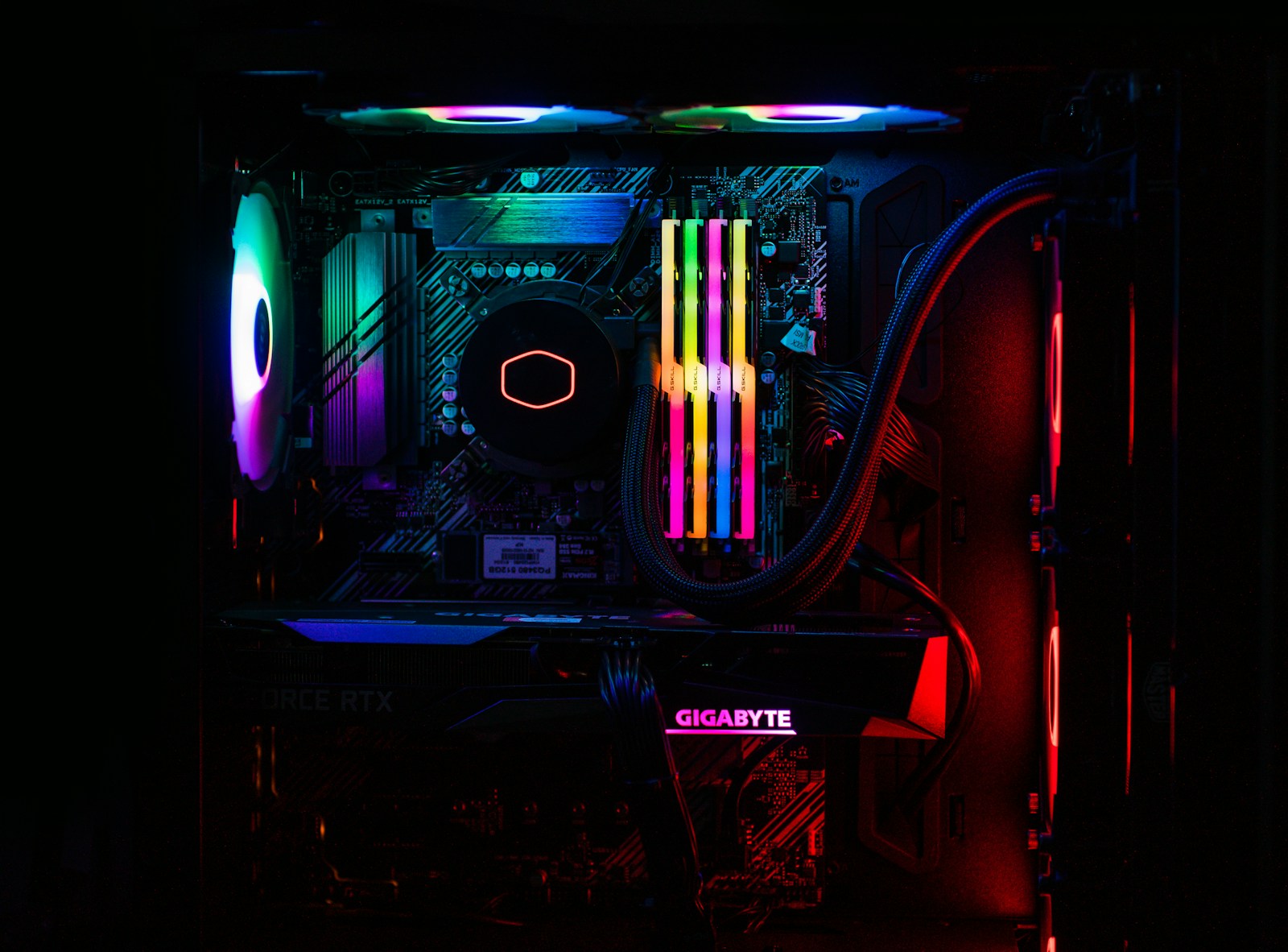
For years, the GPU was dismissed as the graphics card, the thing only needed to run video games. Today it has become much more: it is the engine that drives digital graphics, but also parallel computing, artificial intelligence, real-time rendering. Where the CPU reasons, the GPU crunches data in breadth. And in the world of images, video, and 3D we live in, this difference changes everything.
What a GPU Really Is
The GPU, short for Graphics Processing Unit, is a processor designed to execute a vast number of operations in parallel. If the CPU is built to make a few very complex decisions, the GPU is designed to perform the same operation on thousands of pieces of information simultaneously. This is exactly what you need when you have to calculate the position of every pixel on screen, the color of every fragment, the effect of lights and shadows on an entire scene.
Physically, you encounter it as a dedicated graphics card or as a chip integrated into the CPU. In the first case, you have dedicated memory (VRAM), its own power supply, separate cooling. In the second, you share resources with the rest of the system. This is also why, with the same specifications, a laptop with a dedicated GPU tells a very different story compared to one with integrated graphics.
Sponsored Protocol
How It Works: From the 3D Model to the Pixel You See
Whenever a game, 3D software, or graphics engine needs to draw a scene, it goes through a pipeline that the GPU knows by heart. It starts with models made of vertices and polygons, applies transformations to position them in space, calculates lights, shadows, reflections, and applies textures and materials. Each step produces intermediate data that the GPU reprocesses at an impressive speed.
This work is handled by specialized computing blocks, the shader cores. Vertex shaders handle geometry, fragment (or pixel) shaders decide the color of every single point on the screen. Technologies like real-time ray tracing, pushed by manufacturers like NVIDIA and AMD, add an extra layer: they simulate the physical path of light to generate believable reflections and shadows. All in milliseconds.
Sponsored Protocol
Why the GPU Has Become the Engine of Digital Graphics
Every frame you see on a screen is the result of thousands of calculations. At 60 frames per second, a system must repeat this process sixty times every second. At 120 or 144 Hz, the demand increases further. The CPU alone could not withstand such pressure while keeping the experience smooth. The GPU exists precisely for this: to take the graphics load, parallelize it, and process it en masse.
But digital graphics isn't just gaming. It's complex interfaces in advanced web applications, 3D modeling, video editing, virtual and augmented reality. It's also the modern Web, which uses technologies like WebGL and WebGPU to move calculations to the graphics card directly from the browser, as detailed in the documentation on MDN WebGL. In all these scenarios, the GPU is the part that decides whether an experience is merely usable or truly smooth.
GPU, AI, and Parallel Computing
The interesting thing is that, at a certain point, someone started wondering: if the GPU is so good at doing the same calculation on lots of data, why use it only for graphics? From there, GPGPU was born, general-purpose computing on GPUs. Libraries like CUDA and OpenCL have transformed the graphics card into a computing accelerator for simulations, scientific research, finance, cryptography, machine learning.
Sponsored Protocol
Modern artificial intelligence models, especially deep learning ones, must continuously multiply and add huge matrices. It's a perfect job for the way a GPU is built. It's no coincidence that the explosion of AI in recent years is also linked to the availability of increasingly powerful GPUs in data centers. Where before we only saw 4K games, today we see clusters of cards training language and vision models.
What Changes for Those Working in Digital
For a video game or 3D application developer, the answer is obvious: the GPU is the playing field. Deciding how to use it, how much load to shift, which graphical effects to activate and when becomes an integral part of the design. But even for those involved in web, design, or infrastructure, the GPU is slowly ceasing to be an accessory.
Sponsored Protocol
A heavy interface, unoptimized animations, unnecessarily complex effects can turn an elegant experience into a stuttering website. On mobile devices, where the GPU is also responsible for the smoothness of the entire system, the difference is immediately noticeable. In the server world, however, the use of dedicated GPUs for AI, data analysis, or remote rendering opens the door to increasingly complex services, without forcing end-user devices to be powerful machines.
When Meteora Web designs infrastructures or platforms, this distinction enters the architectural choices: what to have the client do, what to move to the server, what makes sense to delegate to remote GPUs. In an ecosystem where digital graphics and parallel computing are now everywhere, the GPU has become one of those components you can no longer afford to ignore. You may not see it, but if it disappeared, you would notice immediately.