For a long time, the industrial robot was the nightmare of factories and unions: the mechanical arm that arrives, takes the worker's place, and never leaves. Today the scene is more complex, but that image is not entirely wrong. Industrial robots have indeed begun to replace part of the workforce, especially in repetitive and dangerous activities. At the same time, they have changed the nature of human work, shifting it elsewhere. Understanding how they work is the only way to read this change without slogans.
What are industrial robots
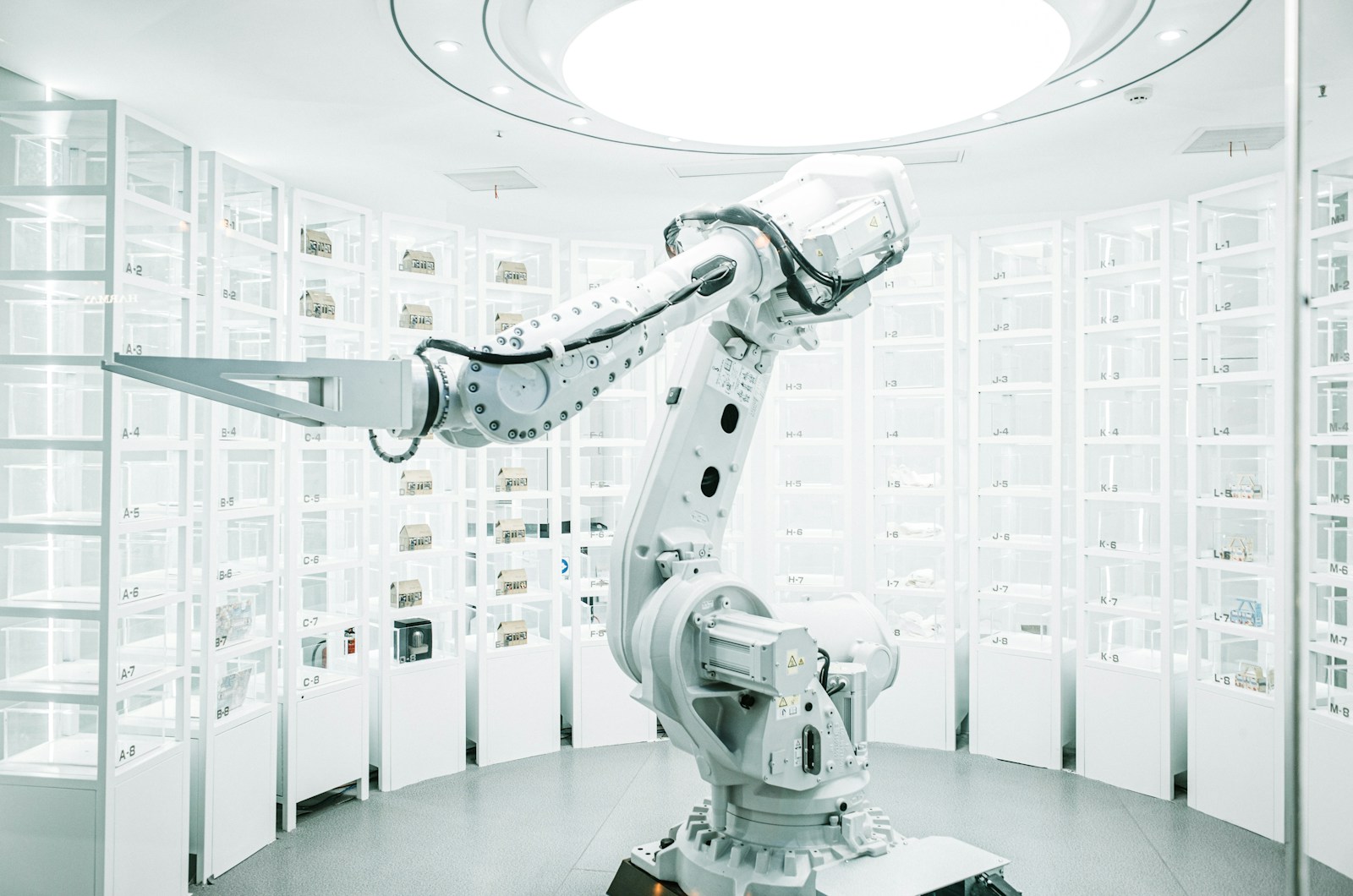
An industrial robot is a programmable machine, designed to perform movements and operations automatically or semi-automatically in a production context. In practice, they often appear as multi-jointed mechanical arms, mounted on the floor or suspended, that perform precise tasks: welding, assembling, moving, painting, packaging. They are not intelligent in the science-fiction sense of the term, but they are extremely consistent: if you ask them to repeat the same action ten thousand times, they will do it without variation, without tiring, without distraction.
Sponsored Protocol
These systems live inside work cells or along production lines, integrated with conveyor belts, sensors, and machine vision systems. Where before several coordinated workers were needed, today a combination of robots, electronic controls, and a human supervisor may suffice.
How they work inside a production line
The heart of an industrial robot is the controller, the electronic brain that translates programs, sensor signals, and factory orders into movements. The actuators move the arm's axes, the sensors measure position, force, the presence of objects, and any obstacles. Above all this lives the software: predefined routines, cycles, conditions, and logic that determine what must happen at every moment.
Every movement is defined rigorously: from point A to point B, with a certain trajectory, at a certain speed, with a certain tolerance. The robot can receive input from a vision system that recognizes parts on a conveyor, from a PLC that coordinates the entire line, from safety sensors that stop it if people enter its work area. The result is an industrial choreography that, when it works, seems almost natural.
Sponsored Protocol
From caged robots to cobots
The first industrial robots lived enclosed behind physical barriers: they were fast, powerful, potentially dangerous. Humans had to stay away from them. In recent years, collaborative robots, or cobots, have arrived, designed to share space with people. They have more refined sensors, controlled movements, limits on force and speed, and immediate stop systems. They don't simply replace the operator, but assist them: they hold the part, repeat strenuous actions, leaving the human with the tasks of control, verification, and adaptation.
This evolution has changed the perception of the robot: from a closed and distant machine to an everyday work tool. But the central point remains the same: whenever an activity can be described in repeatable steps, the robot tends to be a natural candidate to perform it.
Sponsored Protocol
Why they replace labor
The brutal answer is simple: a robot doesn't get sick, doesn't ask for vacation, doesn't take breaks, doesn't get distracted, doesn't demand raises. From the perspective of a company working with large volumes, this means more predictable costs, more uniform quality, less waste. Where before three people on three shifts were needed to keep a machine running 24/7, today a robotic island with supervisory personnel may suffice.
Robots fit into all those tasks that don't require creativity, but endurance: loading and unloading, tightening screws, moving pallets, visually inspecting parts in a repetitive manner. In these cases, human labor becomes a growing and inefficient cost compared to a machine that, once amortized, continues to work with the same precision for years. This is where the most evident replacement occurs.
Sponsored Protocol
What remains for the human being
Saying that robots steal jobs is a convenient but incomplete simplification. It's not work itself that disappears: it's certain tasks that become marginal. In exchange, others are born: programming, maintaining, configuring, designing workflows, analyzing production data. The problem is the reaction time: the robot arrives immediately, the transformation of human skills takes years.
Those who remain fixed in purely executive roles see the machine as an enemy. Those who learn to read it as a tool and to interact with it become harder to replace. In the most advanced factories, the generic worker is disappearing; in their place come technicians, specialized operators, hybrid figures who know both production and the software that governs it.
Sponsored Protocol
Industrial robots as a sign of a larger change
Industrial robots are not just a technology: they are a symptom of a broader trend. Where work can be standardized, it will be. Where it can be automated, sooner or later someone will try. And this doesn't only concern automotive assembly lines, but also logistics, food, pharmaceuticals, and progressively even service sectors.
For those working in digital and engineering, the lesson is clear: the software systems, control platforms, and human-machine interfaces that orchestrate these robots become a crucial part of the game. Realities like Meteora Web operate precisely on this boundary: designing infrastructures, applications, and tools that don't just live on a screen, but interact with an increasingly automated physical world. Because if machines replace part of the workforce, someone will still have to decide how, when, and why to make them move.