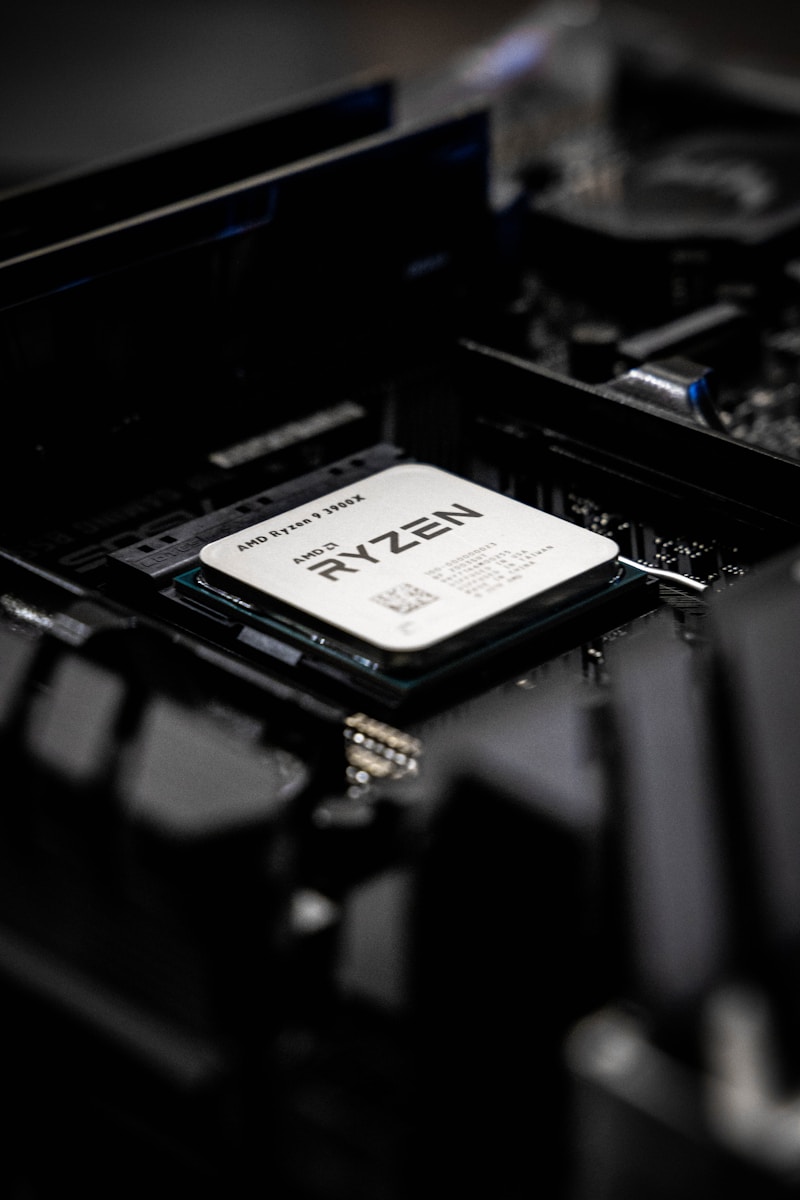
Most people think about a computer's power by looking at the graphics card, RAM, or SSD. In reality, everything that happens, even the smallest gesture you make in front of the screen, first passes through a precise point in the machine: the CPU. It's a tiny chip, but inside that little rectangle of silicon flows the fate of every computation. If it doesn't work, nothing works. It's a silent king, and like all true sovereigns, it doesn't need to draw attention to itself.
What a CPU is when you look at it without filters
The academic definition calls it the central processing unit. But put that way, it sounds sterile. A CPU is much more: it's an interpreter capable of transforming abstract instructions into concrete actions, one after another, without pause. Inside are logic blocks that communicate with each other like gears in an impossible clock: the control unit that sets the pace, the ALU that does the raw calculations and makes mathematical decisions, the registers that hold the most urgent data in memory. Everything happens in invisible spaces, with a precision that defies physics.
Its life is marked by the clock, a continuous pulse reminiscent of a heartbeat. Every gigahertz is a billion steps forward in its work. But frequency doesn't tell the whole truth: the efficiency of an architecture says much more than any number written on the box.
The real operation, not the one from the manuals
The CPU doesn't execute operations, it executes stories. Every instruction is part of a flow that traverses deep pipelines, conditional jumps, predictions about the future. Yes, because modern processors don't wait: they try to guess what the next instruction will be, execute it in advance, and, if necessary, discard it without blinking. A continuous bet on probability.
This dance would be fragile without the cache. Small portions of memory, extremely close to the heart of the chip, that keep what's needed there, warm. L1 is extremely fast, a whisper. L2 is larger. L3 is the support network. When data comes from here, the CPU flies. When it has to go all the way down to RAM, it's like forcing it to walk instead of run. And every millisecond lost is a lifetime in the world of processing.
Cores, threads, and the illusion of multitasking
A modern CPU is not a brain: it's a team. Each core is an independent worker, capable of handling its own tasks. Threads are the diplomacy that allows exploiting every sliver of time, every possible interlock. And it's thanks to this architecture that we can open ten applications, watch a video, debug, have fifty browser tabs open, and hope everything stays smooth. Hope, indeed.
Because a CPU works in balance. If you saturate it, if you ask too much of it, it responds by slowing down. And that slowdown propagates like a wave throughout the entire system.
Where Intel, AMD, and ARM enter the scene
The sector is dominated by three silicon philosophers.
Intel, the historic guardian of x86 architectures, has built the rhythm of modern computing for decades.
AMD rewrote the rules with Ryzen, forcing everyone to rethink what power really was.
ARM chose efficiency as its weapon, bringing a radically different approach to the mobile world and edge servers, so effective that it convinced Apple to change course with its own chips.
Three styles, three visions: one single goal. To give developers an ever-wider margin of possibilities.
In servers, the CPU decides everything
A slow computer is annoying. A slow server is a problem. Every request that arrives at a website, every SQL query, every PHP process, every microservice in a cluster passes through it. And that's why the CPU is crucial in infrastructure design: because you can't afford mistakes. In containerized environments, platforms like
Kubernetes manage the CPU as a living resource, to be measured, limited, and distributed with surgical care.
In Meteora Web architectures, the processor is not a component: it's the metric around which the entire service is shaped. A struggling CPU means a site that responds poorly, a service that degrades, an experience that breaks.
Understanding it is not a technical exercise: it's a form of clarity
When you truly understand what a CPU does, you start reading systems differently. You notice how an application consumes resources, how a server breathes under load, when a bottleneck isn't in the code but in the hardware. It's an awareness that is useful for those who develop, design, and build platforms meant to last.
Because the CPU is the origin of everything. Not as flashy as a GPU, not as showy as an 8K display, not as trendy as an NPU. But it's the one that holds the machine together, that guides it, that protects it. And it's the one that, in silence, allows every digital project to truly exist.