For years, artificial intelligence remained more of a theoretical promise than a practical one. Then
deep learning arrived, and things changed for real. It's the technology behind generative language models, facial recognition systems, automatic translation, and the recommendations we see every day on video, e-commerce, and social platforms. When someone says a machine learns from data, very often, quietly, there is a deep neural network at work.
What deep learning really is
Deep learning is a branch of
machine learning that uses
deep artificial neural networks, meaning networks composed of many layers of artificial neurons connected to each other. Unlike traditional algorithms, where a human often manually selects the relevant features to feed into the model, here it is the network itself that learns which patterns to extract from the data to solve a task.
From a mathematical point of view, a deep neural network is a huge function with millions or billions of adjustable parameters. It receives numbers as input: the pixel values of an image, the vector representation of a sentence, samples of an audio signal. It outputs a decision, a probability, a prediction, or generated content. The theoretical framework is described in detail in the reference text
Deep Learning, but the basic idea remains concrete: modify the parameters until the error between what the network produces and what it should produce is minimized.
How a deep neural network works
A neural network is made of artificial neurons organized in layers. Each neuron receives a series of input values, combines them with weights and a bias, applies an activation function, and generates a new value. Layer by layer, the network builds increasingly abstract representations of the starting data. In the first levels, it sees simple structures; in the middle ones, it begins to recognize shapes and patterns; in the final ones, it makes high-level decisions.
Learning happens through a continuous cycle. Examples with their expected responses are shown to the network, the difference between the model's output and the correct solution is calculated, and the weights are updated to reduce that error. This mechanism, known as
backpropagation combined with gradient descent, is the engine of modern deep learning. To handle models of this size, frameworks like
PyTorch and
TensorFlow are needed, capable of leveraging the power of GPUs and hardware accelerators.
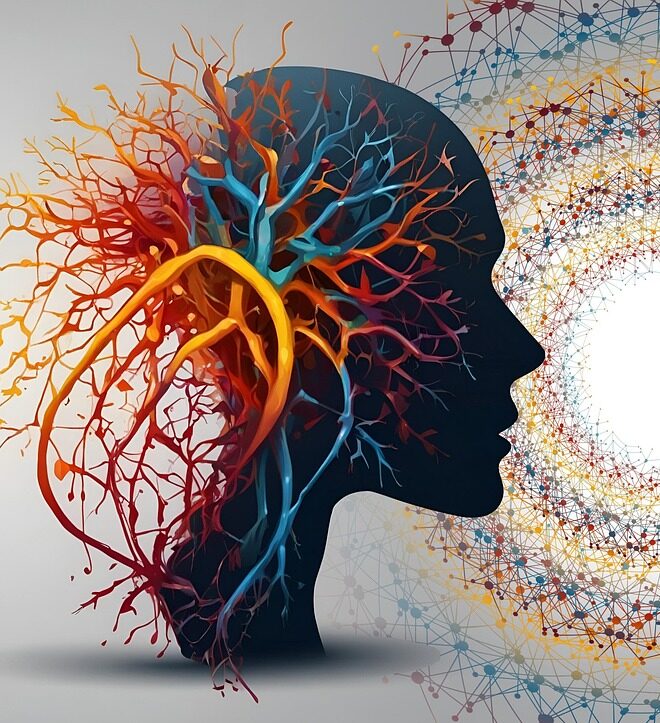
Why it's said to mimic the human brain
The reference to the brain is not just a slogan. Artificial neural networks are inspired, in an extremely simplified way, by biological neural networks. Each artificial neuron receives signals, weighs them, decides whether to activate, and passes the result forward. The analogy with neurons and synapses is not perfect, but it is strong enough to guide the intuition of those who design these systems.
This similarity is especially evident in deep architectures. In a convolutional network for images, for example, the first layers learn to recognize edges and basic textures, the intermediate ones assemble these shapes into parts of objects, and the final layers recognize the complete object. Something similar happens in networks for natural language: the lower levels capture character and word patterns, the intermediate ones capture syntactic and semantic relationships, and the higher ones capture discourse structure and context. This is the principle behind the large language models developed by entities like
OpenAI or
Google DeepMind.
Where we encounter deep learning in real life
Many of the digital functions we take for granted today exist thanks to deep learning. Smartphone facial unlock, content suggestions on video platforms, automatic translation systems, spam filters, automatic object recognition in photos, text and image generation: behind all this are deep neural networks trained on volumes of data unimaginable just a few years ago.
In the industrial world, deep learning is present in medical image analysis, automatic inspection systems in factories, predictive maintenance of machinery, risk models for finance and insurance, and assisted driving and vehicle autonomy systems. In the software realm, it has become a standard ingredient for everything related to classifying, predicting, generating, and synthesizing.
For those who design digital products and platforms, as Meteora Web does with clients ranging from web to SaaS, deep learning is no longer an academic curiosity but a technological building block to be evaluated with the same clarity used to choose a back-end framework or a database.
The limits and fragilities of deep learning
Despite its impact, deep learning is not magic. It is powerful, but also fragile. It works very well when it has large amounts of data representative of the problem, but it can fail unpredictably when faced with situations it has never seen before. It is often a black box: we know the model produces good results, but it's not always clear which internal steps lead it to a certain decision.
To this is added the issue of
bias. If the data used to train a neural network contains prejudices, imbalances, or errors, the model will tend to replicate and sometimes amplify them. This is why many guidelines, from the responsible AI initiatives of major players like Google to European discussions on regulation, insist on audits, transparency, and human oversight. Deep learning is not neutral: it inherits everything behind the data.
Finally, there is the issue of cost. Training ever-larger models means consuming enormous amounts of computational resources and energy. It makes no sense to fire up a gigantic model for every problem. Often the best solution is a smaller model, well-trained on quality data, integrated into a broader system that combines classical logic and neural components only where they are truly needed.
Why deep learning is central to software and business
For those working between software development, digital products, data science, and infrastructure, deep learning is now a stable piece of the landscape. It doesn't mean every project must use it, but ignoring it entirely is risky. It's necessary to understand which problems are suited for it, which data is truly available, what level of complexity is sustainable in the long term, and how to integrate these models into reliable architectures.
This is where the role of technical partners like
Meteora Web comes into play, who don't just integrate a trendy library but help answer more uncomfortable questions: is deep learning really needed in this case, or is a simpler, more interpretable model enough? What operational costs will it bring in a year? How do you monitor and update a system like this without breaking the product?
Understanding deep learning, in this sense, is not just a technical matter. It's a way to read ahead of time the trajectory of software, services, and entire sectors, and to consciously decide when to ride the wave and when to stay light.
If you are evaluating how to bring artificial intelligence into your product or company, starting from a clear understanding of deep learning and its limits is the best way to avoid passing fads and invest only in what can generate real value over time.