You've heard about ChatGPT, maybe even played with it for an afternoon, but you’re still not sure if it can actually help your business. You’re not alone. We see it every day in the projects that come to us: everyone talks about AI, but few know where to start concretely.
We at Meteora Web have integrated ChatGPT into our workflows – from drafting SEO article outlines to automated customer support – and we’ve learned to separate hype from substance. This guide cuts straight to the point: what ChatGPT is, how it works, and what you can do right now to start using it for real.
What Is ChatGPT and Why You Should Care
ChatGPT is a language model developed by OpenAI. In plain English: it’s a program that has “read” an enormous amount of text (books, articles, code, conversations) and learned to predict the next word in a sentence. Sounds simple, but the result is a virtual assistant that can write, summarize, translate, explain, and even write code.
But here’s the catch: ChatGPT doesn't “understand” in a human sense. It generates statistically probable text. That’s why it works great in many contexts, but can also fail spectacularly. We call it the side effect of statistical intelligence.
Sponsored Protocol
For a business, the value lies in three areas:
- Automation of repetitive tasks (standard replies, drafts, translations).
- Creative support (ideas for content, headlines, email marketing).
- Analysis and summarization of large volumes of text (reports, chat logs, documentation).
Don’t expect it to solve everything on its own. AI amplifies, it doesn’t replace. Every output must be verified by someone who knows the domain. At Meteora, for example, we use it to speed up first drafts for client content, but every line is reviewed before going live.
How It Works: Models, Tokens, and Prompts
Models
ChatGPT comes in different versions: GPT-3.5 (faster, less precise), GPT-4 (slower but much more capable), GPT-4 Turbo, and the latest GPT-4o. The main difference is the number of parameters and the amount of training data. With the same prompt, GPT-4 gives more contextual and less generic answers.
Sponsored Protocol
Tokens
The model doesn’t read words, it reads tokens: chunks of text roughly 4 characters in English, 2 in Italian. Every request (prompt + response) has a maximum token limit. For GPT-4 it’s around 8k-32k tokens depending on the variant. Exceeding the limit means the response gets cut off, or you need to ask for a summary.
Example: "ChatGPT is useful" = 4 tokens (Chat, GPT, is, useful)Prompt Engineering
The quality of the output depends almost entirely on how you ask the question. A good prompt is specific, provides context, and states the desired format. Example:
❌ "Write something about marketing."
✅ "Write a 50-word paragraph for a furniture company website. The tone should be professional but welcoming. Talk about craftsmanship and sustainable materials."
Our rule of thumb: treat ChatGPT like a talented but distracted junior employee. Give clear instructions and always check the result.
How to Start Right Now: 4 Actionable Steps
1. Create an OpenAI Account
Go to chat.openai.com and sign up. The base version (GPT-3.5) is free. With the ChatGPT Plus subscription (around $20/month) you get access to GPT-4 and extras like DALL·E for images.
Sponsored Protocol
2. Your First Useful Prompt
Don’t ask something generic. Try something concrete for your business right away:
“You are a marketing consultant. Write 5 Instagram post ideas for a clothing store that wants to promote its new spring collection. Each idea should include a hook, a brief description, and a CTA.”
Copy it, paste it, read the result. Then ask for modifications (“make it shorter”, “more casual”, “add a note about colors”).
3. Use the Chat for Real Problems
- Translate: “Translate this text into Spanish while keeping the formal tone.”
- Rewrite: “Rewrite this paragraph in simpler language for a non-technical audience.”
- Explain: “Explain what a 301 redirect is as if I were 10 years old.”
4. Integrate via API (if you have some technical skill)
If you want to automate, you can call ChatGPT from your code. Example in Python using the openai library:
Sponsored Protocol
import openai

openai.api_key = "your-key"

response = openai.ChatCompletion.create(
  model="gpt-4",
  messages=[
    {"role": "system", "content": "You are a helpful assistant."},
    {"role": "user", "content": "Write a short follow-up email for a client who requested a quote."}
  ]
)

print(response.choices[0].message.content)
Important: keep your API key secret and be aware of usage costs. We use it to auto-generate product descriptions for e-commerce clients, always with human review.
Limits and Caveats: What ChatGPT Won’t Tell You
- Hallucinations: it makes up facts, dates, and quotes with absolute confidence. Never trust without verification.
- Privacy: data you input is processed on external servers. Do not share sensitive information or client data without encryption and company policy.
- Bias: the model reflects biases present in its training data. It can generate stereotyped or inappropriate responses.
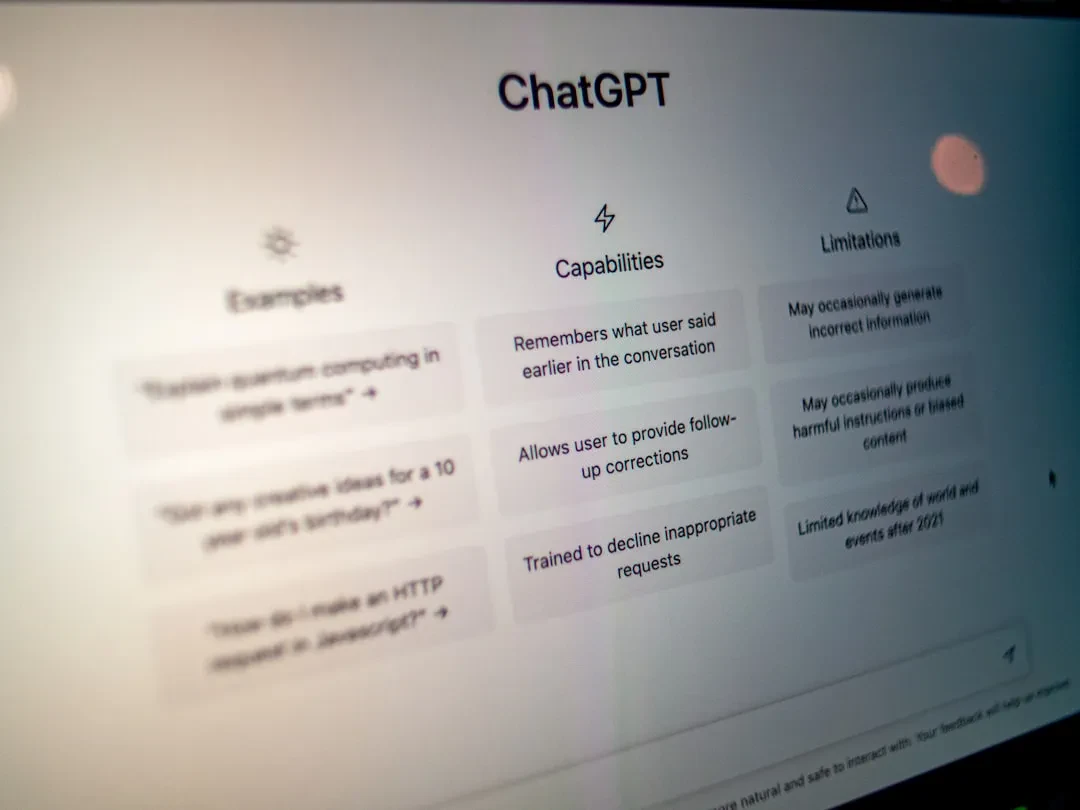
- Knowledge cutoff: its training data only goes up to a certain date (around September 2021 for GPT-4, later for newer models). For current news, use the browsing feature if available.
We at Meteora Web keep saying it: security in Italian SMEs is systematically underestimated. If you use ChatGPT for business activities, train your team on these risks.
Sponsored Protocol
In Summary — What to Do Now
- Sign up at chat.openai.com and try the concrete prompt we gave you.
- Set a rule: before publishing or using any AI-generated output, always have a human review it.
- Identify a repetitive process in your business (e.g., answering FAQs, writing product descriptions) and experiment to see if ChatGPT can cut it in half.
- Don’t jump into the API before understanding the limits. Play with the free web chat first.
- Talk to a consultant – if you want to integrate AI into your workflows in a solid and secure way, we’re here. Get in touch.
ChatGPT is not magic, it’s a tool. Like a drill: used correctly, it drills through walls. Used badly, it breaks everything. With the right guidance, it can become the fastest colleague you’ve ever had.