For decades, producing objects meant removing material from solid blocks or filling molds with fixed shapes. With
additive manufacturing, the opposite happens: you start from emptiness and add material where needed, layer by layer. What many simply recall as 3D printing has become, for companies, a set of technologies that changes the timing, costs, and logic of innovation.
What additive manufacturing really is
Additive manufacturing refers to the family of processes that build physical objects by adding material in a controlled manner, through successive layers. The joint
ISO ASTM standards define it as the fabrication of parts from 3D models, by addition rather than removal of material
ISO ASTM 52900. In practice, it means moving from a world of milling machines and molds to one where the protagonist is the digital file.
The 3D printing we know from labs or makerspaces is one of the most familiar faces of this revolution, but additive manufacturing also encompasses industrial technologies using metal powders, advanced polymers, and composite materials. It is not a gadget for prototypes; it is a new way to design and produce limited series or highly customized batches.
From CAD to powder layer: the digital-physical flow
The journey of a part produced via additive manufacturing almost always begins with a
3D CAD model. Whether created through dedicated modeling, scanning, or existing libraries, the model is exported into formats like STL or 3MF and delivered to slicing software.
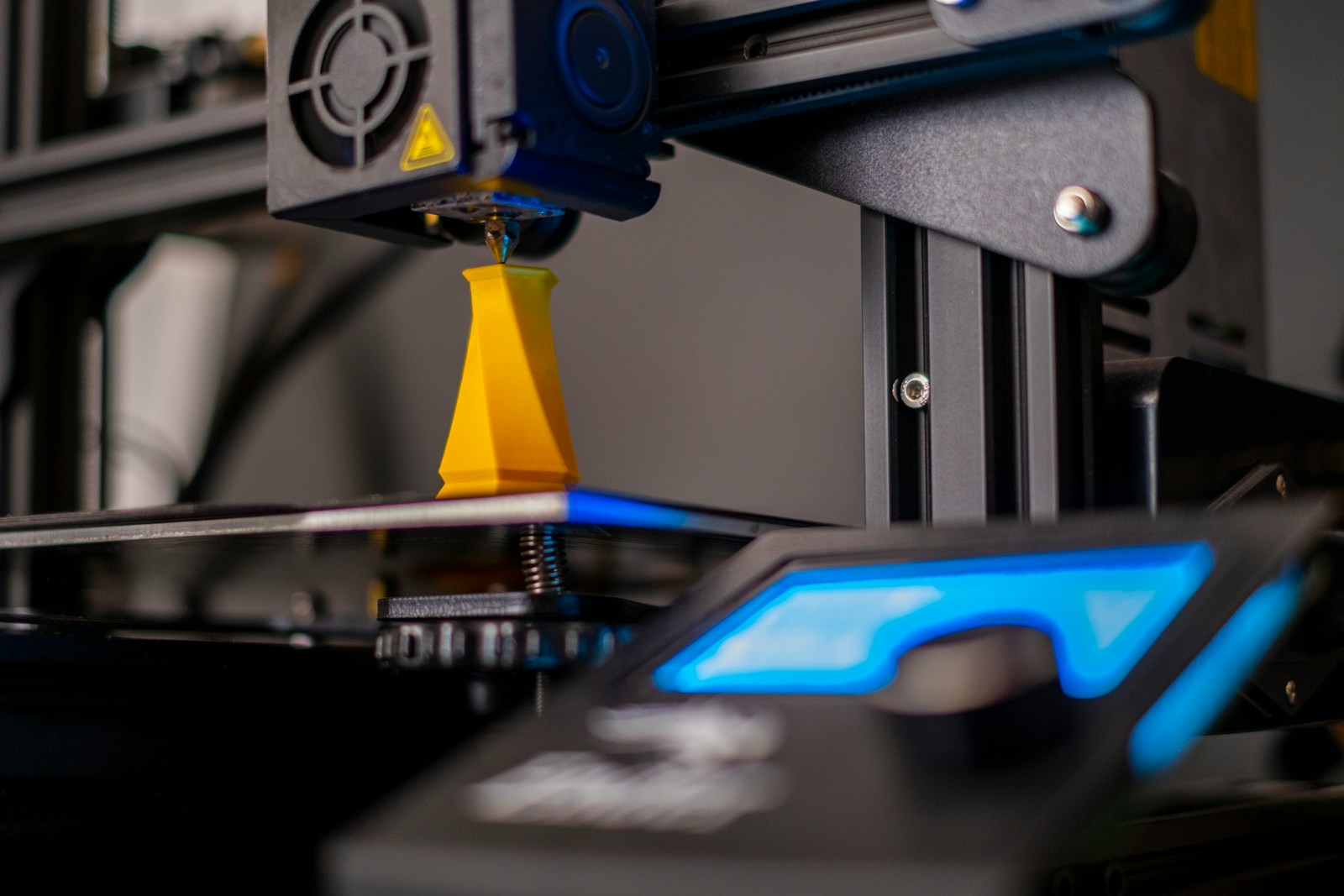
The slicer decomposes the object into hundreds or thousands of layers and generates machine trajectories, internal infills, and support structures. This data becomes instructions for the machine, which, in the case of a filament printer, will guide an extruder, or in a powder bed system, will control a laser or electron beam. The key step is that
every variation of the part originates in the file, not in new hardware equipment.
The main families of additive processes
Behind the additive manufacturing label coexist multiple technologies. In the polymer realm,
material extrusion processes like FDM/FFF push a filament through a hot nozzle that deposits layers of molten material.
Vat photopolymerization processes, such as SLA or DLP, solidify liquid resins via UV light, achieving fine details and smooth surfaces.
On an industrial scale,
powder bed fusion for polymers and metals comes into play. In SLS systems, polymer powder is sinterized by a laser, while in technologies like SLM or EBM, a high-energy beam melts metal powder in controlled environments. Technical portals like
Autodesk's or the websites of major machine manufacturers provide detailed overviews of the variants and use cases, from prototyping to final production.
Why it's different from traditional manufacturing
The difference is not just aesthetic. In subtractive processes and classic molding, much of the cost is concentrated in the startup phase: design and creation of molds, tooling, and fixtures. This model makes sense for large volumes, less so for small series or unique parts. With additive, tooling cost is minimal, and machines can produce different components in the same build, simply by changing the loaded file.
This shifts the center of gravity of economies of scale. Suddenly, it becomes sustainable to produce
continuous variants, advanced customizations, and on-demand spare parts. For designers, it means being able to experiment with geometries impossible with traditional methods, such as internal cooling channels or lightweight, resistant lattice structures, often showcased in case studies by players like
GE Additive or
EOS.
Design for additive manufacturing changes the rules of the game
Using additive manufacturing as if it were just a slightly smarter milling machine is the quickest way to waste its potential. The discipline of
Design for Additive Manufacturing instead pushes to rethink components from the start, leveraging design freedom. Parts composed of multiple assembled elements can be redesigned as a single piece, with fewer joints and less weight.
This approach requires different tools and mindset. Topology optimization, generative design, and behavior simulations enter the toolbox of those designing for additive. It's no longer just about "fitting" a part inside a machine, but imagining objects where
function and geometry are more tightly linked.
From prototyping to limited series production
For years, additive manufacturing was synonymous with
rapid prototyping. Creating a physical model to hold in your hands in a few hours was already a revolution. Today, many companies have shifted the focus toward actual production. Aerospace components, medical parts, automotive and industrial machinery parts regularly come out of additive systems and end up in commercial products.
The strength of the model lies especially in
limited series production or the creation of custom internal tooling. Masks, jigs, grips, and line supports are designed and printed when needed, without waiting weeks for traditional machining. It's a form of everyday innovation, less spectacular than 3D-printed houses, but much more widespread in factories.
Impact on supply chains, warehouses, and logistics
When a part originates from a file and not a mold, the logic of
supply chains also changes. Spare parts can be produced near the point of use, reducing downtime and immobilized stock. Some companies already work with catalogs of digital parts printable on demand, instead of warehouses full of components that may never be needed.
In distributed scenarios, the very definition of a factory expands. A network of qualified service providers, each with suitable machines and materials, can become an extension of internal production. Organizations like the
Additive Manufacturing Users Group and dedicated industrial platforms show how networked printing is already a reality in various sectors.
Current limits and open challenges
Additive manufacturing is not the answer to everything. The costs of industrial machines and materials remain high, production speeds still don't compete with injection molding for large numbers, and surface finish often requires post-processing. Added to this are issues of
repeatable quality and certification, crucial in sectors like aerospace and medical.
The dedicated ISO ASTM technical standards for additive aim precisely to provide a common framework for processes, materials, and controls. But bringing additive production into a certified flow means rethinking controls, documentation, and skills. Sustainability must also be measured case by case, balancing reduced material waste with energy consumption and the management of powders and resins.
Why it's the key to innovation
Additive manufacturing is a key to innovation not because it will replace every lathe, but because it opens new degrees of freedom in three directions. It allows designers and engineers to imagine otherwise impractical forms, reducing the time between idea and real part. It offers companies the possibility to test markets and variants without monolithic initial investments in molds and tooling. It enables business models based on customization, distributed production, and digital spare parts.
In a context where innovation is no longer just about having the biggest machine, but about being able to rapidly adapt products and processes, additive manufacturing becomes a strategic advantage. It is not a universal magic wand, but a powerful tool in the hands of those who know how to integrate it skillfully into design, engineering, and supply chain. And it is precisely in this interplay between digital and physical that a significant part of tomorrow's industry is being shaped.