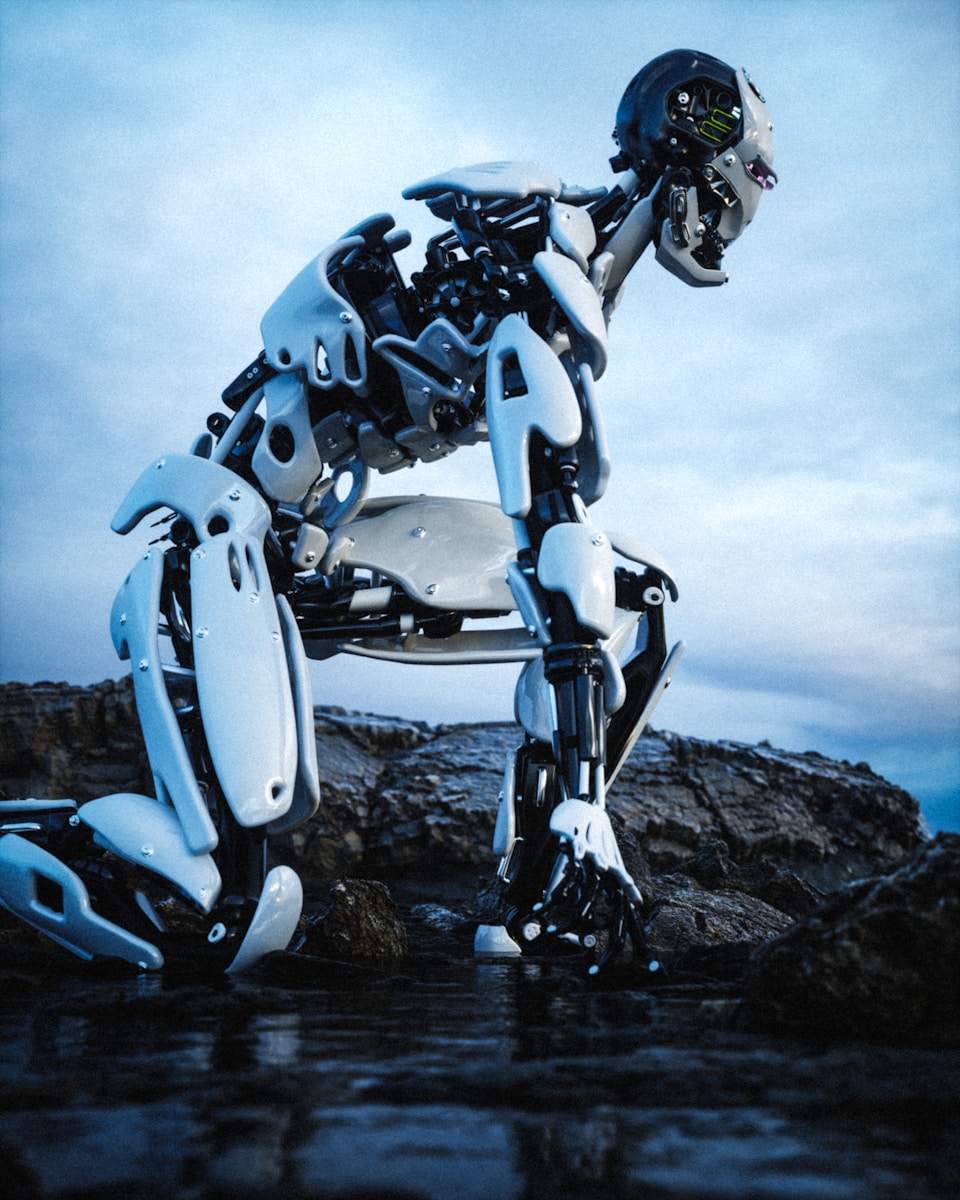
In the collective imagination, the
humanoid robot is the one that walks beside us, talks to us, perhaps serves coffee without spilling it. Between viral videos, laboratory prototypes, and aggressive press releases, understanding what these robots really are, how they work, and how "intelligent" they actually are is a useful exercise for distinguishing science fiction from contemporary robotics.
What is meant by a humanoid robot
In a technical sense, a
humanoid robot is a machine that replicates the appearance and, at least in part, the motor capabilities of a human being. It may have two legs, two arms, a torso, a "head" with sensors and cameras. The goal is not only aesthetic but functional: to move in environments designed for people, use the same tools, open doors, climb stairs, grasp objects.
Research centers and companies like
Boston Dynamics, technological NGOs like
euRobotics, and academic projects have for years documented prototypes capable of walking, jumping, and manipulating objects in controlled scenarios. These robots are not born to imitate humans out of vanity, but to adapt to a world built on human measurements and constraints.
From mechanics to sensors: how a humanoid moves
The first challenge for a humanoid robot is purely
mechanical. Arms and legs are made of rotating joints powered by electric motors or more sophisticated actuators, connected to structures that must be rigid enough to support the weight but light enough to remain efficient. Each joint is controlled by position, torque, and speed sensors that allow the system to know where each body part is.
To this are added sensors for balance and perception. Inertial measurement units, gyroscopes, and accelerometers help maintain stability during walking. Cameras, lidar, and other depth sensors provide a three-dimensional view of the environment. This data is processed in real-time by onboard computers running complex control algorithms to coordinate every step, every torso rotation, every hand movement.
Motion control between dynamic balance and coordination
Walking on two legs, for a robot, is a matter of
dynamic balance. Unlike industrial robots anchored to the floor, humanoids must continuously manage the relationship between center of mass, support points, and gravity. Techniques like zero-moment point control and simplified models of the human body are used to calculate the "right" position at every moment to avoid falling.
Coordination becomes even more complex when adding tasks like climbing stairs, navigating uneven terrain, or interacting with objects that themselves move. Many demonstration videos, including those of the most famous robots, are the result of choreographed sequences and repeated trials, not of a general understanding of the environment similar to that of humans.
Perception and planning between sensors and algorithms
To do something useful, a humanoid robot must first perceive the world and then decide what to do.
Perception relies on visual and depth sensors that generate three-dimensional maps, recognize objects, and identify obstacles. Algorithms for computer vision and
localization and mapping, often inspired by the world of autonomous vehicles, work on this data.
Planning, on the other hand, deals with transforming high-level goals into sequences of concrete actions. Picking up a box means understanding where it is, choosing an approach, calculating the arm's trajectory, modulating the grip strength. Many of these functions today are based on combinations of classical controls, planners, and machine learning models trained on specific scenarios.
How truly intelligent are humanoid robots
The crucial question is whether these systems are truly
intelligent in the sense we usually attribute to the word. The answer, at least for now, is that their intelligence is extremely
specialized. A humanoid robot can repeatably perform tasks for which it was designed and trained, but struggles enormously as soon as the scenario deviates from the expected one.
Conversational abilities, when present, are often the result of integrations with external artificial intelligence services that handle language and dialogue, not of a general understanding embedded in the body. Many humanoids are actually
teleoperated or semi-autonomous platforms, where some decisions are made by human operators or remote systems, especially in sensitive contexts like rescue robotics.
Humanoids, generative AI, and science fiction movie expectations
The arrival of
generative AI has further fueled the idea of "almost human" robots, capable of speaking, understanding, and acting. In practice, however, integrating advanced language models into robotic platforms poses significant engineering challenges. It is necessary to manage latency, reliability, safety, and consistency between what the model says and what the robot can actually do.
Universities, companies, and research institutes are increasingly publishing work on combined robotics and AI, but the distance from movie characters remains enormous. Humanoid robots do not have consciousness, their own intentions, or emotions. They are complex systems that process sensory and linguistic inputs to produce motor and vocal outputs, within precise constraints designed by engineers and researchers.
Concrete applications in industry, logistics, and care
Beyond stage prototypes, where do humanoid robots find space today? The answer is evolving, but some areas are emerging clearly. In industrial and logistics contexts, humanoids are being tested for tasks that require adaptability to existing spaces, where reconfiguring lines and tools would be too costly. The human form allows, at least in theory, the use of shelves, corridors, and tools designed for human workers.
In
care and educational fields, there are robots with human or semi-human appearances designed to interact with elderly people, children, or users in training contexts. Here, however, the ethical issue is as strong as the technological one: how to manage expectations, emotional dependencies, and the collection and use of data generated by these interactions.
Current limits, costs, and open challenges
Despite spectacular videos, today's humanoid robots are still
far from being mass-produced products. Hardware and development costs remain high, maintenance requires specialized skills, and reliability in uncontrolled scenarios is an open problem. Every fall is potentially a costly accident, every malfunction requires complex analysis and repairs.
To these challenges are added social and regulatory questions. Who is responsible if a robot causes damage? How is coexistence between humanoids and human workers managed in a factory or warehouse? What are the acceptable boundaries for using human-like robots in public or domestic spaces? These are questions that legislators, companies, and civil society are only beginning to answer now.
Humanoid robots between the laboratory and the near future
Humanoid robots are one of the most fascinating intersections between mechanics, electronics, computer science, and artificial intelligence. Looking at them with clear eyes means recognizing both the extraordinary progress of recent years and the current limits. They are not yet the universal life companions that populate movies, but neither are they simple laboratory puppets.
In the near future, we are likely to see them increasingly often in targeted roles, in structured environments, for well-defined tasks. The real challenge will be to use them where it makes sense, without falling into the temptation of excessively anthropomorphizing machines that do sophisticated things, but remain tools designed by humans to solve very concrete problems.