Ing. Calogero Bono
On the night between Sunday and Monday, the alert apps of Ukraine and Russia were hit by cyberattacks. Ukrainian citizens received false warnings about radiation, chemical attacks and a missile carrying a nuclear warhead. A few hours later, similar messages appeared in Russia. The case matters because it shows how fragile an alert channel becomes when it depends on a single app, even in the hands of a state.
A few terms before we get into the facts. Push notification is the message the app sends to your phone even when it is closed. Compromise means that unauthorized parties have gained control of a system, or part of it. Air Alarm is the Ukrainian app that reports air raids. Telegram is the channel where the authorities issued their denial. Vulnerability is a flaw in software that an attacker can exploit.
What happened to the alert apps?
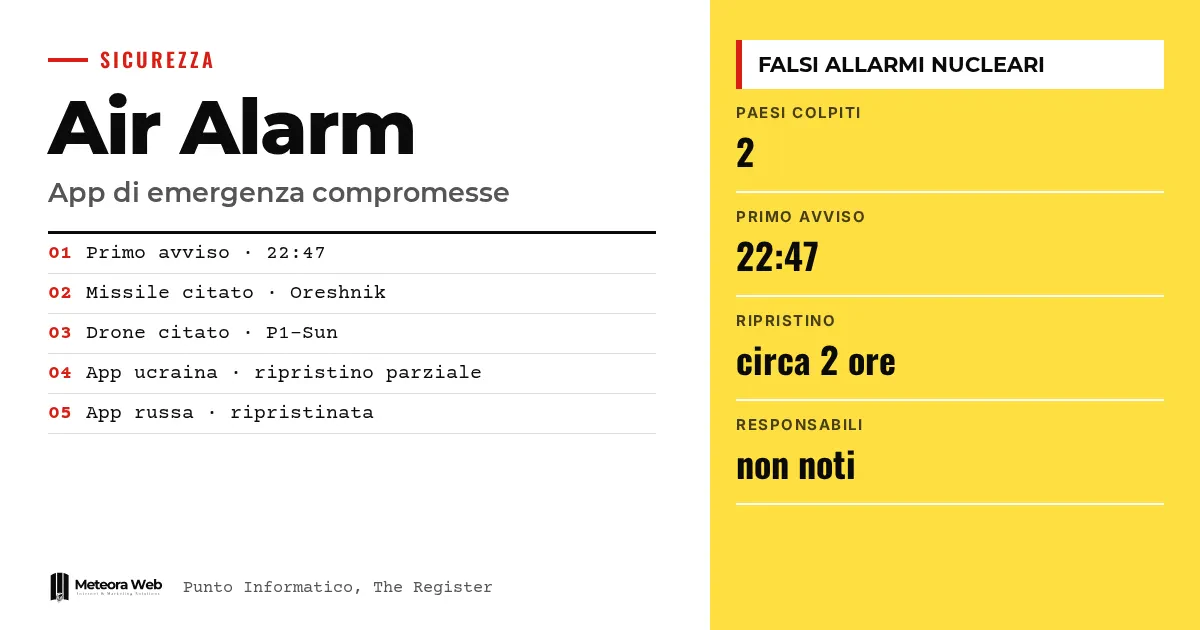
According to Punto Informatico, from 22:47 local time on Sunday, Ukrainians received through Air Alarm warnings of possible radiation, chemical attacks and fighting in the streets. One message said Russia had launched an Oreshnik ballistic missile with a nuclear warhead.
The account from The Register adds that the false warnings also referred to clashes in Kyiv. The authorities of both countries confirmed the attacks.
How did the Ukrainian authorities react?
The Ukrainian air force denied the messages on Telegram. Speaking to The Register, it wrote that the app was "probably compromised" and that "there is no radiation threat". Push notifications were disabled and the service was suspended.
About two hours later, the app was gradually restored. The map of targets remains suspended, while the app shows only the danger level, yellow or red. The Ministry of Digital Transformation pointed to other channels, such as the iOS and Android emergency alerts, the sirens and the official government accounts.
What happened in Russia?
The Russian Ministry of Emergency Situations spoke of a "massive cyberattack" on the app, which allowed false information to be sent. According to the source, the messages announced nuclear attacks "on all regions of Russia" and cited the P1-Sun drone.
About 90 minutes later the ministry declared the app working again. It clarified that hitting the app does not amount to compromising the national alert system, which is based on sirens, SMS, television and radio. The app, it said, is only a support service.
Why did the messages seem false right away?
The first Ukrainian message was written in Russian, while official Ukrainian communications are always in Ukrainian. For Punto Informatico, this made it clearly false. The Register notes that this detail, together with the name Oreshnik, was an immediate signal.
A Ukrainian lawmaker, Oleksander Merezhko, told the BBC that the attack was almost certainly part of Russia's cyberwarfare. This is his assessment, not an established fact.
Limits to know
It is not clear who carried out the attack. HDblog writes that there is not enough information to say whether the same hand was behind both episodes. The link with the end of the Oleshky truce, close in time but not proven, also remains open. Russia has not explicitly accused Ukraine. We do not know how the attackers got in.
What changes for those working in digital
Those who develop apps that send critical notifications must treat that channel as a target. If your app alerts customers, patients or employees, you need control over who can send messages and a quick way to switch notifications off. When you need an app with these requirements, consider iOS and Android app development with security at the forefront. You also need an alternative channel to issue corrections, as Telegram did here. The risk does not only concern states, because a false notification damages trust in any company.
Our take
The most interesting point is defensive. The system held because it did not depend solely on the app, and because the false messages contained gross errors. A more careful attacker would have written in Ukrainian. That is why the Russian statement matters, reminding us that the app is only a support tool. Those who design critical services should repeat the same principle – redundancy and independent channels. This seems to us a more useful lesson than the debate over who is guilty, which for now remains without evidence. The security of an app, let us remember, also depends on end-to-end encryption, but it does not end there.
Frequently asked questions
When did the false alarms arrive in Ukraine?
On Sunday evening, from 22:47 local time according to Punto Informatico. The Air Alarm app showed warnings about radiation, chemical attacks and an Oreshnik missile.
Was Russia also hit?
Yes. The Russian Ministry of Emergency Situations confirmed a massive cyberattack on its app. The messages spoke of nuclear attacks and cited the P1-Sun drone.
Who carried out the attacks on the apps?
It is not known. Sources do not identify any confirmed perpetrators. HDblog writes that there is no information to say whether the same hand was behind the two attacks.
Do the apps work again?
Partly. The Ukrainian one returned gradually, but without the map of targets. The Russian ministry declared its app back to normal after about 90 minutes.
What can Ukrainian citizens use instead of the app?
The iOS and Android emergency alerts, the state sirens and the official government accounts. The Ministry of Digital Transformation reminded people of these.
What to watch after the false alarms in emergency apps
The coming weeks will show whether those responsible and technical details emerge. For those who manage apps with notifications, there are signals to follow in the meantime.
- Follow any official communications on the cause of the attack and the vulnerability exploited.
- Check who in your organization can send push notifications and with what permissions.
- Prepare a denial plan on a channel separate from the app, to use in case of false messages.