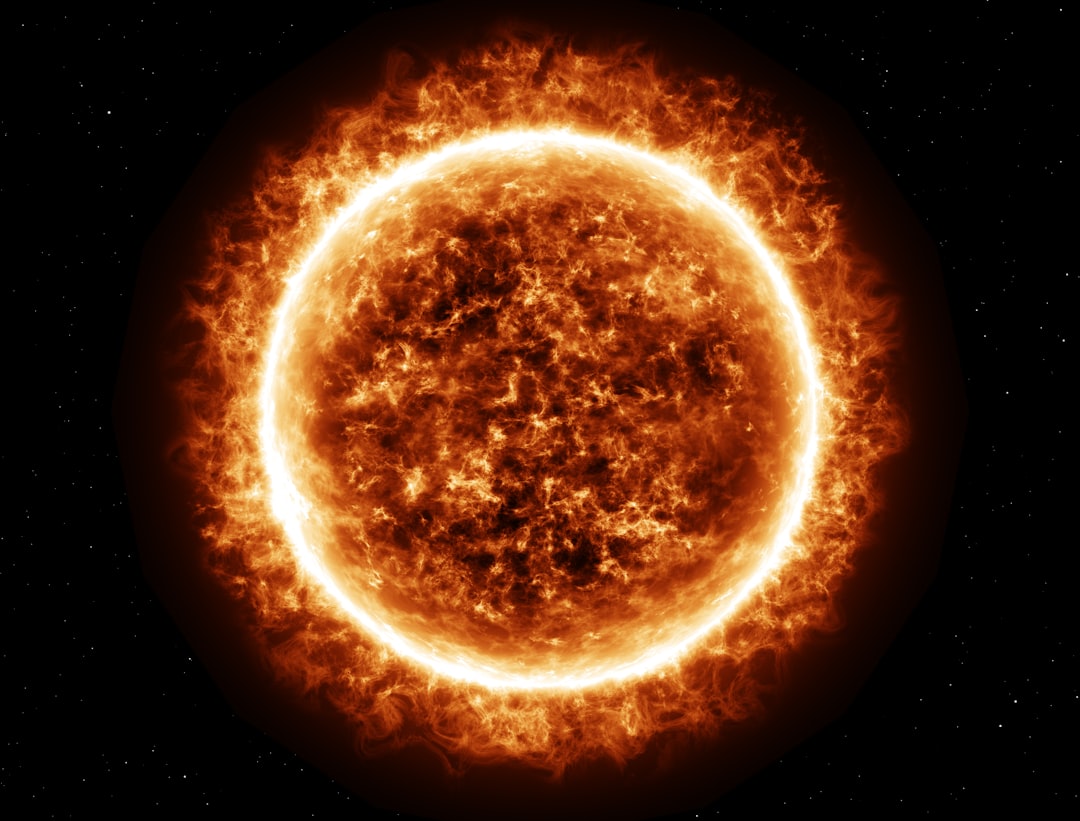
For decades, astrophysicists believed that in about 5 billion years, when the Sun expands into a red giant, Earth would be inevitably engulfed and vaporized. A new study published in Astronomy & Astrophysics radically changes this perspective, suggesting that our planet might instead survive the star's final phase. The research, based on improved models of tidal dissipation and stellar mass loss, shows that Earth's orbit could gradually move outward, avoiding engulfment.
The Sun's Life Cycle and the Fate of Inner Planets
Currently, the Sun is in its main sequence phase, stable for about 4.5 billion years, during which it fuses hydrogen into helium. In about 5 billion years, the hydrogen in the core will be exhausted, and the helium core will contract, igniting hydrogen fusion in a surrounding shell. This will cause the outer layers to expand enormously while the surface cools, taking on the characteristic red color. Until now, it was thought that tidal effects would pull Earth inward, leading to destruction. However, the new analysis suggests that solar mass loss through stellar winds could be so significant that it weakens the Sun's gravity, causing Earth to migrate to a more distant orbit.
Sponsored Protocol
A Cosmic Tug-of-War Between Mass Loss and Tidal Forces
Earth's fate depends on a delicate balance between two opposing forces. On one hand, the Sun will lose mass, reducing its gravitational pull and allowing Earth's orbit to expand. On the other, the planet's proximity to the red giant's gaseous envelope will generate drag and tidal forces that tend to slow its motion. Previous studies assumed tidal forces would dominate. The new work, based on observations of the red giant L2 Puppis (209 light-years away), shows that mass loss could be sufficient for Earth's orbit to recede, escaping engulfment. If confirmed, this scenario represents a breakthrough in understanding planetary system evolution. For more on technologies that could monitor these events, see the article on AWS Managed Database with RDS and Aurora.
Sponsored Protocol
Mars and Icy Moons as Potential Future Refuges
While Mercury and Venus will certainly be engulfed, Mars will experience a temperature rise that vaporizes its permanent ice, but its orbit will move outward. The outer planets, Jupiter and Saturn, will see their moons' orbits reshaped. Increased solar radiation could temporarily melt the icy crusts of Europa and Enceladus, creating liquid water oceans. These worlds could become, for a time, successors to Earth once our planet becomes a barren desert. The research also raises questions about the possibility of life in these new environments. For more on recent space discoveries, see the article on 5-Million-Year-Old Axolotl Fossil Discovered in Mexico.
Sponsored Protocol
Earth's future remains uncertain, but for the first time, scientists have reason to hope our planet may survive the Sun's death. According to the authors, next steps involve refining mass loss models and studying other Sun-like stars to confirm these predictions. Source: WIRED Italia (translated and adapted). For scientific background, see the Wikipedia page on red giants.
Source: https://www.wired.com/story/good-news-it-turns-out-the-earth-will-never-be-swallowed-by-the-sun