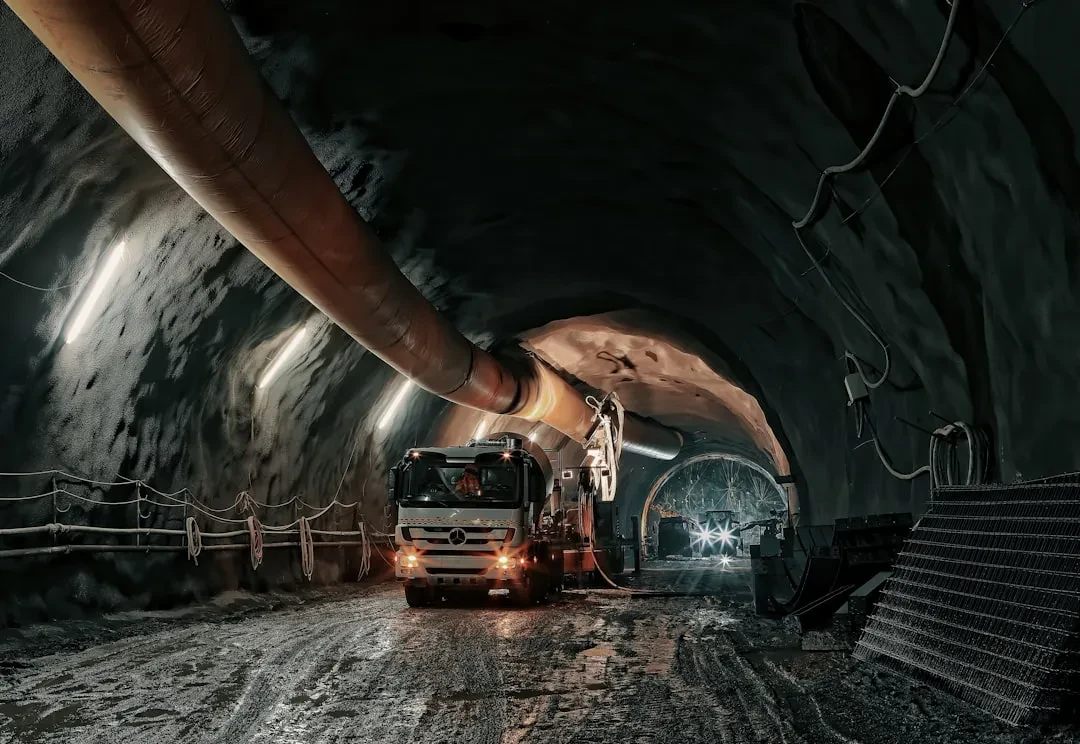
Three hundred meters below the North Sea, inside a damp, noisy cavern, geologist Anne-Merete Gilje jokes about not making it out alive. This is no apocalyptic film but the construction site of the Rogfast, the subsea tunnel that will become the longest and deepest on Earth. Spanning 26.7 kilometers and reaching 390 meters below sea level, this infrastructure will transform connectivity between Stavanger and Bergen, eliminating two ferry crossings and cutting a five-hour journey by 40 minutes.
300 Meters Below: The Atmosphere of the Construction Site
Entering Rogfast feels like stepping onto another planet. The water pressure above exceeds 500 pounds per square inch, a force held at bay only by extraordinary engineering. Workers clock 12-hour shifts, from 6 a.m. to 6 p.m., for twelve days straight, followed by sixteen days off. They eat lunch at plastic tables surrounded by safety-notice-covered portacabins. "You have to be a little bit crazy to work underground all the time," jokes Niclas Brusehed, tunnel foreman at Implenia. The project advances from two fronts: Skanska from the north, and Implenia together with Stangeland from the south near Randaberg. The two ends are expected to meet in 2029 with a deviation of just a few centimeters, thanks to daily laser scans.
Sponsored Protocol
Drill-and-Blast Method: Flexibility for Miles of Rock
Unlike tunnels bored by mechanical moles, Norway relies on the drill-and-blast method. Dozens of holes are drilled into the rock face, explosives are inserted, and the blast advances the tunnel by five to six meters each time. "This is the longest continuous blast on the sea," says John Olaf Østerhus of Implenia. The method's flexibility is key to handling Norway's complex geology, shaped by Ice Age glaciers. During a visit, a blast occurred just a few hundred meters away, leaving a dull roar that shook the ground. The cavern resembles a cathedral carved out of rock, with towering vaults and rubble scattered everywhere.
Sponsored Protocol
The Never-Ending Battle Against Water: Grouting to Seal Leaks
The biggest challenge is water. Under immense sea pressure, water always finds a way in. Before each blast, crews drill probe holes 25 to 30 meters deep to measure inflow. If leakage exceeds four liters per hole per minute, they move to grouting: pumping cement-like mixtures into fan-shaped holes in the ceiling and walls to seal fissures. "It's a lot more difficult to stop a leak that's behind you," says Ole Magne Rønning, project leader at Implenia. Tarald Johan Nomeland, the grouting specialist, describes his work with passion: "There's not necessarily just one solution to a problem. There may be many solutions." The pace of advance depends on grouting needs: some weeks the face moves 30 meters, others as few as 10.
Sponsored Protocol
Timeline and Goals: Linking Stavanger and Bergen by 2033
Completion is scheduled for 2033. Then, four lanes of traffic will flow beneath the Boknafjord and Kvitsøyfjord, featuring two undersea roundabouts at 220 meters deep and sections where only 50 meters of rock separate drivers from the North Sea floor. Norway's subsea expertise has attracted attention from Japan, Spain, Morocco, and several US states, whose representatives visited the site in May. Rogfast is not just a monumental feat but proof that ambitious engineering is still achievable. As Brusehed puts it, "Every blast creates a new world."
Source: https://www.technologyreview.com/2026/06/22/1138821/inside-worlds-deepest-longest-subsea-road-tunnel