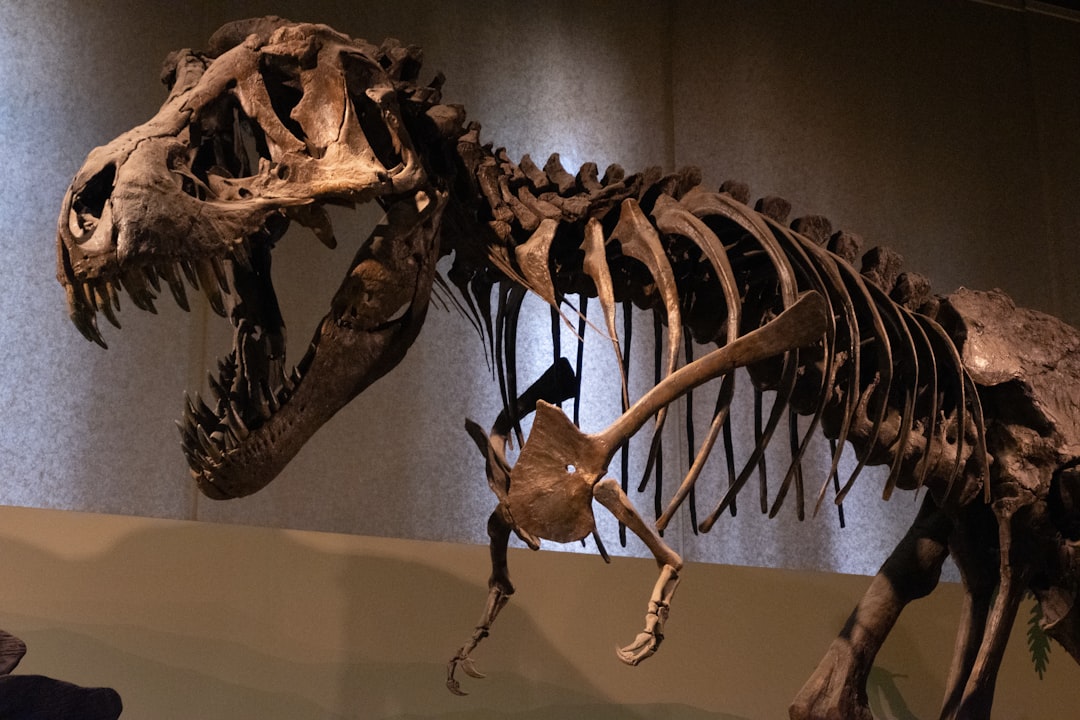
A Tyrannosaurus rex specimen nicknamed Gus, billed as one of the largest and most complete ever found, is heading to auction at Sotheby's with an estimate of up to $30 million. The sale has reignited a debate among paleontologists and scientists who worry that private collectors are increasingly snatching fossils away from research. Gus, discovered on a ranch in South Dakota, comprises 183 fossil bone elements, about 61% complete by bone count. The skeleton is mounted on a custom steel armature with replicas of missing bones, posed as if in hot pursuit with a mouth full of dagger-like teeth.
A specimen of exceptional scientific completeness
According to Thomas Holtz, a tyrannosaur specialist at the University of Maryland, the completeness and high quality of the bones make Gus scientifically significant. The trend of major dinosaur fossils going to auction in the US began in earnest in 1997 when Sotheby's sold Sue, the most complete T. rex on record, for $8.4 million. Since then, the market has boomed, bolstered by a court ruling that fossils belong to the landowner in the US. While museums once secured such specimens, today ultra-wealthy individuals like tech entrepreneur Dan O'Dowd, owner of a T. rex named Samson, increasingly buy them as luxury assets. A 2025 study found that more T. rex fossils now reside in private collections than in public trusts.
Sponsored Protocol
The risks for paleontological research
Paleontologists warn that when a fossil ends up in private hands, it is lost to science. Even if a collector loans it to a museum, as happened with Ken Griffin's Stegosaurus Apex, scientific reproducibility suffers. Established journals refuse to publish studies on specimens not held in perpetuity in a public repository. Moreover, artistic mounting makes it impossible to use modern techniques like computed tomographic imaging, which could reveal hidden features. Auction houses claim they rescue fossils from erosion, but researchers counter that commercial outfits fail to document the geological context crucial for understanding the organism's age and ecosystem.
Sponsored Protocol
The case of the holes in Gus's jaw
Sotheby's describes holes in Gus's jaw and other bones as tyrannosaurid bite marks, hinting at fights with its own kind. However, paleontologist Stuart Sumida of California State University, San Bernardino, notes the holes are perfectly round with smooth edges, typical of infections, not bites. "It's much sexier to say they're puncture wounds, but this isn't how puncture wounds look," Sumida says. The auction house offered no evidence for its interpretation, raising concerns about scientific marketing. Sotheby's vice chairman Cassandra Hatton defended the bite-mark claim but did not disclose the source of the analysis.
Sponsored Protocol
Toward a shared solution
In the absence of US laws banning fossil sales to private individuals, the Society of Vertebrate Paleontology is working as a liaison between collectors and museums. The goal is to persuade buyers to donate specimens to public institutions immediately after purchase. Kristi Curry Rogers, a paleontologist at Macalester College, emphasizes that a scientifically important fossil is a permanent source of data for future generations with tools yet to be invented. "All the cool discoveries of the last 50 years about dinosaur diets, coloration, reproduction, and neurobiology would not have been possible if fossils had disappeared into private collections," she says. The fate of Gus may serve as a test case for a new model of scientific philanthropy.
Source: https://www.wired.com/story/sothebys-t-rex-auction-shows-wealth-upending-science