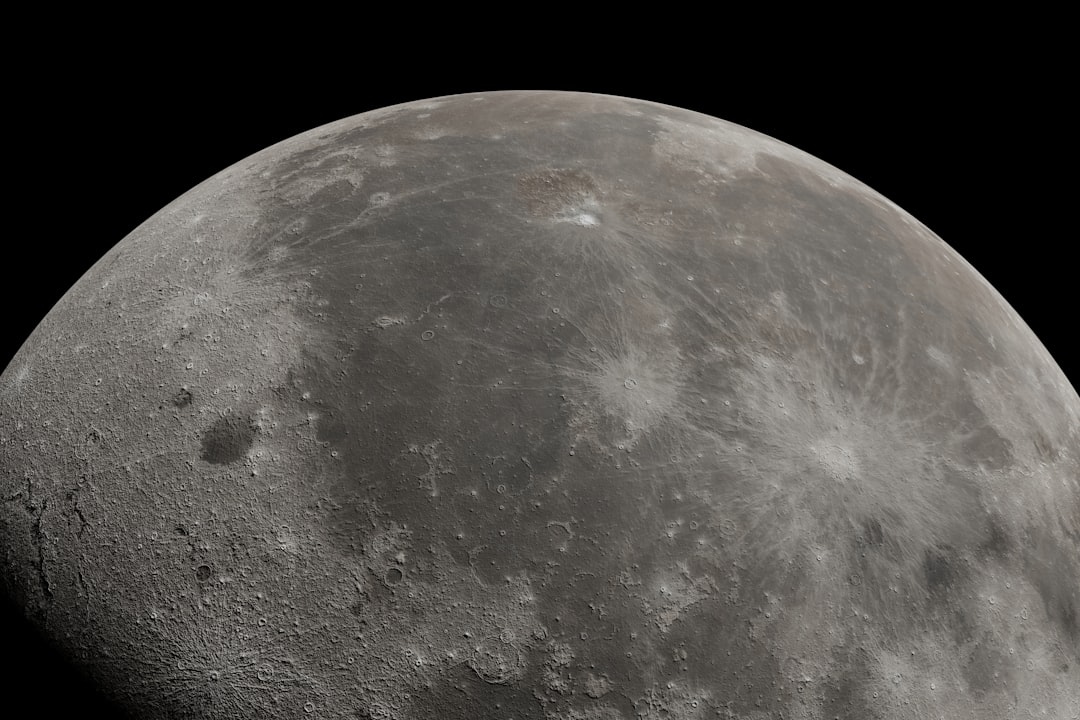
The Korea Aerospace Research Institute has released the first photographs of the crater generated by the impact of a SpaceX Falcon 9 second stage on the lunar surface. The images, taken by its Danuri orbiter, show a small depression that confirms the collision, an event predicted by astronomers but never directly observed until now.
Danuri's close flyby and photographic evidence of the impact
The Danuri spacecraft, operating at an altitude of about 100 kilometers above the Moon, flew over the impact zone shortly after the event. The institute explained on its X account that it photographed the site both before and after the collision. The images reveal signs of a recent impact, with a crater that astronomers estimate to be several tens of feet in diameter and about 3.6 meters deep. This photographic confirmation adds to observations made with the Very Large Telescope, where scientists detected sodium and lithium rising from the lunar surface, a clear indicator that the rocket fragment indeed struck our satellite.
Sponsored Protocol
A difficult prediction to observe and comparison with lunar dimensions
Astronomers had predicted well in advance where and when the Falcon 9 would crash, and there were signs that the event could be visible with sufficiently powerful instruments. However, in the days before the collision, space agencies like NASA warned that it would be difficult to observe the exact moment of impact due to weather conditions and timing. NASA also has lunar orbiters, and in the coming days, after a series of data checks, higher-resolution images of the impact area may become available. But Danuri's new photo already provides a clear perspective: the crater is very small compared to the vastness of the lunar surface, which is about 2,160 miles in diameter.
Sponsored Protocol
Reasons for the uncontrolled fall and SpaceX's response
The Falcon 9 fragment made a crash landing after being in an unstable orbit for more than a year. The rocket was launched in January 2025 to deliver lunar landers, but in its high-energy mission, nearly all of the vehicle's performance was dedicated to placing the payload into the intended orbit, making a controlled deorbit maneuver impossible. SpaceX stated that for most missions they plan a controlled deorbit of the second stage, but in missions like this it is not always possible. Over time, solar activity and gravity deflected the second stage toward the Moon, and the company is collaborating with NASA to find the optimal disposal solution. This incident, although rare, highlights the challenges of space debris management and the need for more robust strategies for future missions.
Sponsored Protocol
For more on propulsion technologies and space mission management, see the article on Nvidia and new APIs for GPU I/O.
For further details on the impact and observations, refer to the original source on Wired.
Source: https://www.wired.com/story/first-images-spacex-rocket-moon-crater