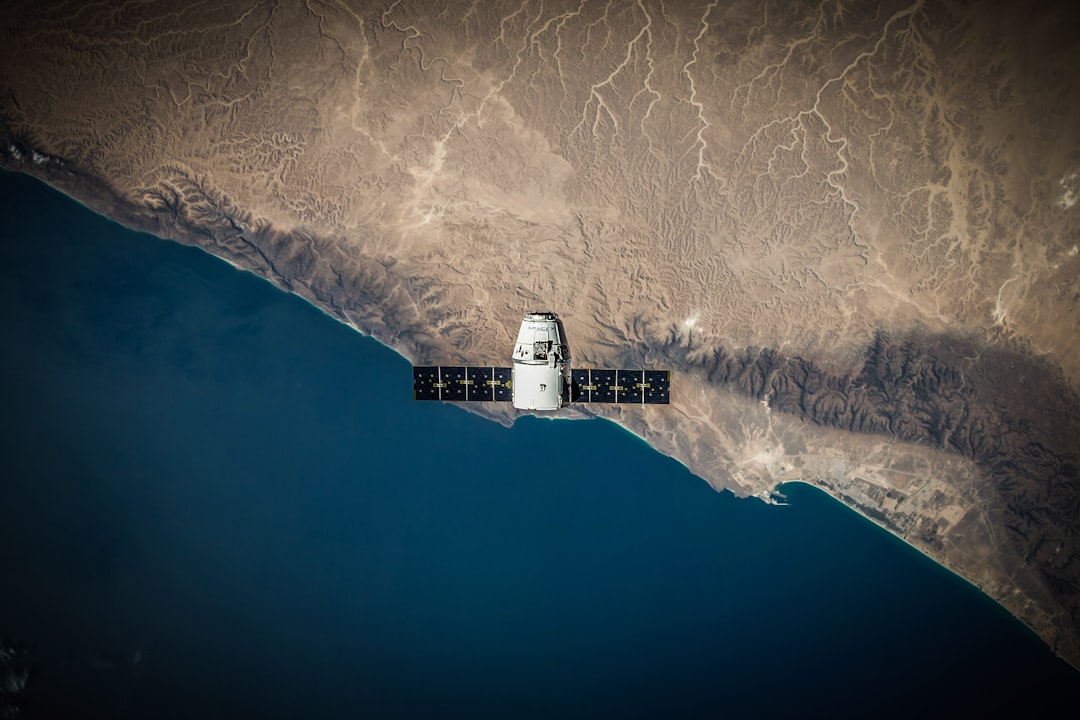
The private space industry is taking on an increasingly central role in national security operations. Two startups, True Anomaly and Rocket Lab, recently completed for the U.S. Space Force an orbital rendezvous mission so complex it was likened to a scene from Top Gun. The exercise, dubbed Victus Haze, saw two rival satellites meet in orbit, coming close enough for one to capture detailed imagery of the other.
An unprecedented demonstration of capability
The mission demonstrated the ability to closely inspect a space vehicle shortly after it reached orbit. True Anomaly deployed its Jackal vehicle, already in orbit, while Rocket Lab launched the Puma satellite with just 16 hours and 42 minutes of notice, an exceptionally short lead time by industry standards. The Jackal identified Puma from 2,000 kilometers away using onboard sensors, approached to a close distance (the exact distance is classified), orbited it, and captured images of different parts of the vehicle before returning to its starting point. According to Even Rogers, CEO of True Anomaly and a former military space veteran, outside of NASA and Space Force crewed missions, this is probably the most complex rendezvous and proximity operation between two spacecraft in modern history.
Sponsored Protocol
The technical challenge of orbital rendezvous
Bringing together two spacecraft in orbit, both moving at speeds approaching 17,500 mph, is a notable technical feat. Previous private demonstrations, such as those by Northrop Grumman's maintenance satellites or Astroscale's orbital debris hunting missions, operated on much longer timeframes. Victus Haze proved that the private sector can execute rapid, precise maneuvers, essential for filling gaps in the Space Force's collection capability. Rogers emphasized that China and Russia regularly launch capabilities into space, and the Space Force's job is to understand what those capabilities are.
Sponsored Protocol
Implications for national security and the private sector role
Victus Haze marks a turning point in the U.S. military's approach to space. Increasingly, the Pentagon sees the private sector as the key to scaling up orbital reconnaissance operations. True Anomaly, founded in 2022 by Rogers and a cadre of former military space experts, has raised over $1 billion, including $650 million in a March 2026 round. The company now aims to compete for task orders under the Space Force's $6.2 billion Andromeda program, which looks to the private sector for exactly this kind of maneuverable reconnaissance. Flight heritage and demonstrated capability are paramount, as Rogers stated. In the coming weeks, the two firms will execute new exercises with increasing difficulty, including evasion and mutual inspection maneuvers.
Sponsored Protocol
This evolution fits within a broader context of U.S. military modernization, which includes upgrading critical platforms. For instance, the recent case of F-35B jets delivered without radar highlights the logistical and technological challenges the Pentagon faces. Meanwhile, the use of artificial intelligence and frameworks like Alibaba's SkillWeaver shows how tech innovation is cutting costs and development times. Public-private collaboration in space seems poised to intensify, redefining the future of orbital defense.
For more on orbital rendezvous technologies, see the Wikipedia page on space rendezvous.