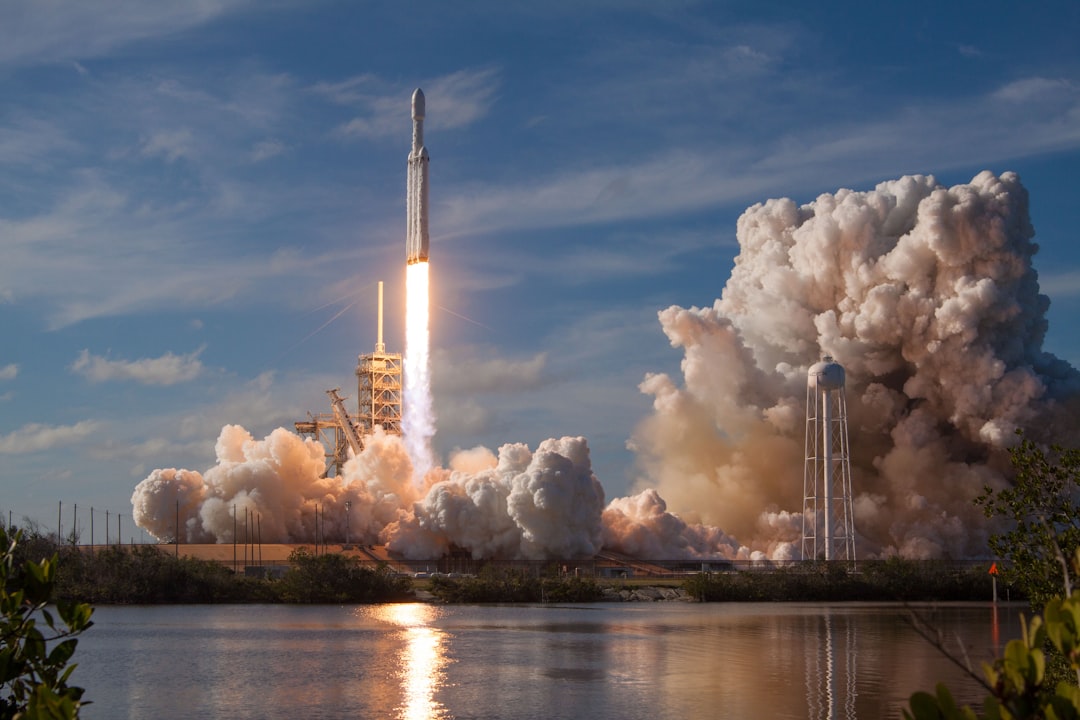
The countdown has begun for the Roman Space Telescope, NASA's next great observatory, set to launch on August 30 aboard a SpaceX Falcon Heavy rocket. With a total mission cost exceeding $3 billion, this telescope promises to transform our understanding of the universe. Unlike the James Webb Space Telescope, which observes small patches of sky with unprecedented detail, Roman will have an enormous field of view, capable of covering the entire celestial sphere in just a few years.
An unprecedented cosmic map to unveil the secrets of dark energy
The Roman telescope, named after astronomer Nancy Grace Roman, is designed to investigate two of the biggest mysteries in cosmology: dark energy and dark matter. Featuring a 2.4-meter primary mirror (the same diameter as the Hubble Space Telescope) and a 300-megapixel camera, Roman will map the large-scale distribution of galaxies and measure distances to billions of objects. Scientists will then create a 3D map of the universe and study how cosmic expansion has accelerated over time. As the NASA project scientist stated: "It's going to do things that currently are impossible."
Sponsored Protocol
The five-year mission will launch on a Falcon Heavy rocket
Liftoff is scheduled from the Kennedy Space Center in Florida. SpaceX will provide the Falcon Heavy rocket, already used for high-profile missions. After launch, Roman will travel to the L2 Lagrange point, 1.5 million kilometers from Earth, where it will share an orbit with the Webb telescope. The primary mission will last five years, but the telescope is expected to operate longer. All data collected will be open to the global scientific community, accelerating discoveries of exoplanets and transient phenomena.
Sponsored Protocol
Nancy Grace Roman's scientific legacy and comparison with other observatories
Nancy Grace Roman, known as the "mother of Hubble," dedicated her career to enabling large space observatories. The telescope named after her combines Hubble's power with a field of view one hundred times wider. Each Roman image will cover an area of the sky as large as 100 full moons. This will allow for extensive wide-field surveys, complementing observatories like the James Webb Space Telescope or the future Extremely Large Telescope. Additionally, Roman will detect planets using gravitational microlensing, potentially finding thousands of distant worlds.
Sponsored Protocol
For those interested in further reading, check out the article on OpenAI President rejects Apple lawsuit claims — though here we focus on pure science. Another relevant piece is the laptop battery vs AC power test, showing how space technology relies on components also tested in computers. Finally, the article on secure authentication with Bcrypt and Argon2 highlights the importance of cybersecurity even in mission control systems.
For more details on the Roman Space Telescope, visit the Wikipedia page describing the mission.