 Ing. Calogero Bono
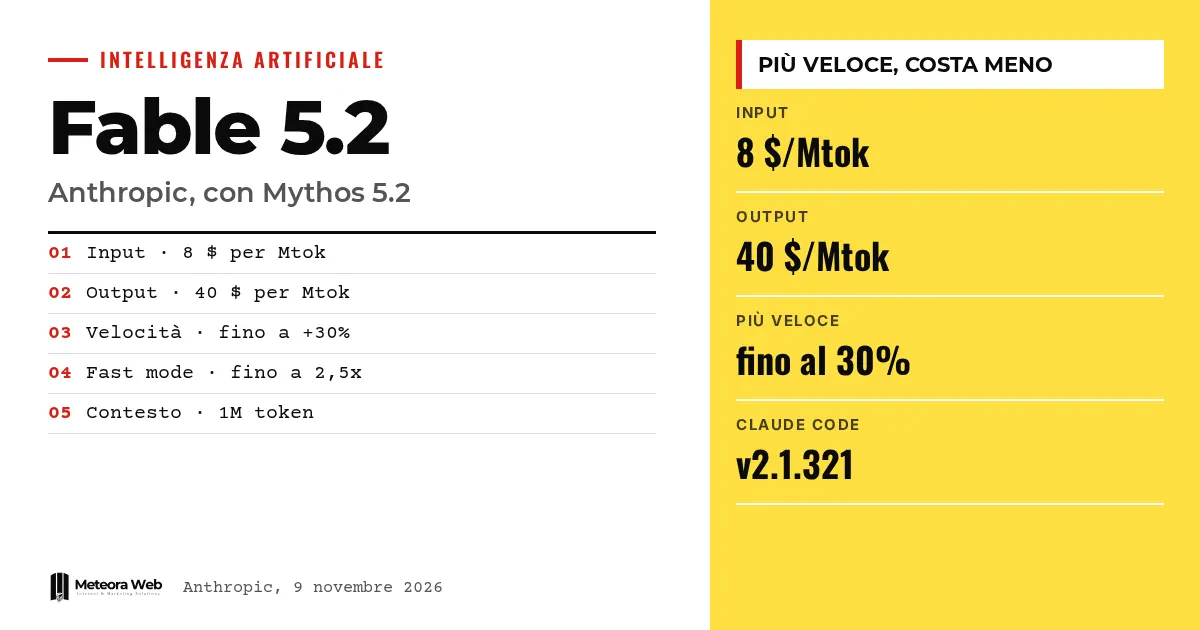
Anthropic has unveiled Claude Fable 5.2 and Claude Mythos 5.2, new versions of its most powerful models. Fable is available right away, Mythos only for verified organizations. According to the company, they are up to 30% faster than the 5.1 versions and cost less, 8 dollars per million input tokens. For those who develop software or use Claude Code, prices, settings and the range of choices among models all change.
A few terms before we get into the facts. Token is the unit models use to measure input and output text, and what you pay for. Context is the amount of text the model keeps in view during a conversation, here 1 million tokens. Fast mode is an optional mode that speeds up generation at a higher price. Cache read refers to rereading text already stored, which costs much less. Effort is the level of computing commitment you choose for the model, from medium to maximum.
What are Fable 5.2 and Mythos 5.2?
According to Anthropic, Fable and Mythos are the same base model. The difference lies in the safeguards. Fable has strong protections on cybersecurity and biology, which is why it can be offered to everyone. Mythos is reserved for those who apply through the verification programs for cybersecurity and life sciences.
As The Verge recalls, the 5.2 versions follow the 5.1 releases from September. According to 9to5Mac, the Fable class was introduced over the summer with version 5.
How much does Claude Fable 5.2 cost?
The price stated by Anthropic is 8 dollars per million input tokens and 40 for output. TechCrunch notes that input drops from 10 to 8 dollars and that Fable 5.2 now costs less than GPT-6 Astra, its main competitor.
Fast mode speeds up generation by up to 2.5 times and costs 16 dollars for input and 80 for output. The Claude Code notes also mention cache reads at 0.20 dollars per million tokens.
How much better is it on benchmarks?
These are figures published by Anthropic, not verified by third parties. On FrontierCode 2.0, Fable 5.2 scores 49.1% against 32.4% for Fable 5.1 and 45.5% for Opus 5.5. On FrontierSWE v2 it rises to 69.9%, against 65.5% for GPT-6 Astra.
It does not win everywhere. On AutomationBench, Gemini 4 Carbon shows 53.9% against 51.4% for Fable 5.2, and on Chartography GPT-6 Astra and Gemini remain close. In the document, Anthropic says that at High effort Fable 5.2 is roughly on par with Opus 5.5 at Max, at half the cost per task.
What can it do in software development?
Anthropic states that over 90% of the changes accepted into its main codebase are written by Claude, with human guidance. It also describes migrating a production service from Python to Rust, which now starts about 26 times faster.
An internal experiment handed Fable 5.2 the design of an operating system. The model reportedly coordinated over 1,000 subagents for eight days, producing a system that boots on a laptop. These are examples chosen by the company, useful as a hint and not as a guarantee for your project. If you want a picture of what is coming, read the clues about Fable 5.5, Mythos and Astra.
What changes in Claude Code 2.1.321?
The release 2.1.321 makes Fable 5.2 the default Fable model, with a 1 million token context. It adds the --settings option to claude remote-control, which applies a settings file to every session started.
The rest is a long list of fixes. Among the most relevant for security, MCP OAuth requests that sent secrets to another host after a redirect, and a read-only Bash command run outside the sandbox without a permission prompt. Errors on network paths, already at the center of Claude Code 2.1.318, are also fixed. For fast mode, the standard speed on the same model is now tried first.
Which model should you use?
Anthropic itself recommends starting with Claude Opus 5.5, described as the strongest everyday model, and moving up to Fable or Mythos only for the most ambitious work. You can step down to Sonnet 5.5 or Haiku 5.5 for simpler tasks.
Fable 5.2 can also act as an Advisor, consulted by smaller models, or as an Orchestrator, delegating to smaller models. On the commercial side, 9to5Mac reports Fable included up to 50% of weekly limits for Pro and standard Team seats, plus one to three usage resets.
Limits to know
The benchmarks come from the company itself, with several effort levels and some internal tests. There are no independent verifications yet. TechCrunch points out that Anthropic itself flags difficulties in evaluating the models, because Mythos 5.2 and Fable 5.2 more often say they suspect they are under test. The cited METR report describes a pace of progress roughly double, with many uncertainties. It remains unclear which model Physical Superintelligence used, since Anthropic has neither confirmed nor denied it.
What changes for those working in digital
If you use Claude Code, after the update Fable 5.2 becomes the default Fable, so keep an eye on costs per session. The lower input price and the 0.20 dollar cache make long jobs more sustainable. If you manage repositories across multiple folders or computers, the fixes to permissions and network paths reduce concrete risks. For businesses, TechCrunch reports compatibility with zero data retention, often a sticking point in internal negotiations.
Our take
The price cut is the most solid data point, because it can be checked on the invoice. On performance we are more cautious. The numbers come from the producer, and a jump from 27.6% to 64.9% on an in-house robotics test should be read as a promise. What stands out, however, is the frankness about models sensing they are being tested. For a small business, the advice remains Anthropic's own – start with an intermediate model and move up only if needed. On the relationship between the major providers, see also the Claude and OpenAI comparison.
Frequently asked questions
Is Fable 5.2 available to everyone?
Yes, Fable 5.2 is available right away. Mythos 5.2, on the other hand, starts only for verified organizations, through the dedicated programs for cybersecurity and life sciences.
How much does Fable 5.2 cost?
8 dollars per million input tokens and 40 for output. Fast mode costs 16 and 80 dollars and speeds things up by up to 2.5 times.
What is the difference between Fable and Mythos?
They are the same base model. Fable has strong safeguards on cybersecurity and biology, while Mythos is for those who gain access through verification.
Is Fable 5.2 the default model in Claude Code?
It is the default Fable model from version 2.1.321. The default effort level in Claude Code is Medium, according to Anthropic.
Are the results independent?
No, the benchmarks cited are published by Anthropic. Some tests are internal and use different effort levels, so it is worth trying the model on your own work.
What to watch in the coming weeks with Fable 5.2
The launch numbers now need to be compared with real-world use. Costs, quality and the first external checks are what matter.
- Compare the average cost per task between Opus 5.5 and Fable 5.2 on your own work for a week.
- Look for independent evaluations of the benchmarks, especially coding ones, before switching tools.
- Follow any clarifications from Anthropic about access to Mythos and the verification programs.
Sources
- github.com, claude-code v2.1.321 · What's changed Added Claude Fable 5.2 ( claude-fable-5-2 ), now the default Fable model — 1M context, $8/$40 per Mtok with $0.20/Mtok cache reads Added --settin
- anthropic.com, Claude Fable 5.2 and Mythos 5.2
- techcrunch.com, Anthropic releases new Mythos and Fable models amid RSI concerns
- 9to5mac.com, Anthropic upgrades Claude with new Fable 5.2 model, details here
- theverge.com, Anthropic launches new Claude Fable and Mythos 5.2 models