 Ing. Calogero Bono
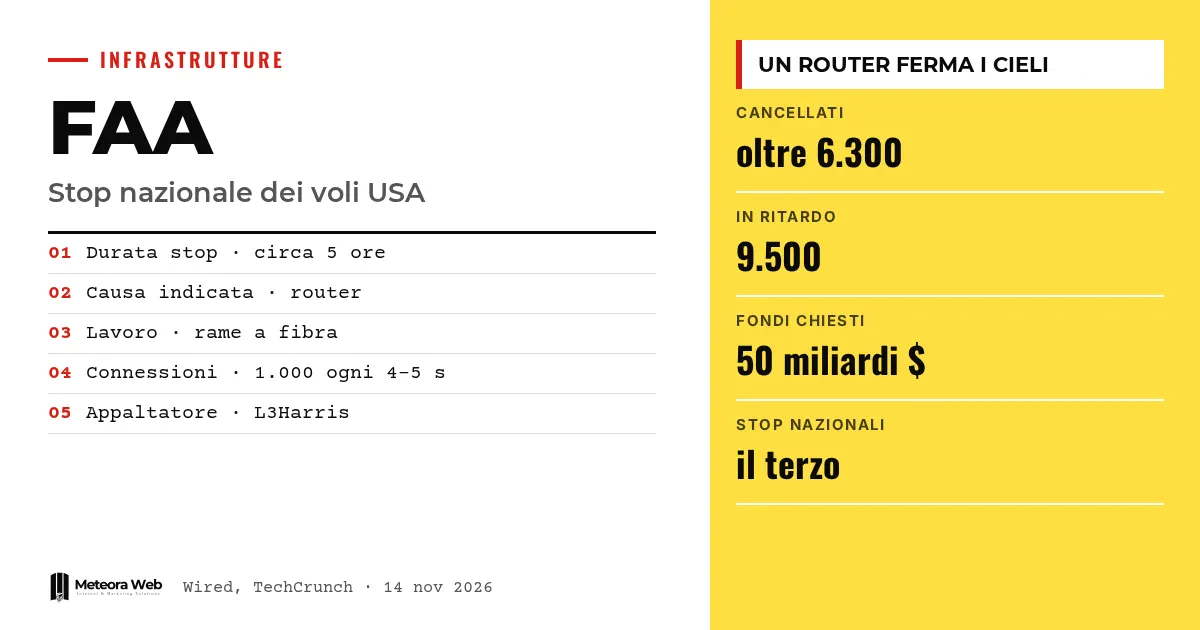
On Friday 13 November the Federal Aviation Administration stopped departures from all US airports for about five hours. The next day Transportation Secretary Sean Duffy blamed the outage on a maintenance job, the move from copper cable to fiber optic at a remote site. A new router allegedly overloaded the air traffic control communication network. For anyone who runs IT systems, it is a textbook case about updates and aging infrastructure.
A few terms before we get into the facts. Ground stop is the order that halts aircraft departures. ARTCC are the air route traffic control centers. FTI is the FAA's private communication network, the backbone linking controllers, pilots and centers. TDM is time division multiplexing, an older transmission technology. Router is the device that routes data between networks.
What actually happened on Friday?
According to Ars Technica the halt began at 3:36 pm (Eastern time) with a "communication problem" affecting all ARTCC centers. Domestic departures were cleared at 8:35 pm.
According to Wired the halt lasted five hours. When it was lifted FlightAware counted over 6,300 cancelled flights and 9,500 delayed. More than a million travelers were affected, according to Ars Technica.
What cause have the authorities indicated?
On Saturday Duffy spoke of "routine maintenance", namely the move from copper to fiber carried out by L3Harris, a longtime FAA supplier, as TechCrunch reports. After the work a router allegedly overloaded a critical communication system.
The Verge reports that the new router was "flooding" the other equipment with over a thousand connection attempts every 4 to 5 seconds. Radar data and contact with aircraft were affected.
The agency disabled the two points at the origin of the traffic and stabilized the network. A root cause analysis is now underway.
Are there different versions of the origin of the fault?
Yes. Duffy does not yet know whether it was an installer error or a faulty router. On Friday, according to Wired, Homeland Security Secretary Markwayne Mullin had spoken of "patches" inserted while new technology was being installed, with the new system "overwhelming" the old one.
Punto Informatico, citing CBS News, mentions Cisco 600 routers produced between 2001 and 2006 overloaded by security patches. Other CBS sources instead point to an update of the private network that caused a reboot. These are journalistic reconstructions, not official conclusions.
How much does it cost to modernize air traffic control?
According to Punto Informatico Congress allocated 12.5 billion dollars, but at least another 30 would be needed. Wired recalls that Duffy had asked for 30.1 billion for systems and airports and on Friday raised the request to 50 billion.
Wired reports that L3Harris states it completed 50 percent of the project by May and, shortly before, 70 percent of FAA sites already on fiber. In September a Government Accountability Office report warned that acceleration could "prioritize speed over cost and disruption", flagging 11,389 schedules not integrated.
Limits to know
The root cause is not established. It is not known whether the fault lay in the router, the configuration or the installation, and sources disagree on patches, Cisco routers and reboots. L3Harris, according to Wired, did not respond to requests for comment. Mullin ruled out signs of a cyberattack but admitted there is not "complete certainty". The final count of cancelled flights varies by source, because Cirium and FlightAware count differently.
What changes for people working in digital
The case shows that even a routine intervention can halt a critical system when it coexists with old equipment. For those who manage company servers and networks, three things matter. First, know which obsolete components keep the service running. Second, test changes in a separate environment. Third, choose intervention times carefully, since the FAA has announced a review. If you rely on hosting with managed security updates, ask how they are scheduled and rolled back. The precedent of the Microsoft 365 outages is a reminder that downtime is paid for in hours of work.
Our take
Politically the episode is already an argument for seeking funds, and Duffy is openly making it. The technical point, however, is another. A national network that depends on a single badly managed router has no real redundancy, whoever is to blame. The chosen timing, 3 pm on a Friday, is also puzzling. Adding money without a single unified schedule, as the GAO points out, risks repeating the same mistakes. There is also the question of AI, ruled out by the FAA head, who says he sees "no evidence" of a link.
Frequently asked questions
How long did the US flight halt last?
About five hours. Domestic departures were cleared at 8:35 pm on Friday, but the effects continued on Saturday with at least another 3,000 flights cancelled, according to Cirium.
Was it a cyberattack?
There are no indications of that. Mullin ruled it out, while adding that there is no complete certainty at the moment.
What role did L3Harris play?
It is the company that managed the upgrade and the network. Duffy said he did not yet know whether there was an installation error or a faulty router, and the company did not comment to Wired.
Is artificial intelligence involved?
No, according to the FAA. Its administrator Bryan Bedford said he sees no evidence of links to AI, even though the day before a tool for controllers had been launched.
Could it happen again?
According to Duffy, yes, if no large-scale upgrades arrive. He warned there will be "more of these" events without investment in the system.
What to watch after the root cause analysis
The FAA's next steps will show whether this was an isolated failure or a problem of method. The inquiry's findings and Congress's decisions will matter.
- Read the root cause report and check whether it points to installer error, a faulty router or configuration.
- Follow Congress's response to the request for 50 billion dollars and the network transition to AT&T.
- Check whether the FAA changes the scheduling of migrations at remote sites.
Sources
- techcrunch.com, Transportation secretary blames ‘routine’ equipment upgrade for grounding flights nationwide
- theverge.com, Work to replace old copper wire led to the FAA’s ground stop
- punto-informatico.it, Aerei fermi per 5 ore negli USA – sistema ATC obsoleto
- wired.com, The FAA Nationwide Ground Stop Is Over
- arstechnica.com, FAA has lifted its third-ever nationwide ground stop