Ing. Calogero Bono
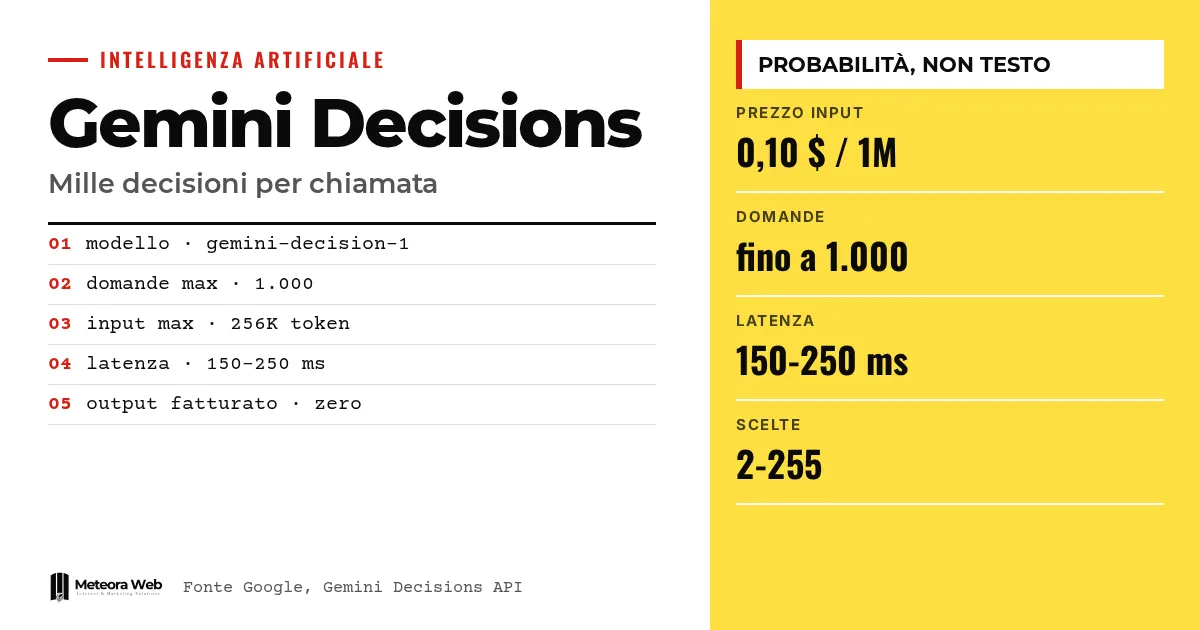
Google has unveiled the Gemini Decisions API, a new endpoint of the Gemini API built for closed-set choices, such as selecting a tool, checking a rule or routing a request. The service uses the gemini-decision-1 model and is available in Google AI Studio. Instead of writing text, the model assigns probabilities to the options you give it. It matters for software developers because it promises responses in 150-250 milliseconds and very low costs.
A few terms before we get into the facts. Endpoint is the address your code sends a request to. Closed-set means a choice among options defined in advance. Token is the unit of text models use to measure input and costs. Calibration tells you how closely the model's stated confidence matches reality. Forward pass is a single pass through the model, without generating word after word.
What is Gemini Decisions API?
According to Google's official blog, it is an endpoint for fast decisions on limited choices. Google cites tool selection, policy checks, model routing and context evaluation.
The Gemini Decision 1 model does not generate answers token by token. It evaluates the candidate options in a single pass and returns probabilities and confidence scores. AI4Business also stresses that the service returns probabilities rather than explanations in natural language.
What kinds of questions can you ask?
You can send a single multimodal input, up to 256K tokens, with text, images, audio, video and PDFs. On that input you can ask up to 1,000 independent questions. Google offers two examples, a call recording with account metadata and a claim PDF with photos of the damage.
The three formats
- Yes or no, estimates the probability that a condition is true.
- Multiple choice, from 2 to 255 options, with probabilities normalized for each.
- Score, rates the input on an ordered scale starting from zero.
Each answer has a confidence from 0 to 1. Your code can use it to send the uncertain cases to a fallback or to a person.
How much does it cost and how fast is it?
Google claims 150-250 ms of total latency, of which 50-100 ms is model computation. The price is $0.10 per million input tokens, with zero output tokens billed. The shared input is paid once per request, and each question only adds the tokens of its instructions and criteria.
Again according to Google, latency stays almost flat from 1 to 100 questions per request. The comparison with Gemini 3.5 Flash-Lite via the Interactions API indicates a cost nearly five times lower on the shared test suite. This is the company's figure, not an independent verification.
There is a free tier for prototyping in Google AI Studio. If you are starting from zero, our guide to Google AI Studio explains how to try prompts without code.
Who already uses it inside Google?
Google describes four internal uses. Gemini Notebook uses it as a router to direct requests to the right model and reasoning level, with latency up to 40% lower. Stitch uses it to generate playable wireframes in seconds.
CC, from Google Labs, uses it to pick the emoji reaction among more than 200 options. Google Search employs it as a safety layer for MCP tools, to spot hostile behavior.
Upcoming integrations include OpenRouter, LangChain, Vercel, LiteLLM, Pydantic AI, Pipecat, LiveKit and OpenCode, as well as the google-genai SDKs. Support in Gemini on Google Cloud will arrive later. For using it from code, the guide to the Gemini API with Python is a good starting point.
Limits to know
Almost all the numbers on performance, calibration and savings come from Google, not from independent tests. The source does not publish the detailed benchmark results here. The API uses the v1beta version, so names and fields could change. Support in Gemini on Google Cloud has only been announced. The AI4Business text, in its visible part, adds no independent verification.
What changes for those working in digital
Many features that today require a purpose-trained classifier, or a slow generative call, can become a definition of options. Think of ticket routing, checking attached documents or choosing the most suitable model. For mixed requests, with images and text together, Gemini's multimodality is already the testing ground. The confidence threshold lets you keep a human in the loop when the model is unsure.
Our take
The idea makes sense. Many AI products waste time and money having the model write a paragraph when a yes or no was all that was needed. Returning calibrated probabilities is more honest than a confidently worded sentence. The risk is blind trust in the numbers. A confidence of 0.9 is not a guarantee, and the published tests come from Google. Before putting it into production, measure the errors on your own data.
Frequently asked questions
What is Gemini Decision 1?
It is the model behind the Decisions API, identified as gemini-decision-1. It evaluates predefined options in a single pass and returns probabilities and confidence, without generating text.
How much does the Decisions API cost?
It costs $0.10 per million input tokens, with zero output tokens billed. There is a free tier in Google AI Studio for prototyping.
How many questions can one request contain?
Up to 1,000 independent questions on the same input. The input can reach 256K tokens and combine text, images, audio, video and PDFs.
Can I use it in production?
You can try it right away, technically, but the API is in v1beta. It is best to test it on your own data and plan a fallback for low-confidence cases.
Where is the documentation?
Google points to guides in Python, JavaScript and REST in the Decisions API documentation. You need an API key from Google AI Studio.
What to watch for in the coming weeks with the Decisions API
The real value will show once independent evidence and stable integrations arrive. Until then, it is wise to proceed with caution.
- Check whether independent benchmarks on calibration appear.
- Follow the exit from the v1beta version and the arrival on Google Cloud.
- Verify which integrations with LangChain, Vercel and LiteLLM become available.