 Ing. Calogero Bono
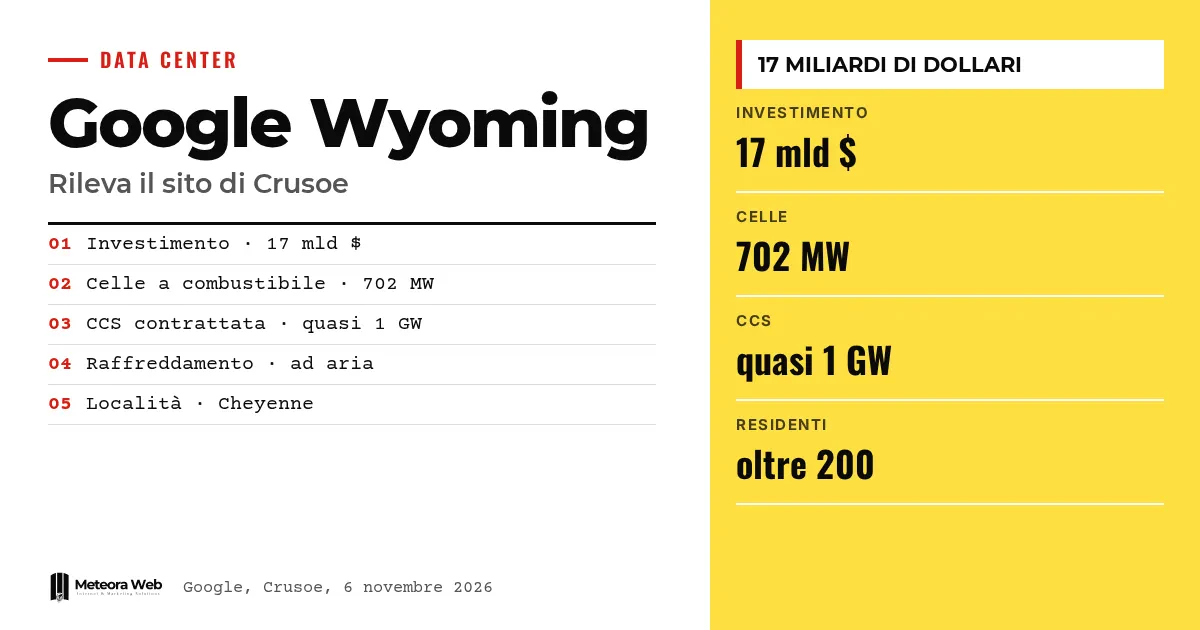
Google has announced its first data center in Wyoming, in Laramie County, with an investment of 17 billion dollars. On November 6, 2026, Crusoe confirmed it had handed Google the site in the southeast of the state, which was not yet finished. The project will rely on fuel cell power with CO2 capture. It matters because it shows how hard it is to build infrastructure for AI, between costs, timelines and energy.
A few terms before we get into the facts. Data center is the building that houses the servers. Fuel cells are plants that turn a fuel, here natural gas, into electricity through an electrochemical process. CCS stands for carbon capture and storage, meaning CO2 is trapped and stored underground. MW and GW are megawatts and gigawatts, units of electrical power. Hyperscaler refers to large cloud operators such as Google.
What happened between Google and Crusoe?
According to Crusoe's statement, Google acquired the site in southeast Wyoming. For Crusoe, the pre-development phase ends here, made up of site selection, permits and the energy strategy developed with Tallgrass Energy.
CEO Chase Lochmiller said the preparation efforts «have put the Wyoming project in a position to be built and, ultimately, to go into operation». Google has not disclosed how much it paid, as TechCrunch reports.
How will the Cheyenne data center be powered?
In the official post, Google declares a contract with AEP for a 702 MW development of fuel cells with CCS. The cells will be produced by Bloom Energy, and Google calls it the largest project of its kind planned so far.
The CO2 will largely be stored in Tallgrass's Eastern Wyoming Sequestration Hub. Google will also use gas generators from Tallgrass and Black Hills Energy, and is conducting a technical study to equip Tallgrass's combined-cycle turbines with CCS. The contracted CCS capacity reaches almost 1 gigawatt.
What does Google promise the local community?
Google states it will pay for 100% of the energy it uses and will cover the infrastructure required by its own growth. The site will be air-cooled to reduce the strain on local water.
The company estimates hundreds of millions of dollars in local property taxes for Laramie County and School District 1. After a meeting with over 200 residents, a Community Council will be set up with partners to address the effects of data center growth on Cheyenne. These are all Google's claims, not yet verified by third parties. The question of local impact is similar to what was seen in this review of Big Tech data centers.
Why did Crusoe sell the project?
According to TechCrunch, Crusoe had unsuccessfully tried to win Google as a customer. Google reportedly raised doubts about costs and construction timelines under Crusoe's management, but these are leaks (the outlet writes «reportedly»). The project was announced last year with Tallgrass, with the idea of reaching 10 gigawatts.
The reports continue. Crusoe is developing another data center for Google near Amarillo, Texas, and in September it raised 3.9 billion dollars. The case shows the struggle of those who develop large plants without being major operators, while demand for AI-related capacity grows, as also seen in Altman's view on RAM in the data center.
Limits to know
The price Google paid and the date the site will go live are not known. Google's doubts about costs and timelines come from leaks. The emission and water reductions are company claims, without independent data. A CCS technology at this scale has not yet been built, and real results could differ from the promises.
What changes for those working with digital
For those working in digital, nothing changes tomorrow, but the picture is clear. The computing capacity for AI depends on energy, permits and construction times, and this weighs on cloud prices and availability. If your services run on large platforms, it is worth asking where the data is and how the energy is produced. Those who manage their own servers or managed hosting can apply the same reasoning to their providers. The debate on AI and energy consumption is also set to make its way into contracts.
Our take
The deal shows that building for AI makes sense for those with the capital to absorb delays and costs. Crusoe took the risky part and then sold the project. The environmental promises are ambitious, but they rest on natural gas and on CO2 capture still to be proven at this scale. The Community Council is a good sign only if it gains real power. Until then, these remain commitments written by the company.
Frequently asked questions
How much is Google investing in Wyoming?
Google announces a long-term investment of 17 billion dollars. The project is in Laramie County, around Cheyenne. The price paid to Crusoe has not been disclosed.
Who is Crusoe?
Crusoe is a data center developer based in Denver, founded eight years ago. It earns money by leasing space, renting GPUs and selling computing power for inference. TechCrunch values it at 30.9 billion dollars.
Will the data center use a lot of water?
Google says no, because it will be air-cooled. The aim is to reduce the strain on local water resources. There is no independent data confirming this.
What are the project's fuel cells?
They are plants that turn natural gas into electricity through an electrochemical process. They will be 702 MW, produced by Bloom Energy. They will be paired with CO2 capture.
Is Crusoe still working with Google?
Yes. Crusoe is developing another Google data center in Armstrong County, near Amarillo, Texas. The partnership therefore continues.
What to watch in the coming months in Wyoming
The project has just changed hands and many of the numbers are still promises. The next steps will show how well they hold up.
- Follow the start of construction and the start-up dates announced by Google.
- Check whether independent data arrives on the CO2 the project actually captures.
- Watch the work of the Community Council and the first local funding announced.