 Ing. Calogero Bono
On March 4, 2026, Google announced a new fee model for Google Play and a program called Registered App Stores. The program makes it easier to install alternative stores on Android. According to sources, from December 1, 2026, approved stores will be able to install apps with a single tap in many countries, Italy included. It matters for anyone who publishes apps, because costs and distribution channels are changing.
A few terms before we get into the facts. Sideloading is installing apps outside the official store, with several confirmation steps. Billing is the system that handles payments inside the app. The service fee is the commission the store keeps on transactions. The EEA is the European Economic Area. A QPR is a quarterly update to the Android platform.
What are the new Google Play fees?
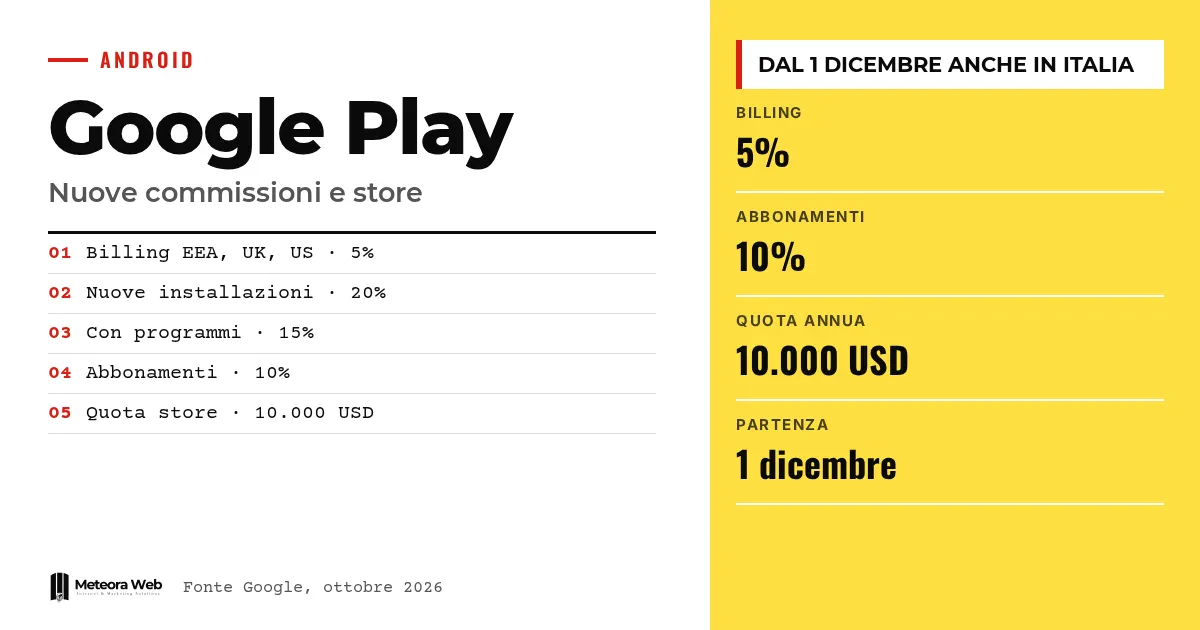
According to Google's official announcement, the commission for the payment system is separated from the service fee. Those who use Google Play billing pay a specific rate for each market. In the European Economic Area, the United Kingdom and the United States, it will be 5%.
Google also states that developers will be able to use their own payment system alongside Google Play's, or direct users to their own website for purchases.
The stated percentages
- In-app purchases on new installs, meaning first installs after launch in a region, service fee at 20%.
- Developers enrolled in the Apps Experience and Google Play Games Level Up programs, 20% on existing installs and 15% on new ones.
- Recurring subscriptions, service fee at 10%.
Google claims its fees are already the lowest among major stores. This is the company's own assessment, not a figure verified by third parties. If you want to refresh the basics of the store, we explained how Google Play works and how an app gets approved.
What are Registered App Stores?
It is an optional program. Stores that meet certain quality and security requirements register with Google, and those who download them via sideloading find installation easier. Those who do not take part see no change, as The Hacker News also confirms.
Today, the outlet explains, the user must enable the store and then confirm every installation and every update. With the program, from December 1, an approved store gets the permission automatically, and updates run in the background according to the user's update settings.
According to Punto Informatico, the program follows Google's court defeat against Epic Games. Google says it has resolved its disputes with Epic worldwide.
What requirements must stores meet?
Stores must pass identity checks and send Google their entire catalog, with every new app and every update, for continuous antimalware scanning. They must be registered as an organization and keep the developer's identity verified. They must prevent malware in the catalog and fix serious flaws.
They cannot block other stores or hide Android's security notifications. They must pay 10,000 dollars a year before Google starts the review.
- Each store remains responsible for its own catalog, and Google does not moderate content.
- If more than 1% of installation attempts or more than 2% of apps are potentially harmful within 30 days, Google applies additional costs.
- Installers must have the user's explicit consent and cannot install silently.
When does all of this arrive?
For the fees, Google has laid out a schedule. By June 30 in the European Economic Area, the United Kingdom and the United States. By September 30 in Australia, by December 31 in Korea and Japan, and by September 30, 2027 in the rest of the world.
For Registered App Stores, the features start on December 1, 2026, only on Android 17 QPR2 or later and in supported countries, which do not include the United States. In the US, a different program for distributing third-party stores through Google Play applies, active since July 22. Availability follows the user's country of residence, and short trips do not turn the features off.
Limits to know
The sources do not clarify how apps are scanned, how long the review of new uploads takes, or what results the checks produce. The program pages do not say whether the block for IT administrators also applies to a store that is already installed.
Android 17 QPR2 is still in beta in its latest version, released on October 16, and there is no date for the final release. Google has also said it will share more details on fees in the coming months. The dates could therefore change.
What changes for those who work in digital
If you have an app with in-app purchases or subscriptions, redo your margin calculations market by market. The math is ours to do, but with Google billing and service fees, the sum of the two items should be compared with a proprietary payment system. With 5% billing and a 20% service fee, for example, you reach 25% on a new install, without any additional programs.
If you develop with cross-platform technologies, as we explain in our Flutter guide, the code stays the same. What changes is the distribution strategy, where Google Play is no longer the only convenient channel. If you are thinking about an app for your business, start from our iOS and Android app development service to evaluate the channels.
For those managing company devices, IT administrators can block registered stores on managed devices.
Our take
This move is a concession made under legal pressure, and it should be read that way. Fees are going down, but the structure remains complex. Between separate billing, different percentages for new and existing installs, and programs with quality benchmarks, a small developer struggles to understand what they will actually pay.
On Registered App Stores the trade-off is interesting. The user gains simplicity, but the 10,000 dollars a year and the submission of the entire catalog to Google keep control close to the parent company. Small stores could stay out. It is also worth remembering that, according to Punto Informatico, by 2027 sideloading will allow only apps from verified developers. The picture is more open than before, but not truly free.
Frequently asked questions
Are Registered App Stores arriving in Italy?
Yes, according to Punto Informatico. They will be available from December 1, 2026 in many countries, Italy included, but only on Android 17 QPR2 or later.
Are alternative stores required to register?
No. The program is optional. Stores that do not take part keep the same experience as any other app installed via sideloading.
How much does it cost to register a store?
It costs 10,000 dollars a year, to be paid before Google starts the review. Google may ask for additional costs if a store exceeds certain thresholds of potentially harmful apps.
Do the new fees apply right away?
No. Google plans a staggered rollout. For the European Economic Area, the United Kingdom and the United States, by June 30, and for the rest of the world, by September 30, 2027.
Can a one-tap installation be silent?
No. The store must obtain the user's explicit consent for each installation. Background installations must show a visible notification.
What to watch for through the end of the year
Keep an eye on the final release of Android 17 QPR2 and the first approved stores. Publication of the billing details will also matter. If you want to organize your work, here are three practical tips.
- Simulate your app's costs with the new percentages, separating billing and service fees, market by market.
- Evaluate whether a payment on your site, perhaps linked to a cloud management software such as Zenith, makes sense for your subscriptions.
- Check developer verification, because Google plans to extend checks worldwide in 2027.