 Ing. Calogero Bono
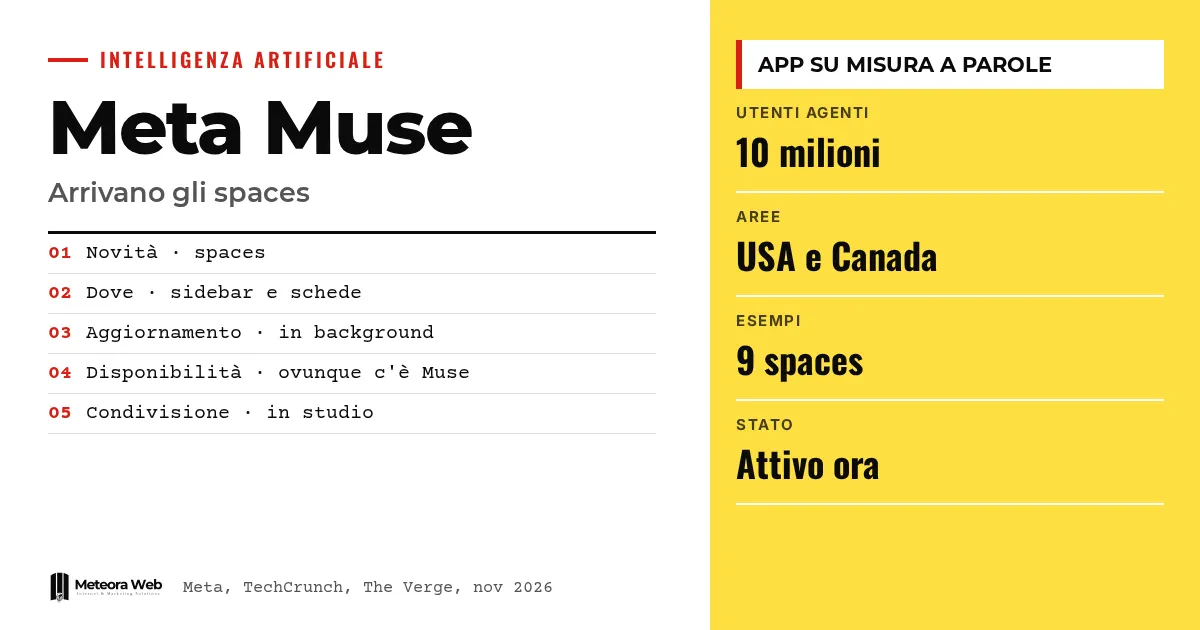
Meta has introduced spaces in Muse, its app with AI-powered agents. These are personalized experiences you create by describing an idea in words, such as a gift tracker or a travel planner. According to Meta, the feature is available right away wherever Muse is available. It matters because it brings to the assistant something close to a small app built on demand, without writing any code.
A few terms before we get into the facts. Muse is Meta's app with AI agents. Space is the personalized area you create inside Muse by describing what you need. Agent is an AI assistant that works toward a goal on your behalf, not just answering questions. Muse Wonder is Meta's AI model from which the specialized versions arriving in the app derive. Sidebar is the interface's side bar where you can pin spaces.
What are Muse spaces?
According to the official Meta announcement, a space is a personalized experience created inside Muse by describing your idea. It can be a gift tracker, a daily word game or a board for a DIY project.
The initial idea is only the starting point. You can keep asking Muse to add what's missing, change the look or adjust how it works. Each space becomes part of Muse, and you can find it again whenever you want.
What can you build?
Meta cites several examples. A shopping hub that brings together gift ideas, wish lists saved from Instagram, Marketplace listings and messages from buyers. A school dashboard that finds your children's events in emails and adds them to the calendar.
There are also work uses.
- An order tracker for a small business, with new orders, customer messages and the day's shipments.
- A client hub for freelancers, with projects, deadlines and invoices.
- A travel planner with flights, hotels, bookings and itinerary.
On the travel front, Airbnb has also announced an AI agent for planning and booking.
How do spaces stay up to date?
Meta says that, by connecting the apps you use, spaces update in the background. New concert dates, price changes or savings progress appear without you having to ask. Inside a space you can tick items, add notes and make changes, and everything is saved.
You can also decide where they live. Put them in the sidebar, move them to the main tabs, hide the ones you don't need and schedule when they appear. Meta's example is a weekly planner shown prominently during the workweek, replaced by weekend plans on Saturday.
Why is Meta launching this now?
According to TechCrunch, spaces are the second Muse feature in a week, after Muse Voice, which lets you talk to the agent on video. During the October earnings call, Mark Zuckerberg said agents had 10 million users in the United States and Canada, less than two months after launch. The figure is the company's own claim.
Competition, TechCrunch writes, includes OpenAI's dots and SpaceXAI's Grokbot. Meta is also active on other AI fronts, such as Style Sketch.
Limits to know
Meta provides no data on the reliability, limits or costs of spaces, nor does it list the apps that can be connected. It is unclear how data from connected apps is handled. Sharing between users is only under study, and the specialized model versions are announced without details. TechCrunch describes spaces as conversations dedicated to a topic, while Meta speaks of personalized experiences. The picture may become clearer with use.
What changes for those working in digital
For a small business, an order tracker or a client hub created in words can replace scattered spreadsheets, at least for simple cases. For software developers the direction is clear – on-demand interfaces become a feature of the assistant. Those who sell apps or management software need to explain where the value lies, namely integration, data control and reliability. Those working with social media and ads will need to watch how Instagram and Marketplace fit into these workflows, including for Meta Ads campaign targeting.
Our take
The feature is clever, but the promise needs to be tested. Building a dashboard by describing it in words is convenient for personal use, far less so for business processes that require rules, permissions and reliable history. Anyone who really wants order in their data still needs purpose-built tools, such as a cloud management system. Spaces look more like a way to keep users inside Muse than a replacement for management software. The real test will be the quality of background updates.
Frequently asked questions
What are spaces in Muse?
They are personalized experiences you create inside Muse by describing an idea. They can be trackers, planners, games or boards. They stay inside the app, and you can change them by asking Muse.
Are spaces already available?
Yes, according to Meta they are available right away wherever Muse is available. The Verge also reports they are rolling out to all users.
Do spaces update on their own?
Yes, if you connect the relevant apps. Meta says dates, prices and progress update in the background. You can still tick items, add notes and make edits.
Can I share a space with others?
Not yet. Meta says it is exploring ways to share spaces and create a more collaborative experience. No dates have been given.
Are spaces useful for small businesses?
They can serve simple uses. Meta cites an order tracker and a client hub for freelancers. However, details on reliability and data handling are missing.
Sharing, models and real-world use of spaces to watch
The coming months will show whether spaces remain a novelty or become a habit. Three signals matter.
- Check whether Meta announces dates and rules for sharing spaces.
- Watch which apps can be connected and with what data permissions.
- Follow how the specialized model versions inspired by Muse Wonder evolve.