 Ing. Calogero Bono
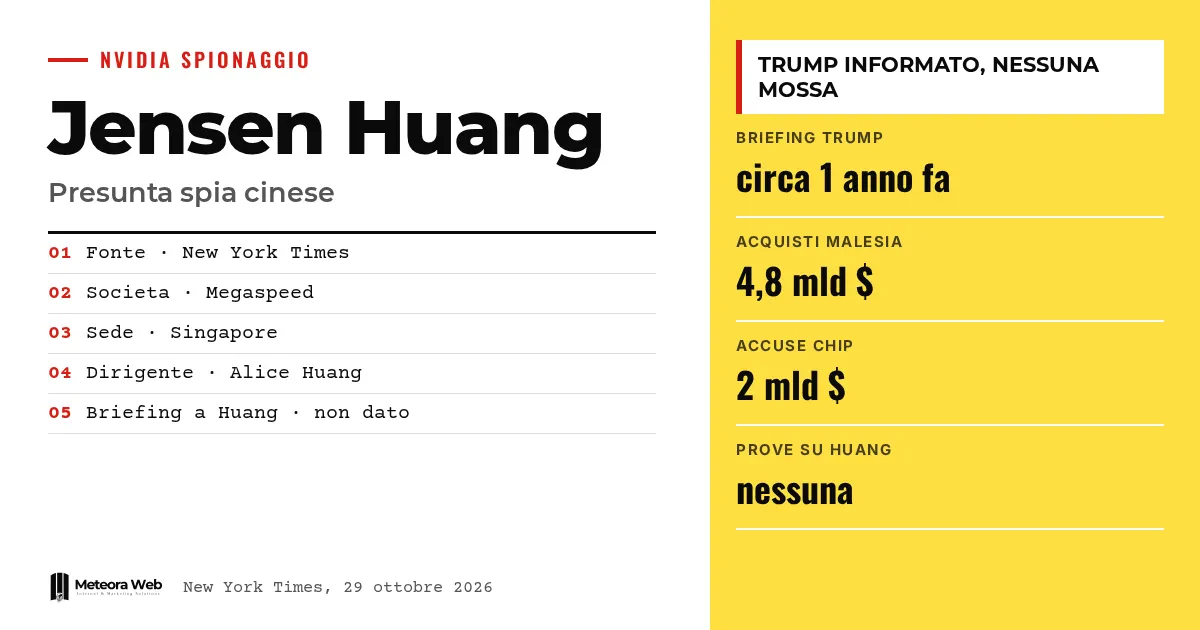
The New York Times published an investigation on Thursday claiming that American intelligence agencies consider Alice Huang, an executive at the Singapore-based company Megaspeed, a suspected Chinese intelligence asset. She reportedly had direct access to Jensen Huang, the CEO of Nvidia. According to the paper, Donald Trump was informed about a year ago and did not act. Nvidia disputes this reading of events, and China denies it. It matters because Nvidia supplies the chips that run the main AI systems.
A few terms before we get into the facts. An intelligence asset is a person who collects and passes information to a secret service. A defensive briefing is the warning that American services sometimes give to citizens targeted by foreign spies. Export controls are American restrictions on the sale of advanced chips to China. A regional cloud is a company that builds data centers and rents out computing power.
What actually happened?
According to the Ars Technica report on the Times investigation, anonymous sources familiar with intelligence findings said that about a year ago Trump was told that Beijing was receiving reports from a person with direct access to Huang. That person is reportedly Alice Huang, also known as Huang Le, a Chinese citizen and former senior executive at Megaspeed. She is not related to Jensen Huang.
As Tom's Guide reports, surveillance of her reportedly revealed a close relationship with Nvidia's CEO. The two were reportedly seen together in Taiwan in 2024 and 2025. According to TechCrunch, the concern was that she was gathering information on Nvidia's plans and on the CEO's efforts to win the administration's approval to sell more advanced technology to China.
Why is Megaspeed already under watch?
Megaspeed is a cloud partner of Nvidia based in Singapore. According to Tom's Hardware, the investigation began when the Department of Commerce visited a data center in Malaysia and found Nvidia machines still in their packaging. This raised suspicion that they had just arrived or were about to leave.
The figures differ across sources. Engadget cites at least 4.8 billion dollars in Nvidia-based equipment bought by the Malaysian subsidiary in under two years. Tom's Hardware recalls the accusation of helping bring in chips worth 2 billion dollars. These are different measures, and we report them as such.
What do Nvidia and Beijing say?
Nvidia rejects this framing. A spokesperson told TechCrunch that Huang's interactions with the executive were "not unusual or unexpected" in the sense that they are normal for a CEO. The original statement is in English, and we quote it as is. The company also says that regional cloud customers receive ordinary business information and nothing relevant to national security.
According to Tom's Guide, Nvidia maintains that the allegations of diversion toward this regional cloud were investigated and dismissed last year. The Chinese embassy in Washington, according to Tom's Hardware, called the claims "groundless smears and slanders". Megaspeed, Tom's Guide reports, has hired lawyers to examine the accusations.
Why would Trump not have acted?
It is not clear. According to Engadget, the Times notes that Trump has been cautious about any move that could disrupt Nvidia's sales or complicate trade with China. Ars Technica adds that Treasury Secretary Scott Bessent said last month that the president is fully aligned with Huang.
Huang, according to the sources, did not receive the defensive briefing. One possible explanation, reported by Tom's Hardware, is avoiding tipping off Alice Huang, who is reportedly still under surveillance. To explore the political context, you can read our article on China's race for Nvidia chips.
Limits to keep in mind
- The story rests on anonymous sources discussing classified intelligence. Other outlets are picking up the Times and have not independently verified it.
- It is not known what information Alice Huang reportedly passed to Beijing.
- According to Tom's Guide, no public evidence shows that Jensen Huang knew, passed on sensitive information or broke export rules. American officials reportedly consider him unaware.
- The Times could not verify Alice Huang's past as a television journalist.
- It is not clear why the agencies began investigating her.
What it means for people working in digital
There is no immediate risk to personal data, as Tom's Guide notes. It remains a reminder of how much we depend on a handful of hardware suppliers. If your company uses AI services, their cost and availability also depend on political choices. We covered this too in a piece on Italian SMEs caught in the middle.
Anyone running infrastructure should ask providers where their workloads actually run. On the topic of owned infrastructure, managed hosting and servers with security updates at least reduce the exposed surface.
Our take
The story is serious, but it should be read with caution. An investigation built on anonymous sources can be accurate and partial at the same time. Nvidia's denials have an obvious interest, but no public evidence contradicts them. The most solid point is a different one. If a president receives information of this kind and does not act, the reason needs to be explained, especially when the person involved is an AI adviser. At the same time, the decision not to warn Huang may have an investigative logic, as Tom's Guide acknowledges. The real knot is the entanglement between commercial interests and national security. If a company's sales are what drive decisions, export controls lose credibility. If it was instead an investigative choice, someone needs to say so. We also wrote about this conflict in Trump is divided over Chinese AI.
Frequently asked questions
Is Jensen Huang accused of anything?
No. Sources report that American officials consider him unaware. According to Tom's Guide, no public evidence shows that he broke rules or passed on sensitive information.
Who is Alice Huang?
She is a Chinese citizen, also known as Huang Le, and an executive at Megaspeed in Singapore. She is not related to Jensen Huang. American services would reportedly consider her a Chinese intelligence asset.
What does Nvidia say?
It denies that the relationship was unusual. It says Huang speaks with thousands of customer executives every year and that cloud customers receive only ordinary business information.
Why would Trump not have acted?
It is not clear. The Times links it to caution about Nvidia's sales and trade with China, but the exact reason is not known.
Does this story matter to people who use ChatGPT?
Not directly. Tom's Guide points out that there is no immediate threat to personal data. However, it does show the tensions surrounding the hardware that powers AI.
What to watch in the coming months
Official confirmations or denials are needed. Also keep an eye on what the Department of Commerce will do about Megaspeed. For practical guidance.
- Follow whether Washington comments on the case or opens formal proceedings.
- Check with your cloud providers where the data centers used for AI are located.
- Read the European perspective in our piece on sanctions and Europe.