 Ing. Calogero Bono
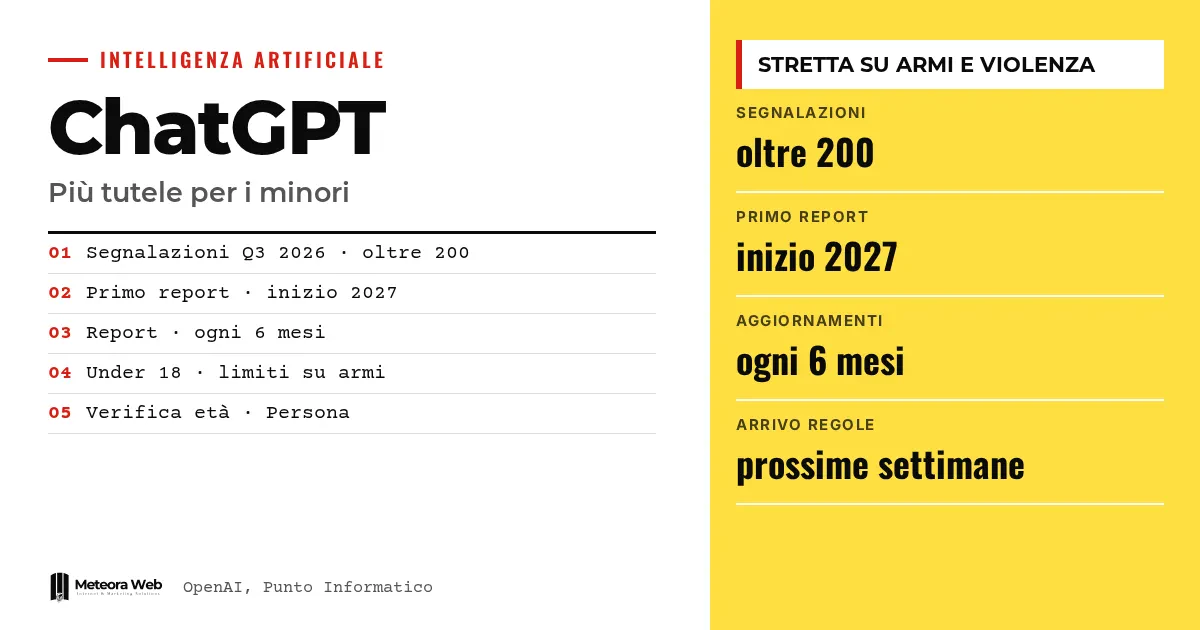
OpenAI has announced a package of measures to limit the risks linked to violence in ChatGPT. The changes concern weapons information for users under 18, answers about past mass attacks, and a new safety report, the first one expected in early 2027. The new rules will arrive in the coming weeks. They matter because they affect everyone who uses ChatGPT every day, families and businesses included.
A few terms before we get into the facts. ChatGPT for Teens is the ChatGPT experience designed for under-18s, with additional limits on sensitive content. Age prediction is the system that estimates, from signals such as usage behavior, whether a user is over or under 18. Persona is OpenAI's partner that handles age verification. Parental controls let parents link their own account to their child's. The Community Safety Report is the periodic report OpenAI promises to publish.
What did OpenAI announce?
According to OpenAI's official statement, there are two novelties. The first is a new community safety report. The second is a set of stricter restrictions on weapons-related content for minors.
The company states that it made over 200 reports to law enforcement in the third quarter of 2026 for imminent threats of violence. The figure is provided by OpenAI and cannot be independently verified.
As Punto Informatico recalls, the move responds to lawsuits filed in the United States and to criticism from Common Sense Media about ChatGPT for Teens.
What changes for questions about mass attacks and violence?
OpenAI says its models are trained not to give useful instructions for planning or carrying out violence. Now the model will give less detailed information about past mass attacks and about who carried them out, even when the details can be found elsewhere online.
Questions to understand the events, their impact on victims and communities, and warning signs remain possible. Reconstructions are limited, including details on weapons, equipment and how they were acquired, as well as comparisons of the scale of harm that could raise the notoriety of the perpetrator. These limits apply regardless of age or the reason for the request.
If recent chats show signs of possible violence, ChatGPT will respond more cautiously. The company is working to apply the same limits when it predicts the user is a minor.
Will ChatGPT be able to close conversations and suspend accounts?
Yes, according to OpenAI. Together with experts in mental health and violence prevention, the company is working on earlier automatic interventions. If a conversation shows a fixation on violence or on the idea of harming someone, ChatGPT will be able to close the chat automatically. If it happens repeatedly, the account could be temporarily suspended.
Bans for accounts that violate the rules on violent activities remain in force. OpenAI admits that it is still unclear how to recognize these signals reliably and when to intervene.
What new protections are there for teens and parents?
For under-18s, the limits on information about weapons and security systems increase, even when the question seems harmless. Teens can still use ChatGPT to prevent violence, look for support and turn to a trusted adult.
Age prediction, launched last year, evaluates new signals during use and moves users into the minor experience. Anyone classified by mistake can confirm they are an adult with Persona.
On parental controls, since July parents are alerted if their child's account is disabled for violations related to violence. OpenAI is working on a notification for suspensions caused by repeated discussions on the topic as well.
To go deeper, see OpenAI develops an autonomous hacker – the security of Italian SMEs is at risk and OpenAI rolls out an autonomous hacker – the security of Italian SMEs is already behind.
Limits to know
Almost everything rests on OpenAI's own statements. There is no independent data on how effective the filters are or on the error rate of age prediction. The precise criteria for closing a chat or suspending an account are missing. Some measures, such as parent notifications for suspensions, are still in progress. The first report, covering the second half of 2026, will only arrive in early 2027.
What changes for those who work with digital tools
If you build products that integrate ChatGPT or use its answers, expect refusals and less detailed responses on weapons, physical security and violent news. This also applies to legitimate research, because the limits on past attacks do not depend on the reason behind the request. If you build services aimed at young people, keep in mind that the age estimated by the system can change their experience. For companies with minor employees or customers, it is worth explaining that parental controls and age verification exist. It is also wise to prepare a clear message for when a response is refused.
Our take
The direction is understandable, but the announcement is still a commitment rather than a result. Limiting reconstructions of past attacks is a sensible choice, although it makes the line between research and risk less clear. The delicate point is age prediction, which can get it wrong and force adults to identify themselves. The semi-annual report will be the real test, if it contains data rather than just examples. On the question of trust in models, the comparison with Anthropic Claude and OpenAI helps you evaluate the differences.
Frequently asked questions
When do the new ChatGPT rules take effect?
In the coming weeks. OpenAI states that the measures will begin rolling out shortly and will then be refined. Some features, such as certain parent notifications, are still in development.
Will ChatGPT give less information to adults too?
Partly, yes. The limits on reconstructions of past mass attacks apply regardless of age or the reason for the request. Questions to understand the events and recognize warning signs remain possible.
What happens if ChatGPT mistakes me for a minor?
You can confirm that you are an adult. OpenAI describes a quick, privacy-protective procedure handled by Persona, after which the teen protections are removed.
When will the Community Safety Report be released?
In early 2027. The first report will cover the second half of 2026, and updates will follow every six months.
Will parents be alerted if their child discusses violence?
It depends on the case. Since July, there is an alert when an account is disabled for violations related to violence. OpenAI is working on a notification for suspensions caused by repeated discussions as well.
What to watch before the 2027 report
OpenAI's promises will be measured in the coming months, between the arrival of the rules and the first report. There are three useful signals to follow.
- Check whether the 2027 report contains measurable data and not just anonymous examples.
- Follow how OpenAI clarifies the criteria for closing chats and suspending accounts.
- Verify whether parent notifications for suspensions actually arrive, and how quickly.