 Ing. Calogero Bono
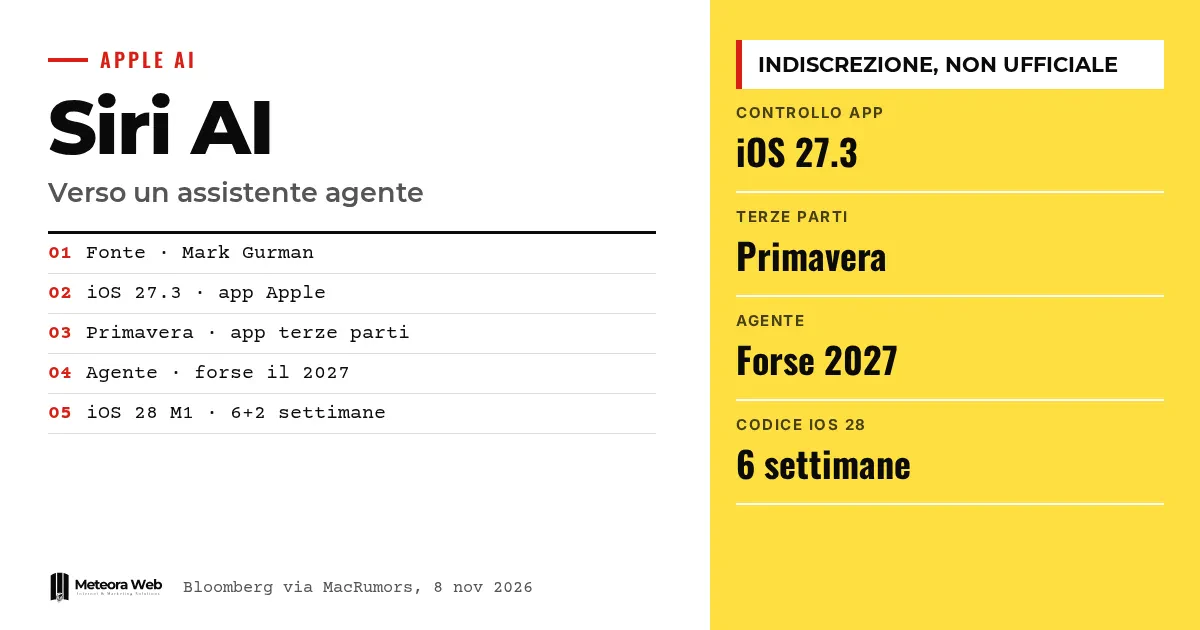
Apple wants to turn Siri into an assistant that can carry out tasks on its own, not just respond to single commands. Mark Gurman of Bloomberg reports it in his Power On newsletter of November 8, saying the shift could arrive as early as next year. CEO John Ternus, again according to Gurman, is pushing Craig Federighi to speed things up. For those who build apps or run digital services, the direction shows how users might reach services in the future.
A few terms, before we get into the facts. AI agent is a system that tracks a goal, decides the next step and keeps going on its own, without the user starting every action. App Intents is Apple's framework that lets apps expose actions to the system and to Siri. Power On is Gurman's newsletter, where the news comes from. Virtual machine is a simulated computer where an agent can work in the background. Computer use is an agent's ability to operate a computer the way a person would.
What did Gurman say about Siri?
According to The Verge, which picks up Bloomberg, Ternus is reportedly pressing Federighi to speed up the roadmap and reach a powerful agent able to compete with OpenAI's Dots or Meta's Muse. Federighi reportedly delivered a working version of Siri AI on a very tight schedule, but the company would not pretend it can keep pace with rivals.
The key passage is this. Gurman writes that Dots, Muse and Grok can track goals, establish what must happen next and keep pursuing milestones without the user starting every single step. Apple, he adds, wants to move in that direction.
What comes first, between iOS 27.3 and the spring?
Before the true agent, two improvements are expected. The first will give Siri fine control over Apple's apps, for example rotating and cropping photos in Photos or organizing Safari tabs. It should arrive with iOS 27.3, whose first developer beta we covered.
The second is more important. Integration with third-party apps, according to Gurman, would arrive later, in the spring. Siri could then order on Grubhub or book a table with OpenTable. Developers can already try Siri AI with the iOS 27.3 Developer Preview.
Why is an agent different from an assistant?
A classic assistant runs a request and stops. An agent, in Gurman's description, carries out ongoing tasks rather than single ones. According to 9to5Mac, Muse and Grok Bot have their own virtual machines and handle tasks in the background, then deliver the results.
9to5Mac argues that Apple starts with an advantage in the frameworks built over the years, such as App Intents. In theory this would mean less computer use, and some tasks would cost less. This is the journalist's assessment, not a verified fact.
Others are also moving toward agents, such as Airbnb, which announced an agent to book trips.
What changes in the iOS 28 development?
9to5Mac reports an internal detail. Usually the two development phases last four weeks each. For the first milestone of iOS 28, called M1, Apple chose six weeks of writing code, exploring and developing features, and only two of integration.
According to Gurman, employees appreciate the change, because it leaves more time to generate ideas before locking them in. 9to5Mac suspects the choice is tied to progress in agentic coding tools, but that is its own reading.
Limits to know
The plan remains a rumor based on sources reported by Gurman, who himself writes that he believes Apple could reach an agent next year. There are no official dates and no details on how it would work. We don't know which third-party apps will be involved or with what permissions. As MacRumors notes, the exact implementation remains to be seen. Apple has not commented in the available sources.
What changes for those who work in digital
If Siri can act inside third-party apps, it will matter how well your core actions are exposed to the system. Anyone with an app should figure out which operations, such as ordering or booking, can be described with App Intents. For shops and services with reservations, an assistant that completes the task could cut steps in the website or app. It is worth starting with a few simple flows. If you have a project in this direction, our iOS and Android app development service starts exactly from these use cases.
Our take
The direction makes sense, but Apple is playing catch-up. The sources themselves say so, describing a company with no illusions about its delay. Its real strength is the ecosystem, with apps, frameworks and a huge user base, not the model itself. The risk is promising too much, as already happened with the personalized Siri announced in 2024. We care less about the date and more about how much control users and developers get over autonomous actions.
Frequently asked questions
Will Siri become an AI agent in 2027?
Maybe. Gurman writes that Apple could get there as early as next year, but this is his belief based on sources. There is no official announcement.
What arrives with iOS 27.3?
More fine-grained control of Apple's apps, according to Gurman. Siri could rotate and crop photos in Photos or organize Safari tabs.
When will Siri use third-party apps?
Probably in the spring. Gurman cites examples such as ordering on Grubhub or booking on OpenTable, without a precise date.
How does this differ from Dots, Muse and Grok?
Those systems pursue goals without the user starting every step. Siri AI today does not do so proactively, according to 9to5Mac.
What changes for iOS developers?
It will matter to expose useful actions through frameworks such as App Intents. This is 9to5Mac's reading, not a requirement announced by Apple.
Signals to watch until spring
Before the agent there are concrete, verifiable milestones. They will tell whether the roadmap holds.
- Follow the iOS 27.3 betas to see whether Siri really controls Apple's apps as described.
- Check whether Apple announces in the spring the opening to third-party apps and under what rules.
- Watch for news on the iOS 28 development cycle and on proactive features.