 Ing. Calogero Bono
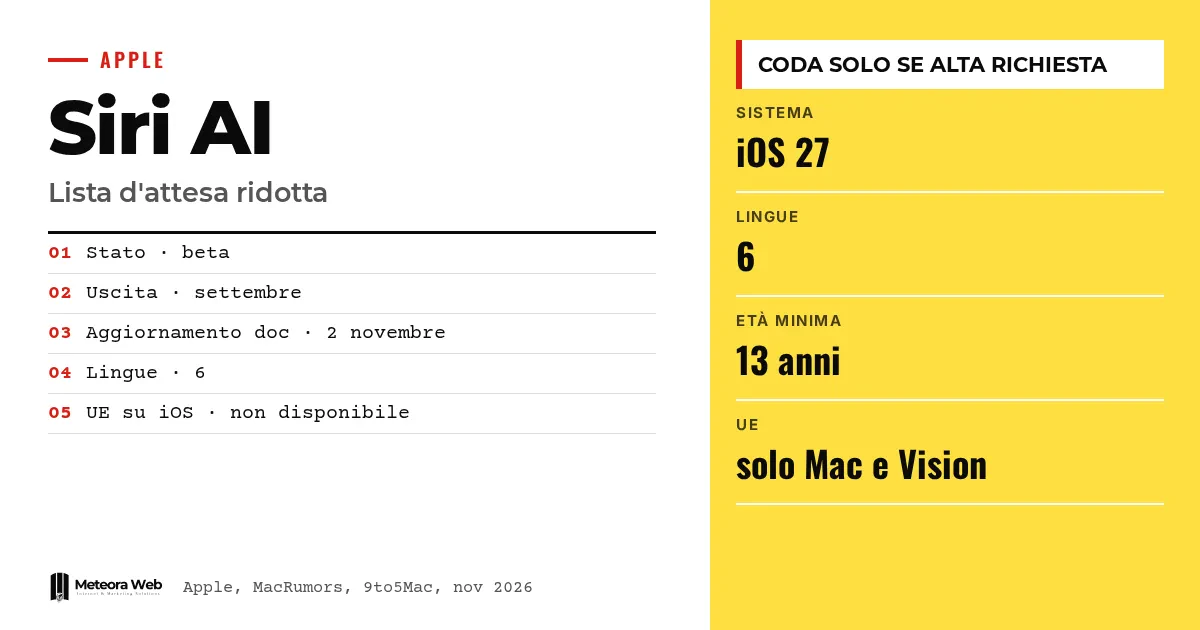
Apple has updated the support document for Siri AI, the beta assistant released in September with iOS 27. The waitlist is no longer the rule, but it still applies "during periods of high demand". The text was changed on November 2, after about two months of rollout. For anyone who wants to try the assistant, the change matters, because activation becomes faster. There are still restrictions on devices, languages and the European Union.
A few terms before we get into the facts. Siri AI is the new version of Siri based on the next generation of Apple Intelligence, currently in beta. Waitlist is the queue you join before receiving access. Server-side models are AI models that run on Apple's servers rather than on the device. AFM Core Advanced is the local model required for expressive voices. Beta refers to a version still being tested.
What changed in Siri AI's waitlist?
According to the Apple support document, after activation Siri AI "will start downloading automatically". Only during periods of strong demand can you end up in a queue, with variable wait times.
As reported by 9to5Mac, the earlier version said activation would add the user to a waitlist. The download started once the queue was cleared. Now the order is reversed.
MacRumors speculates that the update came after two months of testing server load. This is the outlet's reading, not an Apple statement.
How do you activate Siri AI on iPhone?
After the update, go to Settings, tap Siri and then "Try Siri AI (Beta)". If Siri is turned off, it needs to be enabled first.
The system guides you through choosing a voice, recording your voice and reviewing privacy settings. Then the download starts.
The device language and Siri's language must match and be supported. The Apple Account region must also be eligible. Users under 13 cannot use the service.
Which devices and languages does Siri AI support?
Apple lists requirements for each platform.
- iOS 27 on iPhone 15 Pro and later, iPhone 16 and later, iPhone Duo and iPhone Air.
- iPadOS 27 on iPad mini (A17 Pro) and iPad with M1 or later.
- macOS 27 Golden Gate on MacBook Neo (A18 Pro) and Mac with M1 or later.
- watchOS 27 on Apple Watch Series 9 and later, Ultra 2 and later, SE 3, paired with an eligible iPhone.
- visionOS 27 on any Apple Vision Pro.
Languages are English, French, Japanese, Korean, Portuguese and Spanish. Italian is not on the list. Expressive voices, English only, require more powerful hardware, with at least 12 GB of unified memory on iPad and Mac.
What can Siri AI do, and why is it not available across the EU?
Apple lists general knowledge, understanding of personal context across Messages, Mail, Calendar, Notes and Reminders, and awareness of what is on screen. It adds actions across apps, writing assistance, Visual Intelligence and a Siri app with history synced via iCloud. Developers looking for the overview can read how Siri AI opens to developers with iOS 27.3.
In the European Union Siri AI is not available on iOS, iPadOS and watchOS. It is available on macOS 27 and visionOS 27, if the account region is in the EU and the languages match. The document does not explain why. In mainland China the service does not work.
Limits to know
The sources do not say what Apple means by "high demand", nor how long the waits last. There is no timetable for Siri AI's arrival on iOS in Europe or for Italian. The link between the text change and server testing is MacRumors' hypothesis. Daily usage thresholds remain undefined, because Apple only mentions factors such as request complexity and system demand.
What changes for those working in digital
For those who develop and manage apps on the Apple ecosystem, an AI feature that activates without a queue is easier to test and to demonstrate to clients. But the exclusion of the EU on iPhone and iPad weighs on projects aimed at Italian audiences. If you work on iOS and Android apps, don't assume Siri AI will be present on your users' devices. Apple also writes that server-based features have daily limits and that extended access will be paid in the future. It is worth factoring this into your product plans.
Our take
The move makes sense, but it says more about logistics than about maturity. Removing the queue shows that server capacity holds up, not that the assistant is finished, since it remains in beta. The real weak point is elsewhere. For an Italian user the news changes little, between unsupported languages and limited European availability. The announcement of paid extended access, without prices, also weighs in. Apple treats AI as a service with usage caps, and it is worth saying so clearly to clients and teams.
Frequently asked questions
Does Siri AI still have a waitlist?
Only partly. According to Apple, the waitlist can kick in during periods of high demand. Otherwise the download starts automatically after activation.
When did the support document change?
On November 2, according to MacRumors. The news was picked up by 9to5Mac on November 4, when the iOS 27 rollout had lasted almost two months.
Does Siri AI work in Italy?
It is unclear for Italian. Supported languages are English, French, Japanese, Korean, Portuguese and Spanish. It is missing in the EU on iOS, iPadOS and watchOS, but available on macOS and visionOS.
Do I need a recent iPhone?
Yes. Apple requires a device compatible with Apple Intelligence, such as iPhone 15 Pro and later or iPhone 16 and later. Expressive voices require even more powerful hardware.
Will Siri AI be free?
For now there are daily limits on server-based features. Apple writes that extended access will be available for a fee in the future, without indicating prices.
What to watch for Siri AI in the coming months
The end of the queue is a first step. To understand where Siri AI is headed, it is worth watching availability, usage limits and costs.
- Check whether Apple adds Italian to the list of supported languages.
- Follow any news on EU availability of iOS and iPadOS, currently excluded.
- Keep an eye on daily limits and the announcement of paid extended access.