Ing. Pietro Maiorana
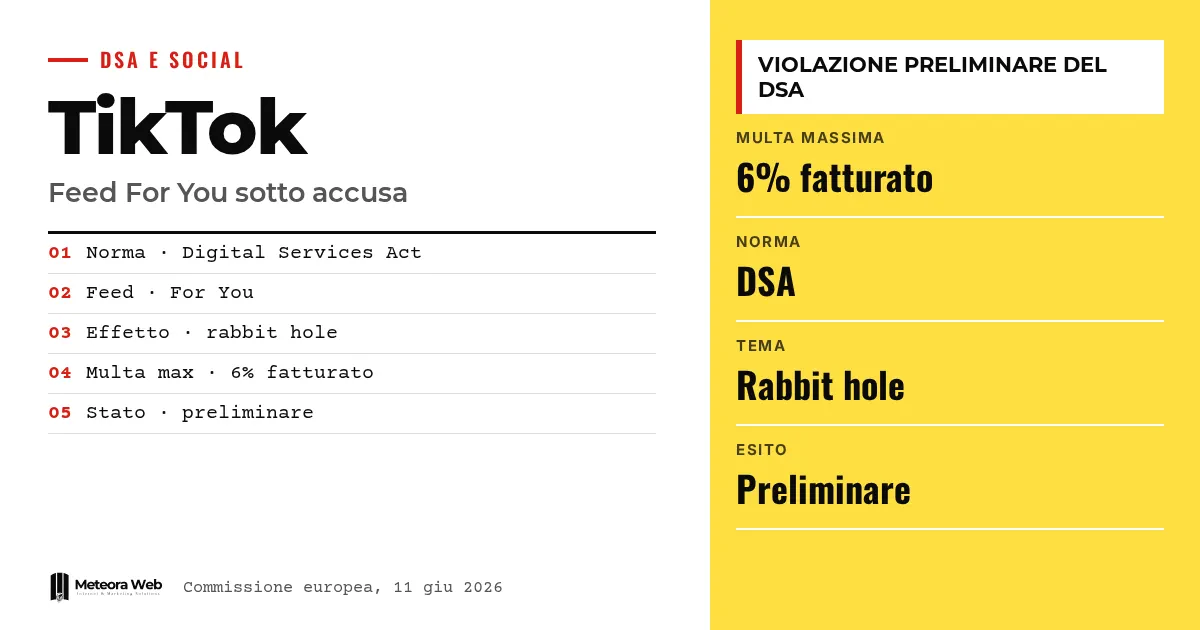
The European Commission has preliminarily found that TikTok breaches the Digital Services Act (DSA) with its «For You» feed. The target is the so-called «rabbit hole» effect, the continuous flow of personalised videos that can pull users towards content linked to sadness, isolation or body image. According to the reports, it is the first time Brussels has cited a recommendation algorithm as the ground for a breach. It matters to anyone who runs platforms and to anyone who works on social media.
A few terms before we get into the facts. DSA is the Digital Services Act, the European regulation that makes platforms responsible for their impact on users. Recommender system is the algorithm that chooses which content you see. Rabbit hole refers to the spiral of similar content that is hard to escape. Preliminary finding is an initial challenge, not a final penalty. Mitigation means the measures a platform takes to reduce the risks it has identified.
What is the Commission challenging TikTok for?
According to the European Commission, the «For You» feed shows a continuous flow of personalised videos, including when they concern mental health difficulties and body image. The more a user engages with one type of content, the more the algorithm proposes similar ones.
For the Commission, this design can be harmful when exposure is endless and repeated. The mental health effects would concern vulnerable adults and minors in particular.
Which DSA obligations does the finding focus on?
The preliminary conclusions cover two areas. The first is risk assessment, meaning the analysis a platform must carry out on the harms its service may cause. The second is mitigation measures, meaning what is done to reduce them.
The official text does not go into the details of individual articles. It refers to the full press release for the details, which is not among the sources we were able to read.
What did Henna Virkkunen say?
The Executive Vice-President of the Commission for Tech Sovereignty, Security and Democracy commented on the decision. According to The Verge, Henna Virkkunen says that «every time a user scrolls or likes a video, the algorithm proposes others like it, leading users into rabbit holes they cannot easily escape».
She adds that the preliminary conclusions once again show that TikTok must do more to protect user wellbeing, including that of minors.
What is at stake for TikTok?
According to The Verge, TikTok has introduced controls to soften the effect, but the Commission preliminarily believes they are not effective. The platform will have to change the design of the feed, or it risks fines of up to 6% of annual global turnover.
The news comes months after another challenge, in which the Commission described TikTok's design as too «addictive». Meanwhile, in the United States the company faces pressure and lawsuits over the safety of minors. A related case is Meta, Google and TikTok against California.
Limits to know
This is a preliminary finding. In the sources we have, TikTok has not yet fully exercised its right of reply, and we do not know how it will respond or when. The size of any possible fine is not known, nor what changes to the feed Brussels will request. The full press release, with the legal details, is not among the sources we consulted. Even the effectiveness of TikTok's controls is, for now, the Commission's assessment.
What changes for those working in digital
If you work with social media, the signal is that recommendation algorithms are coming within the scope of legal liability. Anyone planning campaigns or content on TikTok should expect possible changes in how videos are distributed. Anyone building apps or platforms with personalised feeds would do well to document how they assess risks to vulnerable users. The logic echoes the EU AI Act, which calls for risk analysis. For work spanning several channels, as in multi-channel publishing, it is wise not to depend on a single channel.
Our take
The challenge has merit. It shifts the debate from individual pieces of content to how they are distributed, which is where the platform really has control. The practical knot remains. How do you measure a «rabbit hole», and how much personalisation is too much? Clear criteria are needed, otherwise the risk is a rule applied case by case. It also matters that the controls TikTok has already introduced are judged ineffective without public data. Here, transparency is needed from both sides.
Frequently asked questions
Has TikTok already been fined by the EU over the For You feed?
No, for now there is only a preliminary finding. The Commission believes the feed breaches the DSA, but it has not yet imposed a penalty. Possible fines can reach up to 6% of annual global turnover.
What is the rabbit hole effect?
It is the spiral in which the algorithm keeps suggesting content similar to what you interact with. According to the Commission, when the themes are sadness, isolation or body image, continuous exposure can harm mental health.
Is this the first time the EU challenges a recommendation algorithm?
Yes, according to reports from Politico and picked up by The Verge. It is the first time the Commission has cited a recommender system as the ground for a DSA breach. Other companies, including X, Meta, Temu and AliExpress, had previously been in its sights.
Who is most exposed, according to the Commission?
Vulnerable adults and minors. The Commission argues that repeated content on sadness, isolation and body image can have a negative impact especially on these people.
Must TikTok change the feed?
Yes, if the challenge is confirmed. According to The Verge, the platform must modify the design of the For You feed or risk fines. The timing and content of the changes are not specified in the sources.
TikTok's and Brussels' next moves on the feed
Now it is up to TikTok's reply and the Commission's final decision. The issue is not limited to one platform.
- Watch whether TikTok announces concrete changes to the For You feed and whether the Commission deems them sufficient.
- Check whether other platforms receive similar challenges over their recommender systems.
- Review how your products with personalised feeds treat minor users, also in light of rules like OpenAI's for minors.