Ing. Calogero Bono
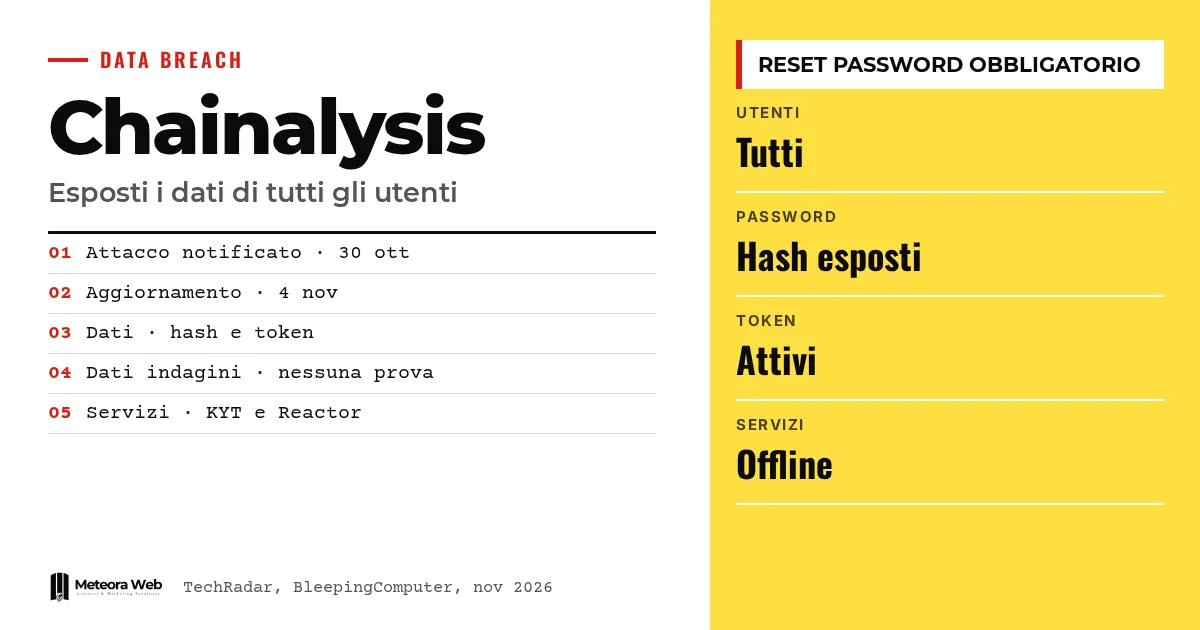
Chainalysis, the blockchain analysis firm used by law enforcement agencies and crypto companies, has admitted that the attack it suffered at the end of October 2026 exposed data of all its users. The exposed data includes names, usernames, password hashes and active tokens. The first statement spoke of limited impact, then the updates changed the picture. It matters because the company provides investigation tools to institutions and businesses, and because the attack appears to be part of a broader wave.
A few terms before we get into the facts. Password hash is the transformed version of a password, which does not show it in plain text but can still be attacked. Active token is a code that keeps a session open or authorizes access. On-path attack (or MITM) is an attack in which someone inserts themselves into the data path. Allowlist is the list of authorized IP addresses. Agentic techniques refers to AI tools that operate autonomously.
What happened at Chainalysis, day by day?
According to TechRadar, on October 30, 2026 the company reported being the target of an attack, "similar to many other tech platforms in recent weeks" and unconnected to the recent crypto theft involving Binance.
Initially, only non-sensitive data appeared to have been accessed. On November 4 came confirmation that an "on-path attack" had exposed part of customers' passwords. Then, as BleepingComputer reports, the company discovered that the data of all users had been exposed.
Which data was exposed?
The first statement listed user IDs, full names, email addresses and role labels. In Wednesday's update the company wrote that "names, usernames, password hashes and active tokens of all Chainalysis users" were exposed to a malicious party.
Chainalysis states it has no evidence of access to investigation data or of tampering with attribution data. This is the company's own statement, not an independent verification. The original source says that plain-text passwords and MFA secrets were not compromised in the initial phase.
Which services were shut down and how do you get back in?
The company took Reactor, Data Solutions and Chain (Beta) offline, then the KYT interface and API, other address-screening products and the login page, due to "unusual activity". The affected accounts were locked.
To regain access, customers must contact support or their account contact with trusted IP addresses, to be entered in an allowlist. They will then need to reset their password and rotate their API keys. Restoration of KYT and Address Screening has started partially, while Reactor and Data Solutions remain to be brought back online.
Why does the attack fit into a wave of AI-driven attacks?
Chainalysis refers to "offensive agentic techniques". The Hacker News notes that Chainstack, OpenCode, Warp and WorkOS have also reported AI-driven attacks, some using the ARTEX tool. According to Microsoft, actors use an AI framework to search public GitHub repositories for secrets.
It has not been shown that the Chainalysis attack is linked to this campaign. The source only says that who is behind it is unclear. In the same weeks Binance reported a theft of about $6.34 billion attributed to North Korean hackers.
Limits to know
Many elements are still missing. No group has claimed the attack, and the data has not reportedly appeared on the dark web, but we do not know whether an extortion attempt will follow. The real extent of the access and the recovery time for Reactor and Data Solutions are uncertain. The absence of evidence that investigation data was accessed is a statement from the company and could change as the inquiry progresses.
What changes for those who work in digital
If you use third-party analysis services or APIs, this case shows that a provider can block you for days. Keep a plan to work without the tool. Hashes are not plain-text passwords, but if they were poorly chosen they can be cracked, which is why it matters how you protect them in your own systems, for example with Bcrypt and Argon2. Chainalysis recommends changing passwords reused on other systems. The same applies after the mSecure breach. Rotate your API keys too.
Our take
The piecemeal communication is the weak point. Saying first that the damage was limited and then that it affected all users costs trust, especially for a company that sells reliability to investigators. It remains commendable that it cut off access and mandated resets and key rotation, even at the cost of interrupting service. The real issue, however, is the speed of AI-agent attacks. Response times that were sufficient until yesterday risk no longer being enough.
Frequently asked questions
Did Chainalysis lose passwords in plain text?
No, according to the sources, hashes were exposed, not plain-text passwords. Hashes can still be attacked, so the reset is mandatory.
Were all customers affected?
Yes, according to Chainalysis's update, names, usernames, password hashes and active tokens of all users were exposed. Initially the impact was described as limited.
Is investigation data safe?
Chainalysis states it has no evidence of access to investigation data or of tampering with attribution data. This is the company's own statement, and the inquiry continues.
How do you regain access?
You must send your trusted IP addresses to support or your account contact for the allowlist. Then you reset your password and rotate your API keys.
Is the attack linked to the Binance one?
According to Chainalysis, no, the attack is "unrelated" to the recent theft involving Binance. The company describes it as similar to attacks suffered by other tech platforms.
What to watch in the coming weeks on Chainalysis
The investigation is open and the picture has changed several times in a few days. It is worth following a few specific signals.
- Check whether Chainalysis updates its assessment of investigation data and attribution.
- Watch for claims or data for sale, a sign of possible extortion.
- Follow Microsoft and Google advisories on AI-agent campaigns, and read how DreamHost handled a similar case.
Sources
- techradar.com, Chainalysis admits all users affected in major data breach — names, usernames, password hashes, and live tokens all exposed
- bleepingcomputer.com, Chainalysis says breach exposed credentials for all customers
- thehackernews.com, Chainalysis Breach Exposes All Users' Credentials, Forces Shutdown of Key Services