 Ing. Calogero Bono
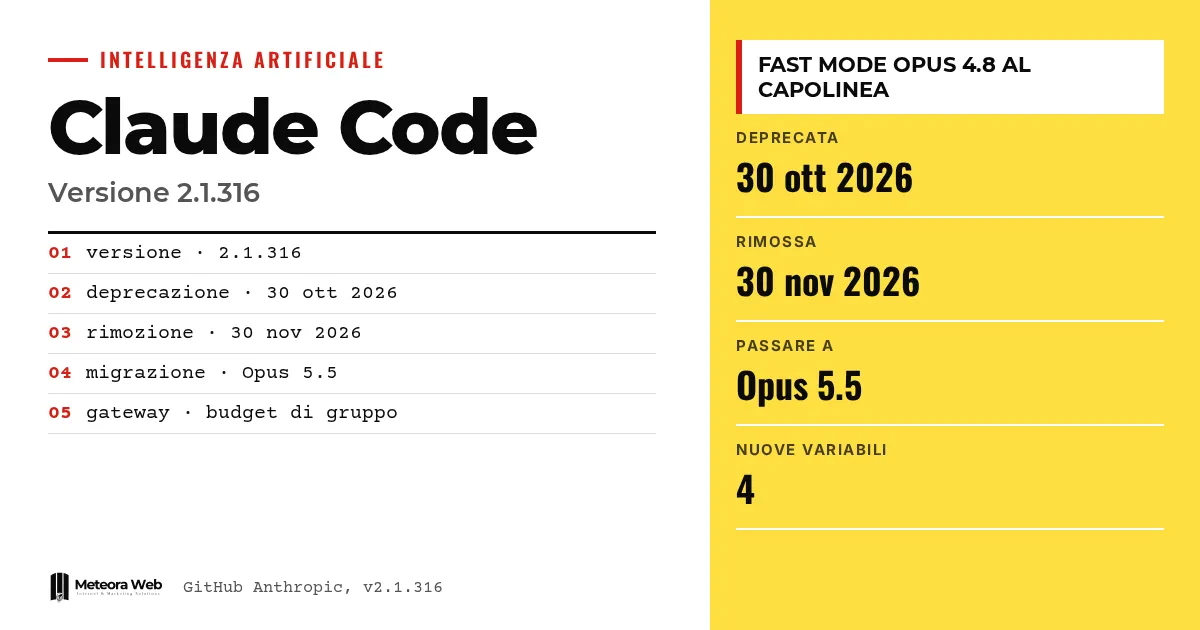
Anthropic has published version 2.1.316 of Claude Code on GitHub. The change that matters most is the deprecation of fast mode for Opus 4.8, scheduled from October 30, 2026 and removed on November 30, 2026. The release also brings shared budgets and layered policies for the Claude apps gateway, plus a long list of fixes. It matters for anyone using the tool in teams or companies, where costs and permissions need to be governed.
A few terms, before we get into the facts. Fast mode is a mode that speeds up a model's responses. Claude apps gateway is the central point an organization uses to route and control access to tools. Subagent is a secondary agent that works on behalf of the main session. Guardrail is a filter that blocks dangerous requests or attempts to manipulate the model. MCP is the protocol through which external servers offer tools to the agent.
What happens to Opus 4.8 fast mode?
According to the official release notes, fast mode for Opus 4.8 is deprecated from October 30, 2026 and will be removed on November 30, 2026.
After removal, fast mode requests on Opus 4.8 return an error. There is no automatic fallback to standard Opus 4.8. To keep the speedup, Anthropic recommends switching to Opus 5.5.
If you have scripts or configurations that force fast mode, you should check them before the deadline, because the failure will be explicit and not silent.
What is new for the Claude apps gateway?
The gateway receives the changes most oriented to organizations. Shared group budgets arrive. This is a single monthly budget that group members split, in addition to the individual limit, set with pooled_budget in the spend limits administration API.
With managed.policy_mode set to layered, all policies that match a developer apply, each stacked on top of those listed below, and not just the first one.
On Bedrock upstreams, guardrail.input_tagging arrives, which wraps prompts in the tags required by Amazon Bedrock's prompt attack filter.
For Team and Enterprise plans, the handling of central settings also changes. Those downloaded from Anthropic's APIs now apply without asking for confirmation, and a saved copy that fails verification is rejected.
Which environment variables were added?
There are three new variables.
- CLAUDE_CODE_DISABLE_ULTRATHINK disables the ultrathink keyword.
- CLAUDE_CODE_SUBAGENT_EFFORT fixes the effort level of subagents when nothing else specifies it, instead of inheriting it from the session.
- CLAUDE_CODE_DISABLE_LOOPED_CROSS_CERT_DROP keeps system certificates that certify each other in a loop, for servers whose private CA needs them.
Linked to ultrathink is a novelty for VS Code, where the word now runs the turn at xhigh effort and appears in rainbow colors in the chat, as in the terminal.
Which bugs were fixed?
The list is long. On the security side, --restricted sessions no longer send files taken from outside the working folders when a read rule covered them. This follows the block on writes outside the folder introduced with version 2.1.314. The gateway now checks every model cited in a request against availableModels, deniedModels and models, and responds with a 400 error that names the field.
On macOS and Linux, shell commands no longer stay active when Claude Code exits on its own. Also fixed are bash aliases with line breaks, scripts that stopped after the first command with an exported SHELLOPTS, and PowerShell hooks that did not block with exit code 2.
Finally, messages for SSL certificate errors have been improved and now indicate likely causes, such as a missing intermediate certificate.
Limits to know
The release notes are a list of changes, not complete documentation. They do not explain why Opus 4.8 is losing fast mode, nor do they detail Opus 5.5 pricing. There are no independent measurements of the effect of the fixes. Some changes, such as server-managed settings, only apply to Team and Enterprise plans, and actual behavior may vary by environment.
What changes for people working in digital
If your team uses Opus 4.8 in fast mode, you have until November 30, 2026 to migrate. After that date, requests fail. If you manage a company gateway, group budgets and layered policies make it easier to control costs and permissions. Anyone working with servers behind a private CA will find the new variable for certificates.
Our take
A deprecation with a one-month gap between notice and removal is reasonable, but the suggestion to switch to a newer model carries an implicit cost that the notes do not quantify. We appreciate that the error is explicit, with no silent fallback, because it avoids surprise costs or latency. The rest of the release confirms a clear direction – tools designed to be governed by IT. The question of trust in the tools that run alongside the agent remains, as the case of a trojanized extension shows.
Frequently asked questions
When does Opus 4.8 fast mode go away?
On November 30, 2026. The deprecation starts on October 30, 2026. After removal, fast mode requests on Opus 4.8 return an error.
What should I replace Opus 4.8 fast mode with?
With Opus 5.5, according to the official notes. Anthropic recommends migrating to keep the speedup. There is no automatic fallback.
What is the gateway group budget?
It is a monthly budget shared by the members of a group. It adds to each person's individual limit. It is set with pooled_budget in the spend limits administration API.
How do I disable ultrathink?
With the CLAUDE_CODE_DISABLE_ULTRATHINK variable. Once set, the ultrathink keyword is disabled.
Are restricted sessions safer?
Yes, on one specific point. They no longer send files taken from outside the working folders when a read rule covered them. It is still worth checking permissions anyway.
What to check before November 30, 2026
The fast mode deadline is the date to mark. In the meantime, it is worth checking how the gateway will apply the new rules.
- Search your scripts and configurations for any use of fast mode on Opus 4.8 and test the migration to Opus 5.5.
- Read the upcoming releases to see whether the deprecation changes dates or conditions.
- Test shared budgets and layered policies on a pilot group before rolling them out further.