Ing. Calogero Bono
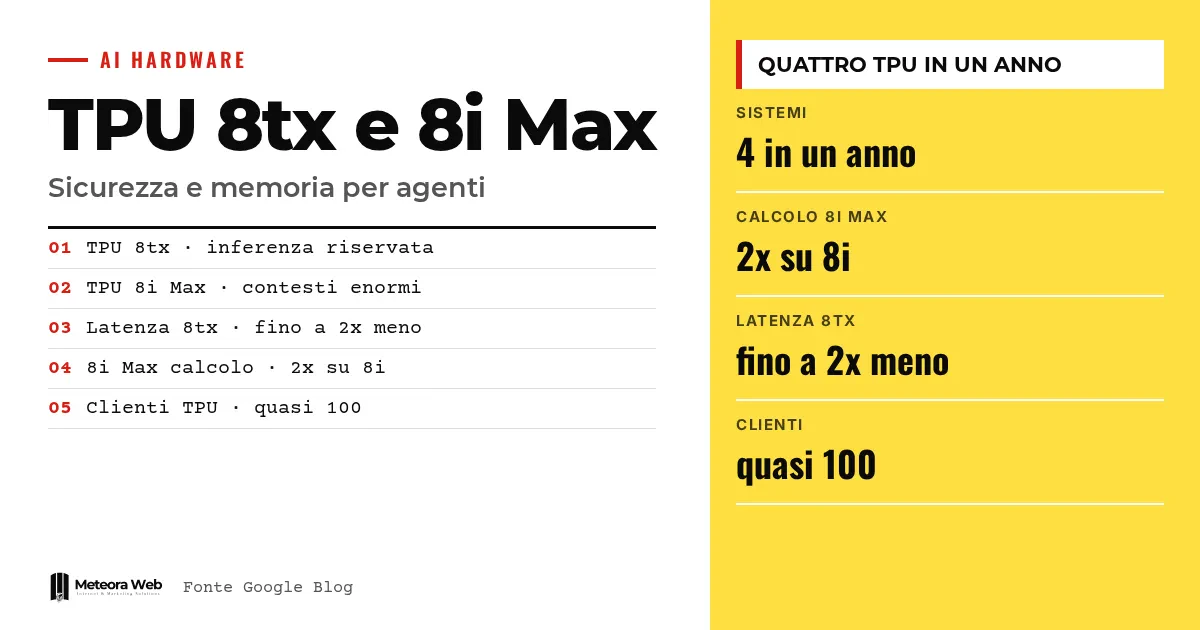
Google has unveiled TPU 8tx and TPU 8i Max, two new systems that complete its eighth-generation family of accelerators. They join TPU 8t and 8i, shown in April during Cloud Next. According to Google, it is the first time it has introduced four TPU systems in a single year. The target is AI agents, which handle more data and work through more steps, and companies that demand stronger protection for sensitive data.
A few terms before we get into the facts. TPU is the processor Google designs for artificial intelligence. Inference is the phase in which an already trained model responds to requests. Context window is the amount of text a model can consider at once. Confidential computing protects data even while it is being processed in memory. HBM and SRAM are types of fast memory located close to the chip.
What did Google present?
In the official Google post the newcomers are two systems. TPU 8tx is designed for secure and private inference, and is also suited to small-scale training. TPU 8i Max is instead designed for very large context windows and for maximum compute density per rack.
In April, TPU 8t had arrived for large-scale training, and TPU 8i for real-time reasoning. Google claims up to 2.7 times more performance in training and 80% better price-performance in inference compared with the previous generation. The news was also covered by HDblog.
How does TPU 8tx work and who is it for?
Data is usually encrypted when stored or travelling over networks, but it must be decrypted in memory during processing. Google explains that TPU 8tx brings protection to the hardware layer, so sensitive data and model weights remain isolated even in use. It uses the same silicon as TPU 8t, paired with hosts featuring fifth-generation AMD EPYC CPUs.
It also adopts the low-latency Boardfly network of TPU 8i. For Google, latency drops up to 2 times compared with TPU 8t, with almost no performance penalty. The target is regulated companies and governments.
On the same system you can train and customize, for example fine-tuning on private data, without moving data between different clusters.
What is TPU 8i Max and what problem does it solve?
Google ties it to the so-called memory wall problem. When dozens of agents work together on an entire source code base or on hours of video, memory bandwidth becomes the bottleneck. The declared solution is to join two TPU 8i chips in a single package.
The result, again according to Google, is double the compute, SRAM and HBM bandwidth compared with TPU 8i. Since twice the silicon fits in the same rack, data centers can host more power per square metre and per watt. The infrastructure theme is the same as the Crusoe data center in Wyoming acquired by Google.
What changes for developers?
Google insists on accessibility. Last month it released TorchTPU as open source, so PyTorch code and Hugging Face models run natively on TPUs without rewriting the code. There are backends for inference engines such as vLLM and SGLang.
A TPU agent suite, in preview, connects to tools such as Claude Code, Cursor and Google Antigravity to automate setup and diagnose bottlenecks. An open source XLA Serving Engine lets you train in Python and serve in a C++ runtime on TPUs, GPUs and CPUs.
On the InferenceX and AgentX benchmarks Google claims state-of-the-art price-performance with its vLLM-TorchTPU stack. These are figures declared by the company. Developers working with models can start from our Gemini API guide.
Limits to know
The figures on performance, latency and price-performance are Google's own claims, with no independent verification. The sources we have contain no prices, regional availability or release dates for the two new systems. The official text we received is truncated, so some parts, such as how idle agents are managed, cannot be assessed. The promised software updates could change the results.
What changes for those working in digital
For almost all Italian companies nothing changes immediately, because TPUs are used through Google's cloud. The signal concerns those handling sensitive data, for example in healthcare or finance. Inference protected even in memory can make it easier to bring an agent onto confidential data. Developers working with PyTorch get a shorter path to try these machines without rewriting their code. It is still worth comparing real costs with those of GPUs. If you already use Google's Gemini line, these machines are the base it runs on.
Our take
The move is consistent. Google is not only chasing the fastest chip, it sells systems tailored to each phase of the work. Confidentiality in use is a strong argument, because it holds back many companies from entrusting data to agents. It remains, however, a closed ecosystem, with advantages that depend on Google's numbers. Before getting excited, we need independent prices and tests. The regulatory front should also be followed, as our guide to the AI Act for developers reminds us.
Frequently asked questions
What is the difference between TPU 8tx and TPU 8t?
TPU 8tx uses the same silicon as TPU 8t, but is optimized for private inference. It has the low-latency network of TPU 8i and hardware protection for data in use. TPU 8t remains the system for large-scale training.
What does TPU 8i Max add compared to TPU 8i?
It doubles the resources. According to Google, it combines two TPU 8i chips in one package, with double compute, double SRAM and double HBM bandwidth. It is meant for very large contexts.
Can I use TPUs with my PyTorch code?
Yes, according to Google. TorchTPU is open source and runs PyTorch code and Hugging Face models natively on TPUs, without rewriting the code.
How many TPUs has Google presented this year?
Four eighth-generation systems. They are TPU 8t and 8i, shown in April, plus TPU 8tx and 8i Max. Google says this had never happened in a single year.
How many customers use TPUs?
Nearly 100, according to Google. They include frontier labs, trading firms, resellers and universities.
Prices, independent tests and sensitive data, what to watch in the coming months
The value of these systems will show up beyond the press releases. Availability, costs and external verification are what matter.
- Check when and where TPU 8tx and 8i Max become available in the cloud and at what price.
- Look for independent tests of the InferenceX and AgentX benchmarks, not just Google's data.
- If you handle confidential data, evaluate with your advisor which confidential computing guarantees you really need.