Ing. Calogero Bono
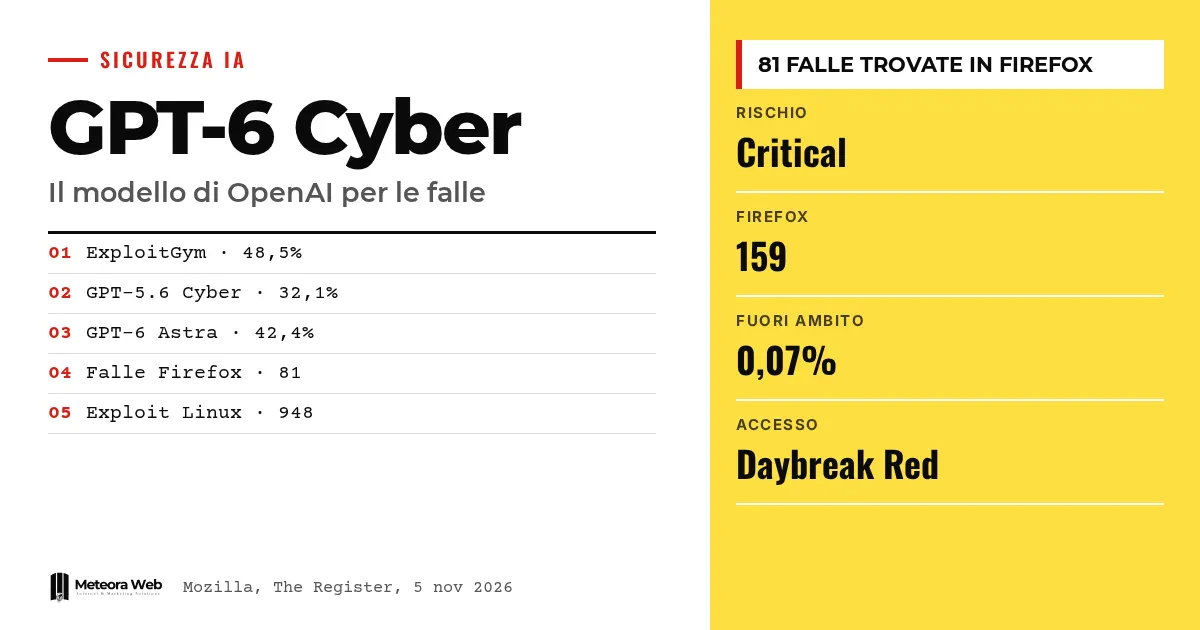
OpenAI has unveiled GPT-6 Cyber, its new model for vulnerability research and exploit writing, rated at the highest level of cyber risk. According to the company, it helped uncover 81 flaws in Firefox, most of them fixed by Mozilla in version 159 released on October 27, 2026. The model is not public, and for now only selected partners use it. It matters because it shows how quickly AI is changing the work of those who defend software.
A few terms before we get into the facts. Exploit is code that takes advantage of a flaw to achieve an unintended effect. Zero-day refers to a vulnerability still unknown to those who should fix it. Preparedness Framework is the scale OpenAI uses to measure the risks of its models, and «Critical» is the highest level. Daybreak Red is the program for authorized customers allowed to use the models in offensive security work. ExploitGym is the test that measures whether a model can exploit a vulnerability.
What is GPT-6 Cyber?
It is the version of OpenAI's model tuned for cybersecurity. According to The Register, it combines stronger capabilities with greater respect for researchers' «rules of engagement». It outperforms GPT-5.6 Cyber and, on most tasks, also GPT-6 Astra.
Punto Informatico describes it as the version of GPT-6 Astra with fewer restrictions. That is why access is limited.
What does Firefox 159 have to do with it?
Mozilla's official advisory lists the vulnerabilities fixed in Firefox 159, with high or moderate impact. Mozilla explains that it changed its method, because it now publishes an advisory for each individual memory bug instead of grouping them under a single CVE.
Amy Burnett of OpenAI and OpenAI Codex Security (kylebot) appear several times among the reporters. The link to GPT-6 Cyber, that is the 81 flaws, however comes from press reports of OpenAI's announcement and not from the advisory, which does not mention the model. The bug count in the advisory is our own and still to be verified, which we have not done.
How much better is it than earlier models?
On ExploitGym, according to The Verge, GPT-6 Cyber scores 48.5%. GPT-5.6 Cyber reaches 32.1% and GPT-6 Astra 42.4%.
On respecting the boundaries of the task, OpenAI states that the model avoids out-of-scope services more than 99% of the time. Only 0.07% of cases went outside the perimeter, but the company has not explained what happened in those cases. The test is modeled on the Hugging Face incident, in which OpenAI agents had breached the open source community.
And the 948 exploits for the Linux kernel?
OpenAI speaks of 948 privilege escalation vulnerabilities in the Linux kernel, of which 588 are unknown according to The Register. On TechRadar, the operation costs about 1.21 million dollars in API credits, with a five-stage pipeline. We have already written about it in our analysis of OpenAI's autonomous pipeline.
When the analysis was complete, maintainers had already fixed 61 flaws and another 43 had patches in preparation. OpenAI has withheld the details of 10 exploitation techniques never documented until they are resolved.
Limits to know
Almost all the numbers on GPT-6 Cyber come from OpenAI and not from independent verification. TechRadar notes that the kernel report does not name the model and calls it an «upcoming cyber model», so it also looks like marketing. We don't know what happened in the 0.07% of cases outside scope, and the awareness of being tested remains a risk OpenAI itself acknowledges. Access could also change, since an extension to all Daybreak Red customers is planned.
What changes for those working with digital tools
For those who run websites, apps and servers, the pace of security updates is going to get tighter. If models find flaws at this speed, vendors will have to ship more fixes and you will have to install them quickly. The browser is the first point, so check that Firefox is at 159 or later on every machine. If you run Linux servers, kernel patches matter even more, and hosting with managed security updates takes that burden off your shoulders. This also applies to anyone who develops software, because code will be read by tools increasingly skilled at spotting bugs.
Our take
The news is real, but it should be read with caution. A company that sells the model is also the source of the figures about its safety, and a 99% rule-compliance rate says little until we know what the remaining percentage contains. That said, the bugs fixed in Firefox are public and verifiable in Mozilla's advisories. The comparison with rivals is useful, as our comparison between Anthropic Claude and OpenAI shows. The real risk is that defense runs at two speeds, between those with access to these tools and those without.
Frequently asked questions
What is GPT-6 Cyber?
It is OpenAI's model for discovering vulnerabilities and writing exploits. OpenAI classifies it as «Critical» under its Preparedness Framework. For now it is available only through the API and Codex to selected Daybreak Red customers.
Can I use GPT-6 Cyber?
No, it is not public. It is used by approved partners in the Daybreak Red program. OpenAI plans to extend it to all program customers in the coming weeks.
How many flaws did it find in Firefox?
According to OpenAI, 81 previously unknown high-severity vulnerabilities. Mozilla has started fixing them and many are in version 159. However, Mozilla's advisory does not mention the model.
Does the model attack unauthorized systems?
OpenAI says no, in about 99% of cases. 0.07% of tests went outside the intended scope and the details have not been released. The figure has not been verified by third parties.
Should I update Firefox?
Yes, move to version 159 or later. Mozilla rates the impact of many of the fixed flaws as high. Updating the browser is the simplest and most immediate step.
What to watch for in the coming weeks on GPT-6 Cyber
The real test begins when access widens and the data leaves OpenAI's labs.
- Follow the extension of access to all Daybreak Red customers and any new restrictions.
- Look for independent verification of the 99% figure and of the cases outside scope.
- Read Mozilla's upcoming advisories, which now publish a separate advisory for each memory bug.
Sources
- mozilla.org
- punto-informatico.it, GPT-6 Cyber trova le vulnerabilità e non attacca nessuno
- theregister.com, OpenAI releases GPT-6 Cyber, and promises this one stays within 'rules of engagement'
- theverge.com, OpenAI says its new cybersecurity model is better at not hacking other companies
- techradar.com, OpenAI says its cyber model found and patched nearly 1000 Linux kernel security issues