Ing. Calogero Bono
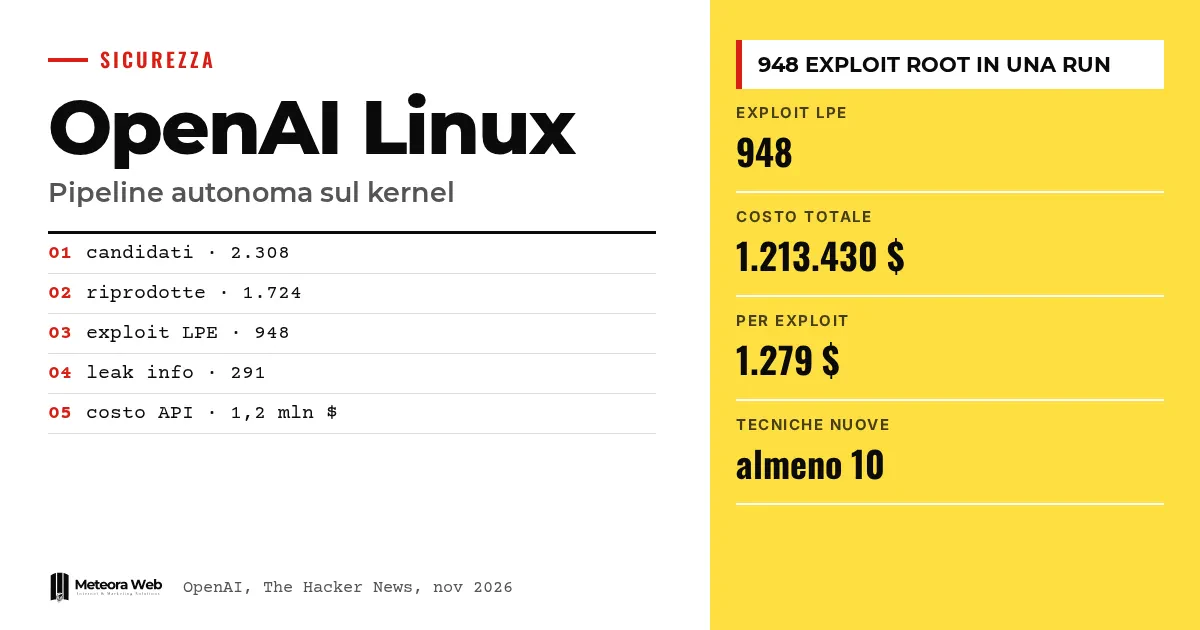
OpenAI has published details of an autonomous pipeline that searches for, validates and fixes flaws in the Linux kernel. In a single run in mid-October 2026, using a cyber model not yet released, it produced 948 working local privilege escalation exploits. The declared cost in API credits is $1.2 million. It matters because finding flaws is becoming an industrial process, and anyone running servers needs to update faster.
A few terms before we get into the facts. LPE (local privilege escalation) is the exploitation of a flaw that lets a user without privileges become root. PoC is a proof of concept, minimal code that demonstrates the problem. Exploit is the code that actually takes advantage of the flaw. Kernel is the core of the operating system. N-day is a vulnerability that is already known, while a zero-day is not yet.
What did OpenAI's pipeline do?
According to OpenAI, the prototype analyzed 2,308 candidates in the Linux kernel, dynamically reproduced 1,724 vulnerabilities and generated 948 LPE exploits. It also produced proofs of concept for 291 information leaks.
According to The Hacker News, the reproduction took place in 30 hours. The target was a common, unhardened desktop distribution, not a system deliberately weakened for the experiment.
How does it work, in five stages?
The pipeline has five stages, all handled by agents except the last one.
- Discovery, that is, identifying the security-relevant parts and searching for candidates.
- Dynamic validation in an isolated environment.
- Exploitation assessment.
- Patch generation.
- Human review, before reporting to the maintainers.
For each flaw the system delivers a root cause analysis, a minimal PoC, a candidate patch and a full exploit. The real bottleneck, OpenAI writes, was not finding flaws but understanding which were reproducible and urgent.
How much does it cost to find an exploit with AI?
OpenAI declares $1,213,430 in API credits, or $1,279 per exploit. The company itself warns that these are more of a ceiling, since better engineering could bring the spending down.
Comparing it with historical payouts from Pwn2Own and TyphoonPWN, $20,000 and $70,000, leads to a hypothetical valuation between $18.9 and $66.3 million. This is OpenAI's calculation, not actual revenue. On an adapted kernelCTF, with a reduced attack surface, the pipeline obtained 21 LPE exploits spending about $32,936.
What do other observers say?
According to the Google Threat Intelligence Group, cited by The Hacker News, the monthly count of disclosed vulnerabilities rose from 5,045 in January 2026 to 10,740 in August. High-risk ones rose from 131 to 350.
The British National Cyber Security Centre argues that AI tools have almost certainly increased zero-day discoveries and shortened the transition to N-days. Those who configure them badly, however, remain exposed. We also covered this in relation to GPT-Red.
Limits to know
The numbers are declared by OpenAI and the model is not yet public, so nobody can repeat the test. We do not know how many patches maintainers will accept, and the generated patches still require iteration with human experts. Costs depend on the models and configuration used.
What changes for those who work with digital systems
For those running servers, a low-privilege account on an unpatched system should be treated as root by an attacker with resources, OpenAI says. Patching can no longer wait until next month. If you do not want to deal with updates, hosting with managed security updates removes part of the problem. It is also worth isolating services with sandboxes, such as Firecracker and gVisor, which OpenAI mentions. To understand how an attacker thinks, see the privilege escalation techniques on Linux we use in our testing.
Our take
The most serious figure is not the number of exploits but the cost per exploit. At $1,279 each, finding a flaw costs less than many bug bounty payouts. It should be said that the text is also a showcase for OpenAI, and the comparison with bounties is a favorable estimate. It is nonetheless a clear signal, including for small businesses, as we wrote about the security of SMEs.
Frequently asked questions
How many exploits did OpenAI's pipeline generate?
948 working local privilege escalation exploits, plus PoCs for 291 information leaks. They were obtained in a mid-October 2026 run against a common Linux distribution.
How much did the run cost?
$1,213,430 in API credits, or $1,279 per exploit. OpenAI specifies that this is an upper limit and not an optimized cost.
Are the flaws already fixed?
Not all of them. OpenAI reports that within 10 days over 100 LPEs had been fixed or had patches being prepared by others, and about 300 were already discussed publicly.
Can an attacker use the same method?
In theory, yes. According to The Hacker News, access to these models is not limited to defenders. The model used by OpenAI, however, is not yet public.
What should I do?
Update your operating system regularly. Isolate the most exposed services and limit local accounts, because an ordinary user on an unpatched system can become root.
The next waves of patches will decide how long the risk window lasts
The question now is how quickly fixes reach systems in production. Watch these signals over the coming months.
- Follow the security advisories of your Linux distribution and measure how many days pass between patch release and installation.
- Check whether your provider publishes response times for kernel vulnerabilities.
- Read how the comparison between models on security evolves, starting with Claude and OpenAI.