 Ing. Calogero Bono
The iPhone Duo, Apple's first foldable, is out, and its first weeks have not been smooth. According to Punto Informatico, several users report a screen that cracks after just a few hours, and Samsung has answered with a tongue-in-cheek campaign. Reviews from DDay and Tom's Guide, meanwhile, describe a well-built device whose software still needs polishing. For app developers, that is precisely the point.
A few terms before we get into the facts. Foldable refers to a smartphone with a flexible screen that opens like a book. OLED is the screen technology in which every pixel emits its own light. IP68 is the certification for protection against dust and water immersion. Adaptive layouts are interfaces that change shape depending on the space available. Split View is the mode that places two apps side by side on the same screen.
Does the iPhone Duo screen really crack?
According to Punto Informatico, several users report that the foldable screen cracks after a few hours of use. The outlet also cites rumors that Apple may have loosened some quality controls to speed up production.
The conditional tense remains essential, however. The same source writes that the matter is still unclear, and Apple has provided no explanation that we have seen. We have already covered the topic in an article on inventory and broken screens.
How did Samsung respond?
On its Canadian Instagram profile Samsung wrote, translated from the original text, "Folding? We've been doing it for eight generations." Then came the invitation "Switch to the Galaxy Z Fold 8."
Samsung has reached its eighth generation with the Galaxy Z Fold 8 and Z Flip 8. Punto Informatico recalls, however, that in 2019 the first Galaxy Fold had screens that failed after just 24 hours, and this year the Galaxy Z Trifold drew attention for a faulty display. The provocation, in other words, does not come from a company without its own history.
What do the reviews say about the hardware?
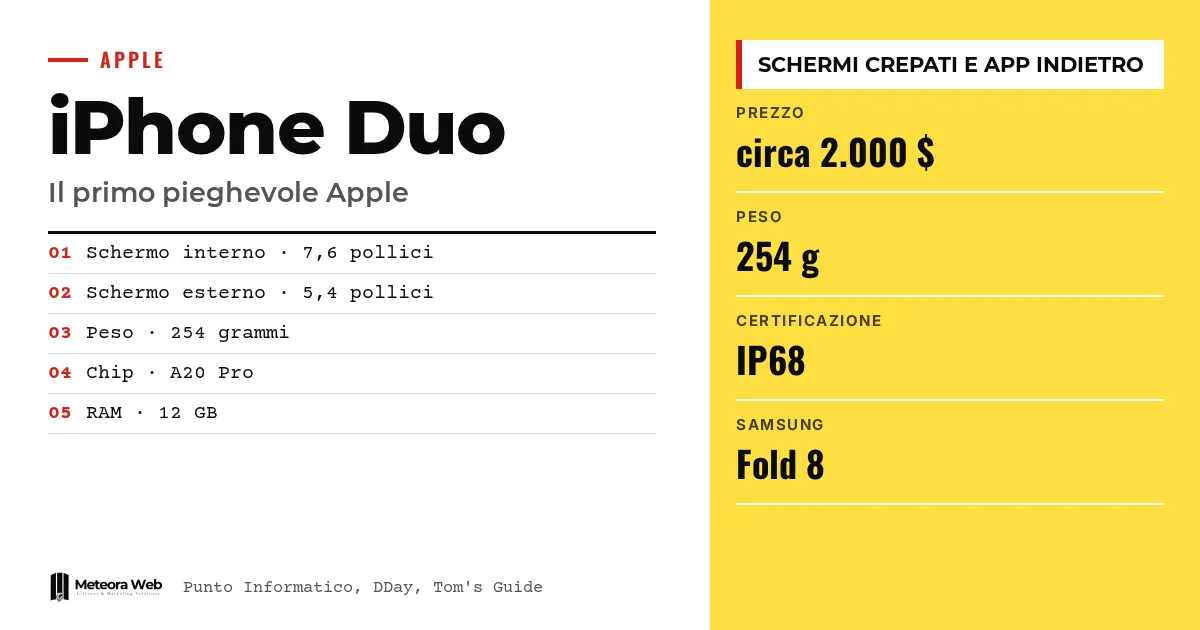
DDay speaks of a construction level that has no rivals. The Duo weighs 254 grams, five more than a 18 Pro Max, has a titanium frame, and is 5.2 mm thick open and 11.3 mm closed. The magnetic hinge is, according to the outlet, the smoothest among foldables.
The inner display measures 7.6 inches compared with the 6.9 of the 18 Pro Max, roughly 50% more surface area. Tom's Guide also cites 12 GB of RAM, an A20 Pro chip and a price that, in its test, is around 2,000 dollars.
The IP68 detail
DDay notes that the certification does not include opening and closing cycles during the dust test. For this reason it advises against the beach, especially since the warranty does not cover water or dust damage.
Why are apps the real weak point?
Tom's Guide writes that many apps are not optimized. Google Calendar and Google Drive have large black bars on the sides, Gmail does not offer the two-column layout of the Galaxy Z Fold 8, and LinkedIn is lagging too. YouTube and YouTube TV, by contrast, fill the entire screen.
For DDay, Apple has created an adaptive layout system and has in effect forced developers to adapt. Many have done so, many are late. The 5.4-inch front display shifts the dock and controls to the right, and according to Tom's Guide this takes space away from content. Moreover, when you rotate the phone the pair of apps in Split View disappears.
Limits to know
The reports of cracked screens come from users cited by a single outlet, with no numbers and no response from Apple. The hypothesis of loosened quality controls is a rumor. The reviews reflect two weeks or ten days of use, not durability over time. Even the iPhone Handoff feature, according to DDay, is not yet active in Italy.
What changes for those working in digital
If you develop apps, the Duo is a new format to test. Check that your interface holds up with black bars, controls shifted to the right and the switch between portrait and landscape. If you already have an app, having it updated for the new formats keeps it from looking neglected next to those already adapted. Anyone running a website should check how it looks on a nearly square screen. Note also that this foldable's design had been anticipated in one of our articles on Apple's first foldable.
Our take
Samsung's campaign is effective but not very credible as a lesson in reliability, given its track record with the 2019 Galaxy Fold and the Trifold. Apple's real problem, in our view, is not a possible manufacturing defect, which still has to be proven, but a software ecosystem that was not ready at launch. Asking developers to adapt has worked in other transitions, as DDay points out, but it weighs on those buying at 2,000 dollars. Waiting for the second generation is not unreasonable.
Frequently asked questions
Does the iPhone Duo screen really crack?
Some users report it, according to Punto Informatico. There is, however, no official data and no response from Apple, so the question remains open.
How much does the iPhone Duo weigh and how big is it?
It weighs 254 grams and measures 117.8 × 84.1 mm. Open, it has a 7.6-inch display, closed a 5.4-inch one, and according to DDay its thickness ranges from 5.2 to 11.3 mm.
How much does the iPhone Duo cost?
Tom's Guide puts it at around 2,000 dollars. The same outlet mentions trade-in offers of up to 1,200 dollars off in the United States.
Do apps work well on the iPhone Duo?
Only partly. Tom's Guide cites Google Calendar, Drive and LinkedIn as having problems, while YouTube and Instagram are optimized.
Should I wait for the iPhone Duo 2?
Not necessarily, writes Tom's Guide, which finds the Duo convincing. Its author, however, would wait for Apple and developers to fix the initial flaws.
What to watch for on the Duo in the coming months
The weeks ahead will show whether the cracks are an isolated case and how quickly apps will adapt.
- Follow any official communications from Apple about screens and warranty.
- Check which apps you use every day are receiving an update for the Duo.
- Verify whether iPhone Handoff arrives in Italy, since it changes how you use two phones.