Ing. Calogero Bono
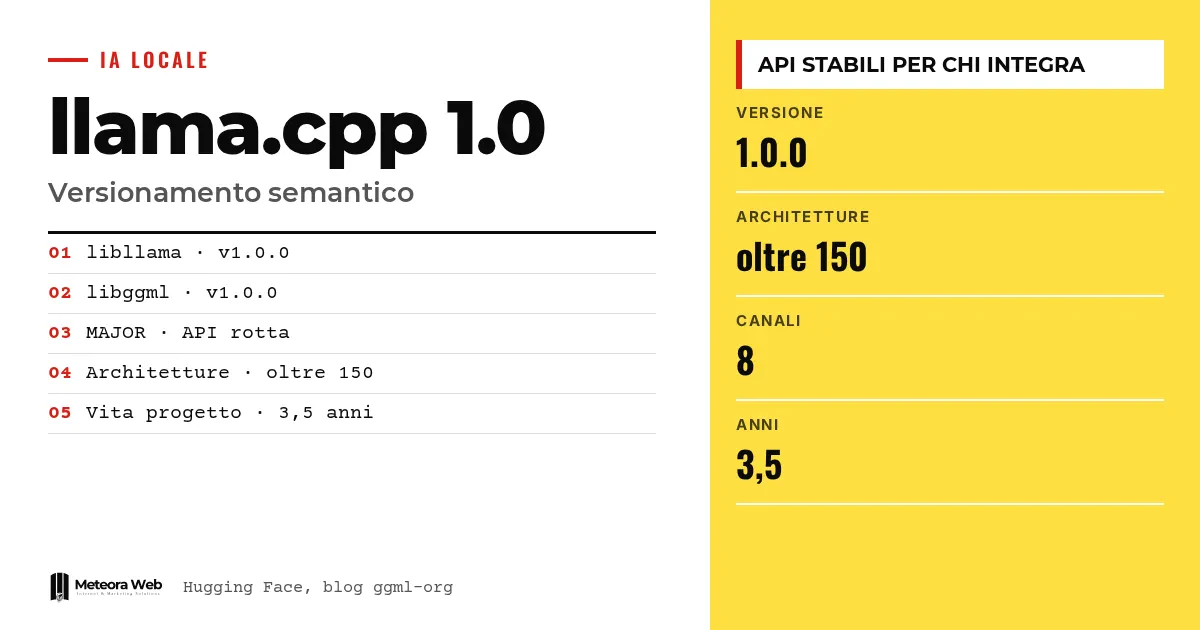
The ggml-org team, which now also works inside Hugging Face, has published version 1.0.0 of the llama.cpp and ggml libraries. After 3.5 years of the project, from now on API and ABI incompatibilities will be signaled with a major version bump. For anyone building local and private AI products on top of these libraries, it is a sign of stability, and a commitment not to change the rules without notice.
A few terms before we get into the facts. llama.cpp is a C/C++ library for running language models on your own hardware. ggml is the tensor library it is built on. API and ABI are the interfaces other programs use to work with the library, the first at the source code level, the second at the compiled binary level. Semantic versioning is the rule by which the version number tells you how risky an update is. A backend is the module that lets the software use a specific type of hardware.
What was released with version 1.0.0?
According to the official post on Hugging Face, two libraries were released. The first is libllama, with public headers in llama.cpp/include, the second is libggml, with headers in ggml/include.
The team explains that many applications already depend on its work and that every new integration means more developers tied to the library's interfaces. For this reason a flexible yet stable API is described as fundamental. The number 1.0.0 is meant to declare this responsibility.
How does the new semantic versioning work?
The rules apply to all ggml-org projects that use semantic versioning.
- MAJOR, an incompatible change to the public C API in ./include.
- MINOR, a backward-compatible feature, a backend update, support for a model or an addition to the API.
- PATCH, a bug fix with no API changes.
In practice, anyone integrating the library can read the number and understand whether an update risks breaking their code. The project states that, as adoption grows, it will be stricter in making these boundaries visible.
Where can llama.cpp be downloaded and on which platforms does it run?
The team says it wants to expand the ways the software is distributed. The listed channels are many.
- Pre-release artifacts for Linux, macOS, Windows, Android and iOS.
- Docker and Debian for Linux.
- Homebrew for macOS and Linux, conda-forge for Windows, macOS and Linux.
- MacPorts for macOS, Winget for Windows, XCFramework for iOS and macOS.
For ggml the project states the goal of running on any existing hardware, through dedicated backends. Each backend can be built as a dynamic library and loaded at runtime, optionally. If you use llama.cpp within a self-hosting setup, these packages simplify installation.
How does a project growing this fast guarantee quality?
The team writes that it is investing more and more resources in continuous integration infrastructure. Thanks to HF Buckets and HF Jobs it says it can scale the capacity needed to verify every change that lands on the master branches. With hardware support from NVIDIA, AMD, Qualcomm, Arm, IBM and Intel, it adds self-hosted runners on all the main platforms.
On the role of AI in development, the post speaks of a deliberate use of models. The priorities remain code quality, architectural control and understanding of implementation details. The project also supports more than 150 architecture variants and the main speculative decoding methods.
Limits to know
The post is a project announcement and includes no independent tests or performance measurements. It is not clear how often major version bumps will arrive, or how transition periods will be handled for those using earlier versions. We also do not know how the project concretely evaluates ABI compatibility between dynamically loaded backends. The full list of backends is deferred to an external link.
What changes for those working in digital
If you develop a product on top of llama.cpp, you now have a readable rule for deciding when to update. A MINOR or PATCH jump should be safe, while a MAJOR jump requires testing and code review. For companies evaluating local AI for privacy reasons, the availability of official packages on common channels reduces the build work. You still need to check open source compliance in the company, starting with the license, and it is wise to pin the version in your release pipelines.
Our take
A library with three and a half years of life and many users needed versioning rules, and doing so is a step of maturity. The number 1.0.0 however does not guarantee stability on its own; the discipline of the coming months will. The growing weight of Hugging Face and chip makers in the project's infrastructure also stands out. For open software this is useful, but it is worth watching how independent its technical choices remain. It is heading in the right direction, with a governance question mark.
Frequently asked questions
What is llama.cpp?
It is a C/C++ library for running multimodal language models on very different hardware, from personal computers to servers. It uses quantization and optimized backends.
What does the 1.0.0 version mean?
It means the project adopts semantic versioning. Incompatible changes to the API and ABI will be signaled with an increase in the major version number.
On which systems can it be installed?
On Linux, macOS, Windows, Android and iOS, through packages such as Docker, Debian, Homebrew, conda-forge, MacPorts, Winget and XCFramework. Some channels cover only certain platforms.
How many models does it support?
The post claims more than 150 architecture variants. It also mentions support for all the main speculative decoding methods.
Who supports the project?
The llama.cpp team works at Hugging Face and thanks maintainers and contributors. For testing it also uses hardware provided by NVIDIA, AMD, Qualcomm, Arm, IBM and Intel.
What to watch in the coming months around llama.cpp
Version 1.0.0 is a promise, and the facts will show how well it is kept. Three signals are worth watching.
- Check how often MAJOR releases arrive in the first months, to understand how stable the API really is.
- Verify whether packaging channels such as Debian and Winget update regularly and promptly.
- Follow the backend documentation for your hardware and test your use case before building a product on it.