Ing. Calogero Bono
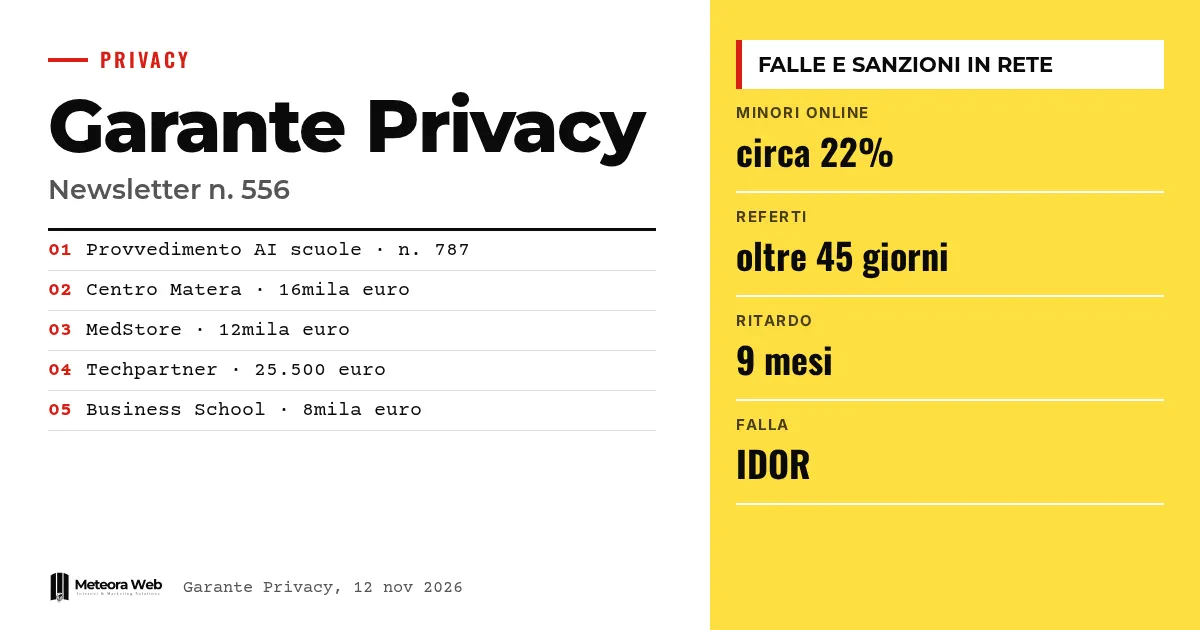
On November 12, 2026, the Italian Data Protection Authority, the Garante Privacy, published newsletter no. 556, with an opinion on AI in schools and four enforcement decisions. They range from minors' data left unredacted by the Ministry of Justice to a flaw in the medical reports of a radiology centre. It matters because many cases stem from technical and organisational mistakes that apply to any company, from email accounts to supplier management.
A few terms, before we get into the facts. IDOR is a flaw where simply changing a number in the web address lets you see other people's data. Pseudonymisation means replacing a name with a code, but the data remains personal. Data processor is whoever handles data on behalf of the controller, for example a hosting provider. RPO is the Italian Public Register of Opposition, which people join to stop receiving telemarketing calls.
What did the Garante ask on AI in schools?
With decision no. 787 of October 20, 2026 the Garante issued a favourable opinion, with observations, on the draft ministerial decree on AI in schools, as reported by Cybersecurity360. The draft provides for pseudonymised accounts for students and the separation between school identities and AI platforms.
The Garante asks the Ministry of Education to guide institutes' choices with requirements for suppliers, reference services and possible dedicated support. These are indications to be developed, not a list of certified products.
Is a random username enough to protect students?
No, according to Cybersecurity360's analysis. The content of a conversation can identify a person, because a question may include a diagnosis, a photo or a grade. For this reason the draft recalls information campaigns against entering personal data into generative systems.
The text also mentions the risk of indirect prompt injection, hidden instructions in a document that push the assistant off its task. Anyone wanting to go deeper will find the guide on jailbreaks and prompt injection useful. On the regulatory side there is also the EU AI Act.
How did the Matera radiology centre's reports end up online?
According to the Garante's newsletter, the report platform had an IDOR vulnerability. By editing the final numeric sequence of the address received by email, you could see the name, tax code, address and medical history of other patients, without authentication.
Fines of 16,000 euros were issued to Centro Radiologico Madonna della Bruna and 12,000 to MedStore Srl, responsible for hosting and maintenance. The company should have applied the patches. The reports also remained online beyond the 45 days allowed. The Garante reiterated that timely updates and supervision are legal obligations, a topic close to anyone managing hosting and servers.
What other fines are in the newsletter?
Techpartner
A total fine of 25,500 euros for the Modena company. It replied after nine months to a former employee's request, against the one month required, and kept former workers' emails active for months. The Garante reiterates that accounts must be deactivated and removed, with an automatic reply to senders.
Business School and the Ministry of Justice
Business School S.r.l. was fined 8,000 euros for a promotional call to a number registered on the RPO. A typing error is not enough to exclude liability. The Ministry of Justice was found to have acted unlawfully over decisions on minors left unredacted, about 22% of the total referring to minors. It has since redacted the data. On sensitive data see also the case of Tajani's data on the dark web.
Limits to know
The opinion on schools still concerns a draft, the final decree has not been adopted. In the available text of the newsletter the Business School case is cut off and the conclusion of the decision cannot be read. We do not know which national requirements for AI suppliers will actually be set, nor when.
What changes for those working in digital
If you run platforms holding customer data, check that document addresses cannot be guessed and that authentication is always required. Apply patches and verify that automatic deletion works. Review the rules on former employees' emails and respond to access requests within one month. For those building tools for schools, it matters to design with separate identifiers, secure logs and clear retention periods. For SMEs adopting AI there is the guide on AI for SMEs.
Our take
The common thread across these cases is how banal the mistakes are. A number in an address, a missing patch, an email account never closed. These are well-known flaws, not sophisticated attacks. On schools, the Garante is right to ask for common standards, since leaving each institute to vet complex AI services is unrealistic. The doubt remains that without resources and trained staff, the rules will stay on paper.
Frequently asked questions
What is an IDOR flaw?
It is a vulnerability that lets you see other people's data by changing a value in the web address. In Matera it was enough to edit the final numeric sequence of the report URL. It is avoided by always checking authorisation on the server side.
Is the decree on AI in schools already in force?
No. The Garante gave a favourable opinion with observations on a draft decree. The Authority's approval does not equal final adoption by the Ministry.
Within how long must you respond to a data access request?
Within one month, according to the European Regulation cited by the Garante. Techpartner replied after nine months and was fined 9,500 euros. The deadline applies even when the request sits inside a broader query.
What must a company do with a former employee's emails?
Deactivate and remove them. The Garante indicates automatic systems that notify senders and provide alternative contacts, and measures that prevent the employer from reading incoming messages.
How long can medical reports stay online?
For 45 days, a limit the Garante recalled in the Matera case. The platform kept them beyond that limit, breaching the storage limitation principle.
From opinion to decree, what to watch on AI in schools
The decisive step will be the final adoption of the decree and the translation of the requirements into verifiable contracts.
- Follow whether the Ministry of Education adopts the decree and sets national requirements for suppliers.
- Check whether the dedicated support service for institutes is established.
- Take stock of the AI tools already in use and ask suppliers where prompts and logs end up.