 Ing. Calogero Bono
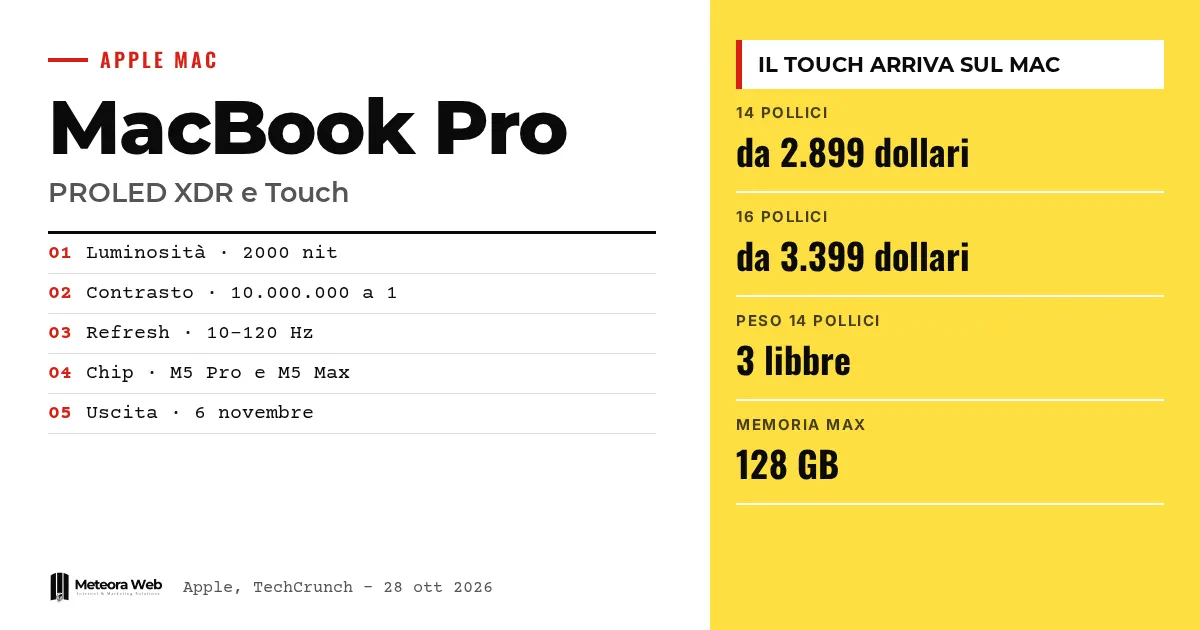
On October 28, 2026, Apple unveiled the new MacBook Pro in 14 and 16 inch versions. The display moves to an OLED technology called PROLED XDR and, for the first time, the Mac has a touch-sensitive screen. The chips are M5 Pro and M5 Max, and shipping starts November 6. It matters because it changes an idea of computer that Apple had defended for years, and because the starting price and the price of the richest configurations rise sharply.
A few terms before we get into the facts. The nit is the unit used to measure screen brightness. OLED is a panel in which each pixel produces its own light, so black can be truly off. Tandem OLED means two layers of light-emitting material stacked together, for more brightness and longevity. The contrast ratio measures the distance between the brightest white and the darkest black. ProMotion is Apple's name for the variable refresh rate of the screen.
What is the PROLED XDR display?
According to the official Apple announcement, PROLED XDR is a tandem OLED panel with peak brightness up to 2000 nits, in both HDR and SDR, and a claimed contrast of 10,000,000 to 1. The refresh rate ranges from 10 to 120 Hz thanks to ProMotion. These are figures declared by the company, not independent measurements.
Colors and calibration
Apple claims a color gamut that covers P3 and, new this time, also Adobe RGB, which matters for photography and graphic design. It also claims more than 80 percent of the Rec. 2020 gamut for HDR editing and color grading. Each panel is factory calibrated, and the two color spaces are available in a single preset.
Reflections and burn-in
The anti-reflective coating is new, while the nano-texture option is now etched directly into the glass. On burn-in, meaning the image that stays imprinted on an OLED, Ars Technica writes that the company hinted at protections but did not explain which approach it uses. Apple speaks of a display engine that monitors how much each pixel is used over time.
How does touch work on the Mac?
Apple presents touch as designed specifically for macOS. You scroll a page with a gesture, enlarge a photo with a pinch, and drag items between apps. The sensor is built into the panel rather than laid on top, and Apple says this reduces latency. A redesigned hinge should provide more stability when you touch the screen.
According to Ars Technica, the demo video does not show a 2 in 1 convertible. All the scenes show people touching the screen with the laptop in its normal configuration. The Mac, therefore, remains a classic laptop with touch added.
And the apps?
According to Apple, many apps work right away, because macOS automatically translates touches into clicks. New system APIs let developers build experiences designed for touch. Apps cited include Notion, Canva, Zoom, Word, Excel, PowerPoint, Outlook, Adobe Lightroom, DaVinci Resolve and Blender. Developers can also test their iOS and iPadOS apps on the display. If you build them, an iOS and Android app project now has one more testing bench.
The Dynamic Island, already seen on iPhone, arrives on the Mac and hosts Spotlight, Live Activities and Siri AI. On Apple and its recent moves you can also read our piece on the first foldable iPhone and the one on Apple TV and the upgraded Siri.
How much does the new MacBook Pro cost?
According to Tom's Hardware, the 14 inch model starts at 2,899 dollars and the 16 inch at 3,399 dollars. Euro prices are not in the sources we read.
TechCrunch, citing MacRumors, reports that Apple's configurator reaches 14,249 dollars for the 14 inch and 14,549 dollars for the 16 inch, both with M5 Max with 18 CPU cores and 40 GPU cores. The listed extras are these.
- 4 TB SSD, plus 1,000 dollars.
- 8 TB SSD, plus 3,000 dollars.
- 16 TB SSD, plus 7,000 dollars.
- 128 GB of memory, plus 2,000 dollars.
- Nano-texture glass, plus 150 dollars.
Also according to TechCrunch, the previous 16 inch went up to 10,149 dollars, so the ceiling rises by 4,400 dollars. The outlet attributes part of the price pressure to the memory shortage and the hunger for hardware driven by artificial intelligence. This is the outlet's reading, not an Apple figure.
What changes in weight and design?
Apple claims up to 24 hours of battery life and weights of 3 pounds for the 14 inch and 4 pounds for the 16. Tom's Hardware calculates about half a pound less for the 14 inch and 0.7 pounds less for the 16. Thicknesses drop only slightly, by about half a millimeter and nearly one millimeter, and Apple attributes this to the OLED stack.
There are six speakers, with bass 50 percent deeper according to Apple. Thunderbolt 5, a 12 megapixel Center Stage camera and macOS 27 remain. Tom's Hardware also points out the illuminated Apple logo, which had not been seen on a MacBook Pro since 2016. On battery life, if you already use a Mac, you may find this setting to extend battery life useful.
Limits to know
Almost all the technical figures are declared by Apple and not yet verified by independent tests. Brightness, contrast and battery life will need to be confirmed by reviews.
The sources do not agree on a date. Apple says pre-orders open October 28, while TechCrunch mentions October 30. November 6 as the availability date is confirmed by all three. We do not yet know anything about prices and availability in Italy, nor how Apple will handle burn-in. It is also unclear how much third-party apps will really exploit touch beyond translating it into clicks.
What changes for people who work with digital tools
If you develop apps, the Mac becomes a device where you can really test gestures, without going through the simulator. If you design web interfaces or management software, a share of your Mac users may now touch the screen. Buttons that are too small or menus that open only on mouse hover become a problem. This also applies to a cloud management software such as Zenith, which should be designed for mouse, trackpad and finger.
For designers, photographers and video editors, Adobe RGB and P3 coverage in a single preset is the most concrete novelty, at least on paper. For a company that must buy computers, cost matters more than the screen, especially in the high configurations.
Our take
Touch on the Mac is a choice that strikes us as more cautious than Apple presents it. There is no convertible, the laptop remains a laptop, and touch adds to the trackpad and shortcuts. The risk is awkward use, and in the comments on Tom's Hardware many readers fear it, with the screen smudged by fingerprints and the arm growing tired. These are readers' opinions, not data, but they point to a real resistance.
The OLED display strikes us as the real news for people who work with color and HDR. The price, on the other hand, is the debatable part. Climbing to 14,549 dollars for a laptop is a figure that only makes sense for a very few professionals. We are waiting for independent tests before recommending a purchase.
Frequently asked questions
Does the new MacBook Pro really have a touchscreen?
Yes. It is the first time for a Mac. The sensor is built into the panel and macOS translates touches into clicks, so many apps work right away.
When does the MacBook Pro with PROLED XDR come out?
On November 6, 2026. According to Apple pre-orders open October 28, according to TechCrunch October 30.
How much does the new MacBook Pro cost?
It starts at 2,899 dollars for the 14 inch and 3,399 dollars for the 16 inch. The richest configurations reach 14,249 and 14,549 dollars. Italian prices are not yet known.
Which chip does it use?
M5 Pro and M5 Max. It goes up to 128 GB of unified memory and 16 TB of storage.
Is the MacBook Pro a 2 in 1?
No, based on what the video shows. Ars Technica writes that it does not appear to be a convertible and that touch is used with the laptop open in its normal way.
What to watch before and after November 6
In the coming weeks, independent reviews, European price lists and the first apps that will use the new APIs matter. Three practical tips.
- Do not buy before third-party tests of brightness, contrast and burn-in.
- If you develop interfaces, check that targets and menus also work with a finger.
- Calculate the real cost of the configuration, because memory and SSD weigh heavily on the total.