 Ing. Calogero Bono
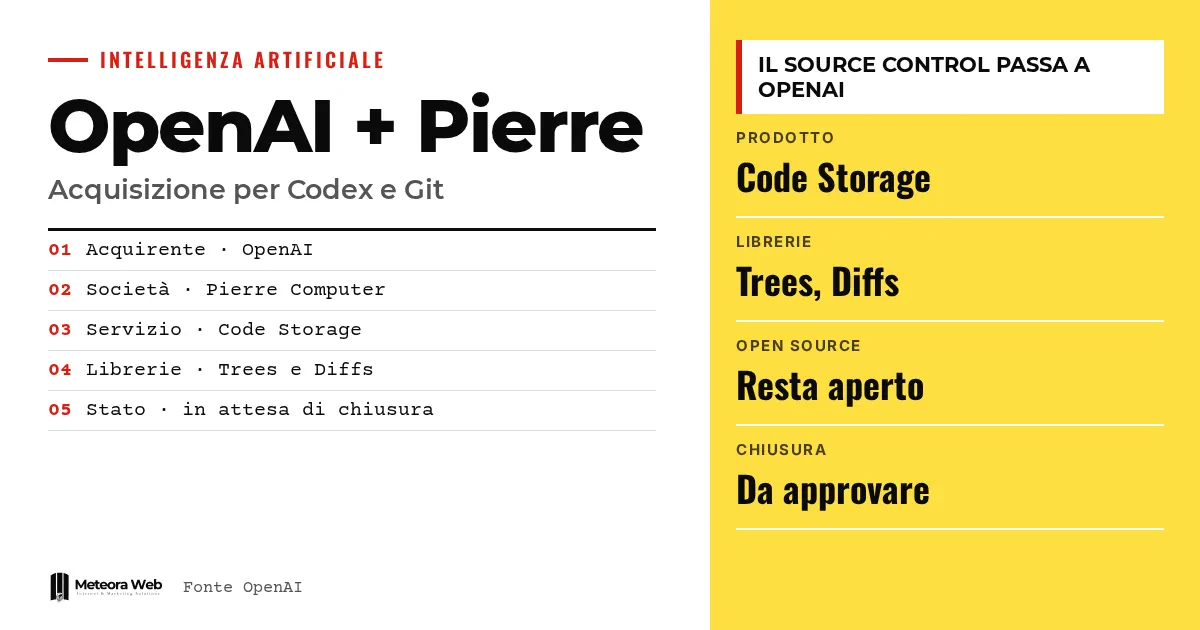
OpenAI has announced it will acquire Pierre Computer Company, the company behind Code Storage and a family of open source tools for developers. Anyone who uses the Codex app has already encountered two of its libraries, Trees and Diffs. The stated goal is to adapt Git workflows for teams working with programming agents. It matters because the company aims to control an increasingly central piece of the development cycle, code versioning.
A few terms before we get into the facts. Git is the system that tracks changes to code. Diff is the view that shows what changed between two versions. Source control refers to managing source code and its history. Programming agent is an AI that writes and modifies code with some degree of autonomy. Syntax highlighter colors code to make it readable.
What is Pierre and what does it do?
According to OpenAI's official announcement, Pierre is the company behind Code Storage, a service that lets apps store code and track its history with Git. It also produces open source tools.
Two of these are already inside Codex. Trees lets you quickly navigate a project's files, Diffs shows the changes. OpenAI describes them as suited to large volumes of code, with performance "without compromise".
Which tools does it bring along?
Beyond Trees and Diffs, OpenAI cites Diffs' Edit mode, which allows whoever reviews code to fix a line right where they spot the problem.
There is also Highlights, a recently released syntax highlighter which, according to OpenAI, is extremely fast and updates while the developer types or an agent generates code. Pierre's small team also designed the Code Storage API.
Anyone who wants to understand how to work with these services can start with our guide to artificial intelligence APIs.
Why does OpenAI want control over code?
OpenAI explains that the systems around Git must evolve when a lot of work happens in parallel. Earlier in the same week it described how it scales Git internally with Pando, an in-house source control backend built for engineers and agents.
The stated ambition is to set the standard for modern development, from the first branch created by an agent to the release of the code. And to make Codex the place where developers and agents tackle their most ambitious projects.
After closing, OpenAI wants to advance source control across the industry and connect code released by a company to the decisions of its people. On the security front, we also discussed this with GPT-Red.
What happens to Code Storage users and open source projects?
OpenAI states that Pierre's open source projects will remain open source and that it will continue contributing to them. Customers will be able to keep using Code Storage after closing, while the company works to bring its functions and capabilities into Codex.
This last sentence is the most relevant for those who depend on the service. It says that Code Storage as a standalone product could be absorbed, although the announcement sets no timelines or long-term commitments.
The deal is subject to the usual closing conditions, including regulatory approvals. Until then the two companies remain separate and independent.
Limits to know
The announcement does not disclose the acquisition price, the closing timeline, or the number of people involved. It is unclear how long support for Code Storage as a separate service will last. The performance of Trees, Diffs and Highlights are OpenAI's own assessments, not independent measurements. Regulatory approvals could change timing or conditions.
What changes for those working with digital tools
For now nothing changes, the two companies remain independent. If you are a developer who uses Pierre's libraries, the open source code remains available. If you have built a product on Code Storage, it is worth knowing that OpenAI intends to bring its features into Codex. Anyone evaluating programming agents for their company should consider that versioning becomes part of the AI provider's platform. To understand how to introduce these tools without waste, read the guide AI for Italian small businesses.
Our take
The move is consistent. Those who sell agents that write code need to control where that code is born, reviewed and stored. Buying a small, respected team is faster than building from scratch. The risk for developers is concentration. If editor, review and archive all sit within the same ecosystem, leaving costs more. The commitments to open source are a good sign, but they remain words until we see concrete licenses and contributions.
Frequently asked questions
Who is Pierre Computer Company?
It is the company behind Code Storage and several open source developer tools. Trees and Diffs, two of its libraries, are already used in OpenAI's Codex app.
Has the acquisition already been completed?
No. Closing is subject to the usual conditions, including regulatory approvals. Until then OpenAI and Pierre remain separate and independent companies.
Will Code Storage keep working?
Yes, according to OpenAI customers will be able to keep using it after closing. However, the company is working to bring its features into Codex, so the future of the standalone service is not defined.
Will Pierre's open source projects stay open?
According to OpenAI, yes. The company states they will remain open source and that it will continue contributing to them.
How much does the deal cost?
The sources do not say. The announcement reports neither a price nor a completion timeline.
What to watch in the coming months for Codex, Git and Code Storage
The game will be played on the closing of the deal and on how OpenAI integrates Pierre's work. Signals will come from licenses, roadmaps and products.
- Check whether the licenses of Pierre's libraries remain unchanged after closing.
- If you use Code Storage, keep a copy of your repositories ready and an alternative in mind.
- Follow announcements on Pando and Codex to see whether source control becomes a service open to others.