Ing. Calogero Bono
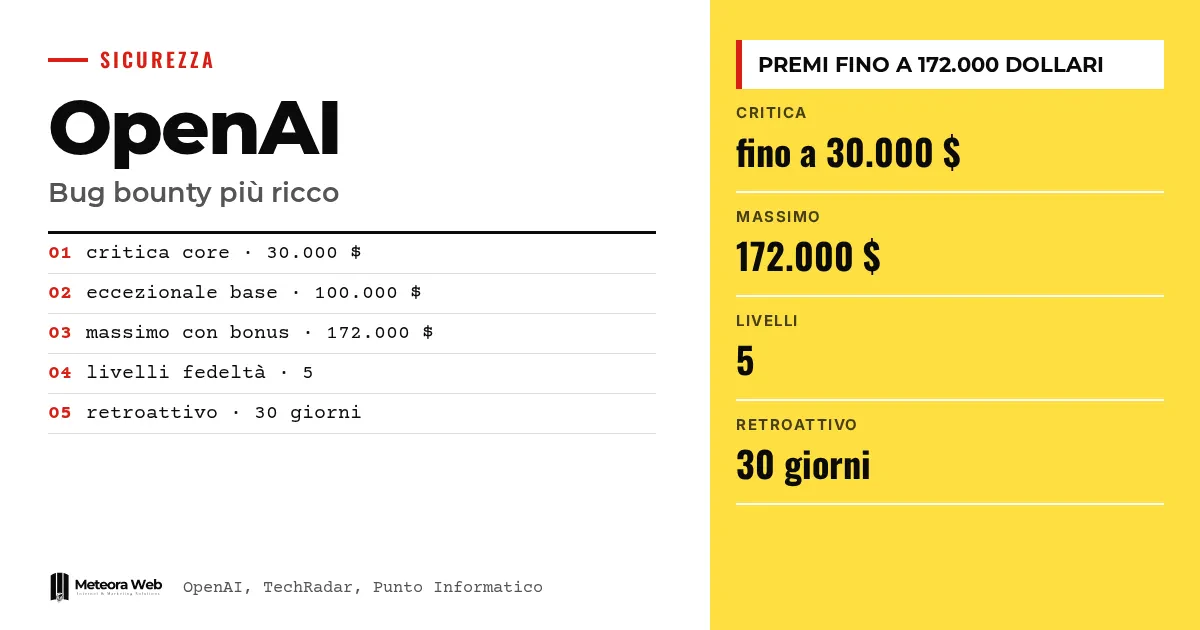
OpenAI has announced higher rewards for its Security Bug Bounty program. A critical flaw in core products such as ChatGPT, Codex or the API Platform will be worth up to $30,000, and exceptional cases up to $172,000 with bonuses. The program also introduces multipliers for quality, loyalty and priority. It matters because the previous rewards were considered low compared with the competition, and because companies building on these platforms depend on those who look for bugs.
A few terms before we get into the facts. Bug bounty is a program that pays those who report security flaws responsibly. PoC (proof of concept) is the practical demonstration that the flaw can be exploited. IDOR is an error that lets you read other users' data by changing an identifier. Multiplier is a coefficient that increases the base reward. Account takeover is the seizure of control of someone else's account.
How much does OpenAI now pay for a vulnerability?
According to OpenAI, the central point of the reward ranges for medium, high and critical flaws is more than quadrupled on average. A critical vulnerability in ChatGPT, Codex or API Platform is worth up to $30,000. Exceptional critical cases remain eligible for up to $100,000, and now up to $172,000 with bonuses.
The final amount depends on severity (medium, high, critical, exceptional) and on the multipliers applied to the base reward.
How do the quality, loyalty and priority bonuses work?
There are three. The quality bonus rewards reports with a reliable proof of concept, one that isolates the bug, shows when it is exploitable and demonstrates its impact. The loyalty bonus is a 5-level system for those who collaborate consistently. Priority campaigns instead have dedicated funds for newly launched features.
An example from the official table
For an account takeover with one click in ChatGPT, OpenAI calculates $30,000 for a 1.15 quality factor, a 1.30 priority campaign factor and a 1.15 loyalty factor, that is $51,577. The previously indicated historical reward was $6,500. The scenarios, the company specifies, are illustrative.
Do the new rewards also apply to reports already submitted?
Yes. Those who have already submitted a report that has not yet been rewarded will get the new ranges. For rewards assigned in the 30 days before the announcement, OpenAI will pay the difference if the discovery would have been worth more (base reward plus loyalty bonus). Punto Informatico confirms this too.
On November 20 and 21 the security team will be at PROMPT2PWN in Oakland, where researchers can test the targets in person.
What does the collaboration with Cathedral Systems involve?
Alongside the rewards, OpenAI has started a partnership with Cathedral Systems. As TechRadar reports, researchers from both organizations will test the AI infrastructure to find weaknesses and improve defenses.
Cathedral's CEO, Gavin Kliger, wrote that OpenAI "is setting an important example by collaborating with external security firms and using its own models to continuously test and strengthen defenses". The topic ties into the work on offensive tools, which we covered when discussing GPT-Red.
Limits to know
The reward figures in the table are illustrative examples, not verified payments. TechRadar writes that the exact figures were not in the announcement, while the official source reports them, so the latter is what counts. The $5,000 paid to Parameter Labs comes only from Punto Informatico. We do not know how many more researchers will come forward, nor whether bonuses will be awarded under uniform criteria.
What changes for those working with digital tools
If you develop on ChatGPT, Codex or OpenAI's APIs, more external researchers will have an incentive to look for flaws in those services, which in theory reduces the risks to your data. It does not replace your own defenses, however. If you manage API integrations, keep your keys carefully and limit permissions. Those working in security have a useful reference for judging how much a well-made report with a reproducible proof is worth. For a broader comparison between providers, read Anthropic Claude vs OpenAI.
Our take
The increase is sensible and overdue. Paying $5,000 for a flaw that exposed private chats, as Punto Informatico reported, incentivized no one. The multiplier system rewards serious work, but it also makes rewards harder to predict, and the highest bonuses depend on time-limited campaigns. The risk is that the figure in the headline, $172,000, remains an exception. The real test will be how many actual payments exceed $30,000.
Frequently asked questions
What is the maximum OpenAI bug bounty reward?
Up to $172,000 for exceptional critical cases, including bonuses. Without bonuses the ceiling stays at $100,000. A critical flaw in ChatGPT, Codex or API Platform is worth up to $30,000.
What are the quality, loyalty and priority bonuses?
They are multipliers applied to the base reward. Quality rewards reports with a reproducible proof, loyalty rewards those who have collaborated over time across 5 levels, and priority rewards flaws in newly launched features.
Do the new rewards also apply to older reports?
Partly, yes. Reports submitted but not yet rewarded will use the new ranges. For those rewarded in the 30 days before the announcement, OpenAI will pay the difference.
Who is Cathedral Systems?
It is the security company with which OpenAI has started a collaboration. From the sources we only know that its researchers will test OpenAI's AI infrastructure alongside OpenAI's own.
Who can take part in the program?
Independent researchers who report vulnerabilities in OpenAI software. The details and full rules are on the program's official page, which the sources do not reproduce in full.
What to watch for in the coming months on OpenAI's bug bounty
The announced figures are the easy part. What matters are actual payments and how the program is used in practice.
- Check the priority campaigns, since the largest bonuses will go to new features, which are the most exposed.
- Follow the outcomes of PROMPT2PWN in Oakland on November 20 and 21 to see what kinds of flaws emerge.
- Verify whether OpenAI publishes rewards actually paid, not just illustrative examples.
Sources
- openai.com, Rewarding defenders with bigger bug bounties
- techradar.com, 'Traditional cyber defenses alone are no longer sufficient' – OpenAI is raising its bug bounty rewards for security researchers as AI attack worries grow
- punto-informatico.it, OpenAI aumenta i premi per la scoperta delle vulnerabilità