 Ing. Calogero Bono
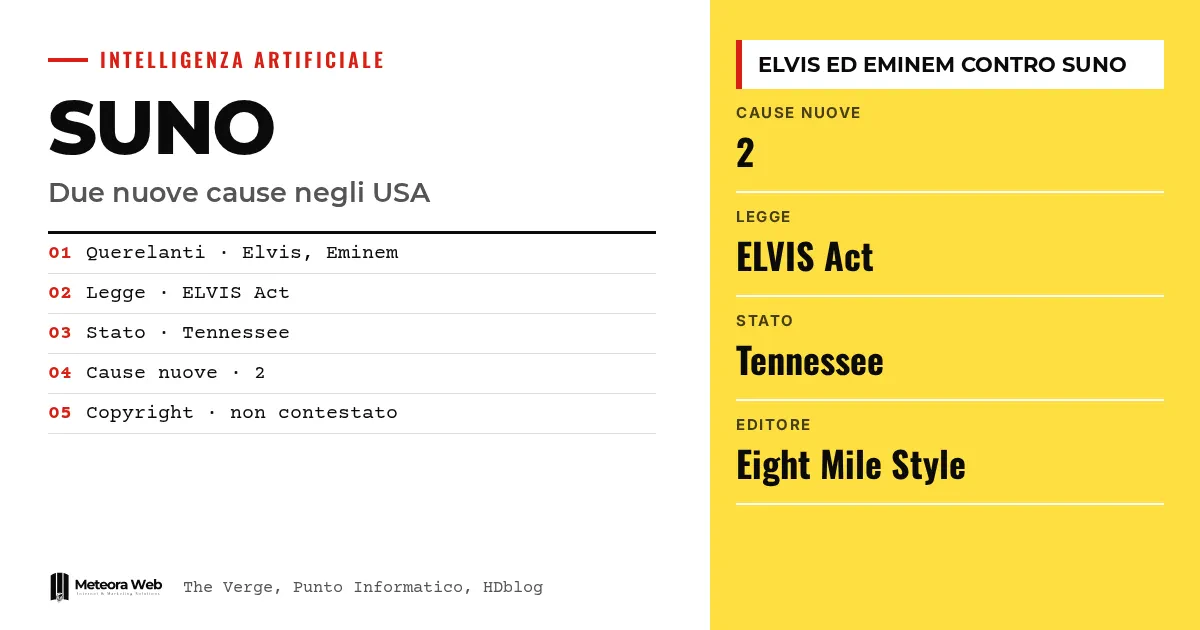
Suno, the platform that turns a text description into a complete song, faces two new lawsuits in the United States. They were filed by rights holders linked to Elvis Presley and by the publisher of some of Eminem's best-known records. The accusation is that the service generates music and lyrics that imitate those artists, without a license. It matters because it puts the line between drawing inspiration from a style and cloning an artistic identity under scrutiny.
A few terms before we get into the facts. ELVIS Act is the Tennessee law, short for Ensuring Likeness Voice and Image Security, which prohibits an AI company from cloning a singer's voice. Prompt is the text description a user writes to get a track. Guardrails are the filters and rules a service uses to block problematic requests. Music publisher is the company that manages the rights to a catalog's lyrics and compositions.
Who sued Suno and why?
According to The Verge, the moves come from a group of rights holders to Elvis Presley's music and the publisher of some of Eminem's biggest records. HDblog specifies that there are two lawsuits and that Eminem's publisher is Eight Mile Style, a company that controls part of the artist's catalog.
The complaint is common. The platform would generate music and lyrics that mimic those artists, without permission and without paying, as summarized by Punto Informatico.
What is the ELVIS Act invoked in the lawsuit?
It is a Tennessee law that makes it illegal for an AI company to clone a singer's voice. Presley's lawyers argue that Suno violated it.
The interesting point is the tool chosen. These suits resemble the one filed in September by Sony, UMG, Jason Isbell and others, which argued that Suno produced imitations of the plaintiffs, without directly contesting a copyright infringement. The legal strategy therefore shifts the focus from copying the work to using the artist's identity.
In what words do the lawyers accuse the platform?
The complaint uses strong language. Presley's lawyers write that Suno has "mechanically codified" the identity, commitment, creativity and time of artists, using them for a constant flow of money. They also speak of a "voracious race to the bottom" aimed at making human creativity obsolete, replicating in seconds, without a license, what takes years to learn and perfect.
These are partisan words, written in a legal filing. They should be read as the prosecution's thesis, not as established facts.
How does Suno defend itself?
Spokesperson Cat McCormack told The Verge that Suno "exists to help people create new and original music, not to exploit anyone's name or likeness". The company states that it prohibits any unauthorized use of an artist's work.
According to Suno, the platform does not accept prompts with artist names or specific song titles and works with external providers that check uploaded audio and lyrics. The company adds that it will keep strengthening its protections. On the subject of filters, developers may find our piece on jailbreaks and prompt injection useful.
Limits to know
The lawsuits have just been filed and no judge has ruled yet. The sources do not say what damages are sought or which specific songs are being contested. It is not verified that Suno's filters work as claimed. It remains open whether the ELVIS Act, a single state's law, can hold up against a service used worldwide.
What changes for those working in digital
If you use generative AI for music, video or voices in your projects, the risk is not only copyright. Resemblance to a recognizable voice can also become a problem. Check the terms of use of the tool and keep the prompts you used to generate content.
For companies that integrate third-party models, it matters to know who is responsible if a dispute arises. The European framework is covered in our guide to the EU AI Act, while developers can start from the practical obligations for developers.
Our take
Banning artist names in prompts is a weak filter. A model can imitate a style without anyone typing the name, and a detailed description of the voice is enough. That is why the choice to focus on identity rather than copyright seems smart to us. At the same time, the complaint's wording is courtroom rhetoric. The real question is how much resemblance is lawful, and for now no law measures it precisely.
Frequently asked questions
Who sued Suno?
A group of rights holders to Elvis Presley's music and the publisher of some Eminem records. HDblog identifies Eight Mile Style as the company that controls part of Eminem's catalog.
What is the ELVIS Act?
It is a Tennessee law that prohibits AI companies from cloning a singer's voice. The name stands for Ensuring Likeness Voice and Image Security.
Does Suno face other lawsuits?
Yes. According to The Verge, these join those from Sony, UMG, Isbell, Reservoir Media and others. In September, a similar suit was filed by Sony, UMG and Jason Isbell.
How does Suno respond to the accusations?
The company says it exists to create original music and prohibits unauthorized uses. It states that it blocks prompts with artist and song names and uses external providers to check uploaded audio and lyrics.
Does the lawsuit concern copyright?
Not directly. Like the September suit, according to the sources it is based on imitations of the artists and, in the Presley case, on the ELVIS Act, without directly contesting a copyright infringement.
What to watch in the Suno lawsuits in the coming months
The legal process will show whether the declared filters are enough and whether state laws such as the ELVIS Act can stand up against generative AI.
- Follow the first judge's decision on whether lawsuits based on the ELVIS Act are admissible.
- Check whether Suno announces new protections and how they work in practice.
- Read the terms of use of music generators before using tracks in commercial campaigns.