 Ing. Calogero Bono
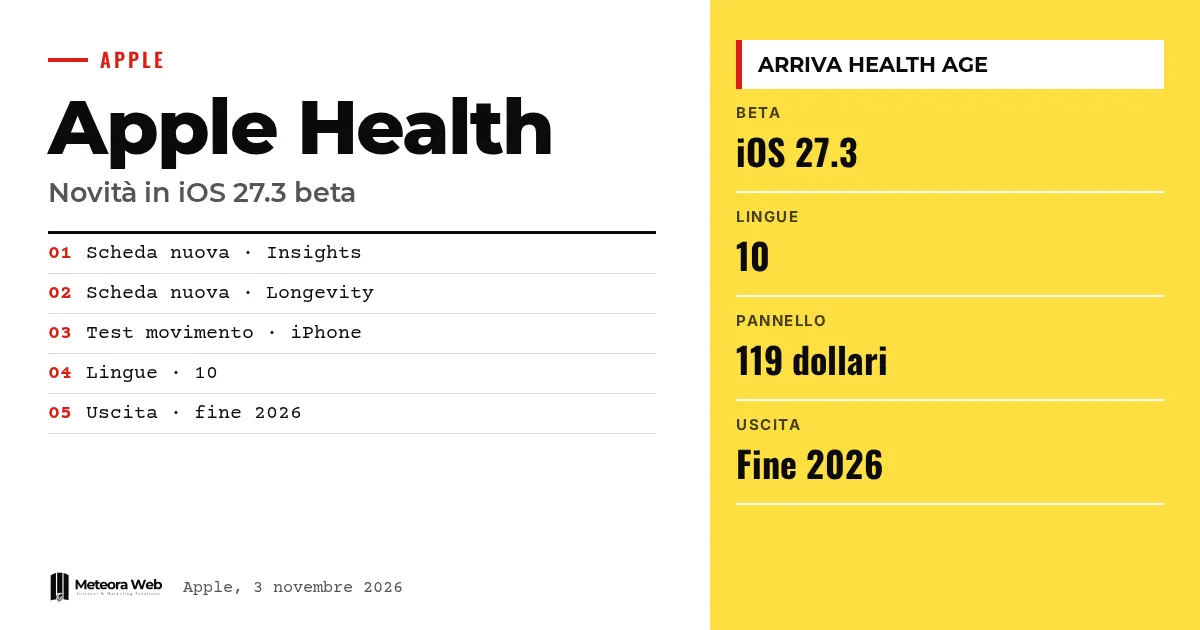
On November 3, 2026, Apple announced the language expansion of the new Health app, available right away in the iOS 27.3 beta. The release for all users will arrive as a free update before the end of the year. Built around Apple Intelligence, the app adds dedicated cards for daily advice and longevity, as well as movement tests done with iPhone and Apple Watch. It matters because it moves a piece of health analysis onto the phone.
A few terms, before we get into the facts. Apple Intelligence is Apple's AI system, partly running on the device. Beta is a trial version, aimed at developers and testers. VO2 max measures how much oxygen the body uses during exertion. HRV is heart rate variability, meaning the time difference between one heartbeat and the next. A1c is a blood test linked to average blood sugar.
What changes in the new Health app?
According to Apple, there is a new Insights card with summaries on heart, sleep, readiness, fitness, vital signs and cycle. A For You section offers habit-based advice, for example how to change your evening routine after several nights of broken sleep.
The app pairs data with video and articles featuring clinical experts. According to MacRumors, those with an Apple Watch Series 12 or Ultra 4 see the readiness score on the watch too. It helps you decide whether to push, rest or train as usual.
What is the Longevity card and what is Health Age?
The Longevity card analyzes heart, sleep, mental wellbeing, movement, metabolic health, hearing and nutrition over time. At its center is Health Age, which turns Apple Watch data into a value to compare with chronological age.
Apple cites VO2 max, resting heart rate, sleep and HRV. Laboratory tests such as A1c and LDL cholesterol can be added. According to MacRumors, Apple will offer a 119-dollar analysis panel with Quest Diagnostics in the future, and results will flow into Health Age. Recent reports can also be uploaded or medical records synced.
How do the home movement tests work?
Using the iPhone camera and Apple Watch, flexibility, strength, balance, movement mechanics and VO2 max are measured, with real-time audio and visual guidance. Apple states that the vision models run on the device and that no video is recorded, stored or shared.
This is the company's claim, not independent verification. The VO2 max estimation test requires an Apple Watch, AirPods Pro 3 or a third-party heart sensor.
Which languages and devices are supported?
The languages are global English, simplified and traditional Chinese, French, Japanese, Korean, Norwegian, Portuguese, Spanish, Turkish and Vietnamese. Italian is not on the list, and we note it. It remains unclear when it will arrive, since Apple only says it will keep expanding support.
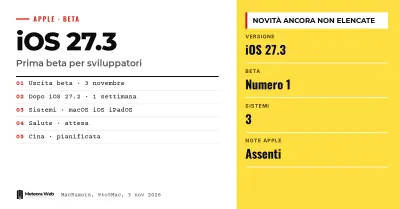
An iPhone or iPad compatible with Apple Intelligence is required. Some features are iPhone-only, others require being at least 18, and availability varies by region. On the Apple Intelligence front, we have already covered its arrival in China with iOS 27.3.
Limits to know
There is no indication of an Italian arrival. There is no independent validation of the accuracy of Health Age or of the camera tests. Apple notes that features may change and that some will not be available everywhere. The 119-dollar panel is information from MacRumors, described as future, with no date or markets. 9to5Mac writes that the release is expected next month, while Apple only speaks of year end.
What changes for those working in digital
For those who build health and wellness apps, Apple is bringing into the system features that previously required third-party apps, such as personalized advice and movement tests. It is worth understanding where your offerings add something more. Those developing on iOS can also weigh iOS and Android app development in light of this shift. For companies handling sensitive user data, the message about on-device processing matters, but it remains a claim. Those with clients abroad should remember that supported languages are limited. On the rules side, see also the new App Store rules.
Our take
The direction is clear. Apple wants Health to become the access point for data, advice and prevention, and it does so with longevity language that promises a lot. A number like Health Age is convenient but risks being taken as a medical judgment, when it is an estimate built on wrist sensors. The strong point is on-device processing of video, if confirmed in practice. The weak point is the exclusion of Italian, which for now leaves out a large market. We will wait for independent evidence before trusting the numbers.
Frequently asked questions
When does the new Health app come out?
Apple speaks of a free update before the end of the year. It is already in the iOS 27.3 beta for developers. MacRumors links it to a release expected in December.
Does the new Health app support Italian?
It is not in the official list. The languages listed are ten, including Spanish and French, but not Italian. Apple says it will add more languages.
What is Health Age?
It is a metric that compares the state of the body with chronological age. It uses Apple Watch data such as VO2 max, sleep and HRV. Blood test results can also be added.
Are the home movement test videos recorded?
According to Apple, no. The experience runs entirely on the device and no video is recorded, stored or shared. This is the company's claim.
Is an Apple Watch strictly required?
For Health Age, yes. For the VO2 max test you need an Apple Watch, AirPods Pro 3 or a third-party heart sensor. The iPhone must support Apple Intelligence.
What to watch before iOS 27.3 is released
Between beta and final release, features and availability may change. It is worth following a few specific points.
- Check whether Italian appears among the supported languages before planning communications to users.
- Verify with the final release notes which features remain iPhone-only.
- Follow the first independent tests on the accuracy of Health Age and the camera tests.