 Ing. Calogero Bono
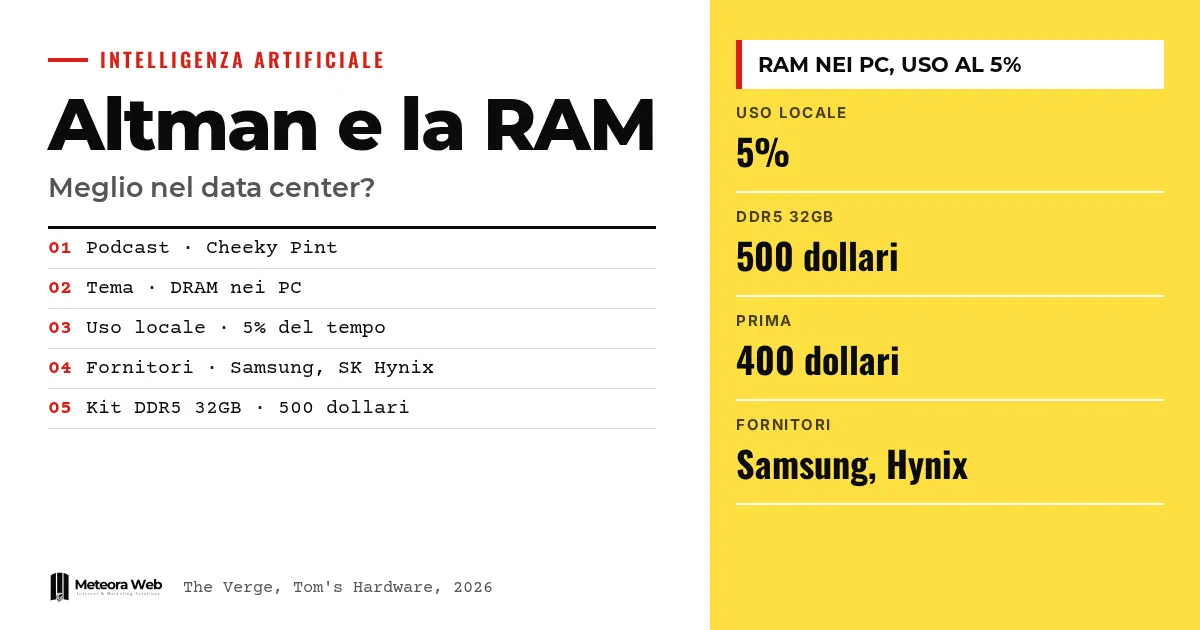
Sam Altman, CEO of OpenAI, told the Cheeky Pint podcast that it is «terrible» to have the world's DRAM sitting inside home computers, where it is barely used. In his view, memory does more work in the cloud. His remarks come as the RAM shortage pushes up the prices of laptops, phones and graphics cards. For buyers and developers, the question is about cost and control over their own hardware.
A few terms before we get into the facts. DRAM is a computer's working memory, the RAM we usually talk about. Local inference means running an AI model on your own device instead of a remote service. Open source refers to models whose weights can be downloaded and used by anyone. Data center is the facility full of servers that hosts cloud services. Utilization is the share of time a resource is actually doing work.
What did Sam Altman actually say about RAM?
In the podcast, hosted according to Tom's Guide by John Collison, Altman answered a question about shortages in the supply chain. He observed that many people think the problem is solved, because open source models will be available to run on your own computer.
The central line, in the Italian translation, is this. According to Altman, «from a global allocation perspective, it is really terrible that everyone has a piece of the scarce global supply of DRAM in their computer, used 5% of the time» (Tom's Hardware). And again, «in the cloud you want maximum utilization».
Why is RAM so scarce and expensive?
According to The Verge, Samsung and SK Hynix have long-term agreements with cloud service operators and with projects such as OpenAI's Stargate, which have reserved much of RAM production for the coming years. For the outlet, the billions spent on chips are the reason for the price increases on laptops and phones.
Tom's Guide adds other factors – AI-driven demand, historically low stockpiles, tariffs, and foundries shifting capacity from consumer products to servers. It reports a 32 GB DDR5 kit at 500 dollars, up from 400 previously.
Is Altman defending a business interest?
Tom's Hardware says it plainly. OpenAI has some open source models, but its main business is closed models running in data centers, so Altman would be defending the company's model. If people could run models at home, they might one day pay fewer subscriptions.
Windows Central recalls that Altman had already spoken of selling intelligence «by the meter», like water or electricity. The outlet, which is very polemical, reads in it the risk that a few giants control computing and rent it out. This is an opinion, not a fact. On Altman and his proposals you can also read the plan to distribute the wealth generated by AI.
Could the AI bubble change the picture?
For the Tom's Guide journalist, yes, but this is his forecast. He cites the Anthropic IPO, with 16.3 billion in revenue in the first half of 2026 and a net loss of 80.7 billion, and stock market drops in China and the United States. He also cites companies cutting AI spending, including Uber, which reportedly exhausted a 3.4 billion budget in four months.
The same author admits he got an earlier forecast on RAM prices wrong. Treat it as a scenario. On the comparison between suppliers, see Anthropic Claude versus OpenAI.
Limits to know
The 5% figure is Altman's own claim, not a measurement we were shown. No source explains how it was calculated. We also do not know how heavily data center RAM is really used, and a comment among Tom's Hardware readers claims idle centers above 70%, but it is an unsourced comment. The price scenarios from Tom's Guide are assumptions. Windows Central is an opinion piece.
What changes for people working with digital tools
For a business, hardware costs stay high and hard to predict. If you need to renew PCs or servers, postponing can make sense, but only if current devices still hold up. Anyone building with local AI has to weigh memory, privacy and the cost of cloud subscriptions. Tom's Guide notes that many companies cite privacy as the biggest obstacle to the cloud. The topic also touches energy and land use, as the case of Big Tech data centers in Italy shows. For a website's servers, managed hosting spares you from buying memory yourself.
Our take
Altman's argument has a real core, because RAM is scarce and an idle unit is wasted. But the reasoning assumes data centers use it better, and he does not prove it. Those who propose moving other people's memory are also the ones buying the most of it. The choice between owning and renting computing is not just a question of allocation, it is a question of dependence on a few suppliers. We would rather the reader decide based on their own costs, not on a metaphor.
Frequently asked questions
Why does Altman say RAM in PCs is a problem?
Because, in his view, home RAM is used little, around 5% of the time, while in the cloud it would work at full capacity. He made the remark to Cheeky Pint while discussing the DRAM shortage.
Is the RAM shortage OpenAI's fault?
Partly, according to the sources. The Verge writes that agreements between Samsung and SK Hynix with cloud providers and Stargate reserve much of production. Tom's Guide also cites tariffs and low stockpiles.
Will RAM prices come down?
Not certain. Tom's Guide outlines two scenarios, one of falling prices and one of prolonged scarcity, and admits it got an earlier forecast wrong.
Is Altman speaking in OpenAI's favor?
Tom's Hardware argues so. OpenAI's main models are closed and run in data centers, so local inference could reduce subscriptions.
Is local AI worth it?
It depends. Tom's Guide cites privacy, no usage limits and independence from subscriptions, but it requires hardware with a lot of memory, which is expensive today.
RAM prices and AI balance sheets, what to watch from here on
Memory prices will follow the choices of manufacturers and the finances of AI companies. The rest is speculation.
- Watch whether Samsung, SK Hynix and Micron shift production back to consumer modules or cut supply.
- Check the financial results and IPOs of AI companies, since a slowdown in spending can change memory demand.
- Assess which workloads could run on open local models before you commit to a hardware budget.
Sources
- theverge.com, Sam Altman says it’s better for RAM to be in a data center than on your desk
- windowscentral.com, OpenAI sociopath Sam Altman says it's "terrible" that your PC, Xbox, etc. have RAM that could be used for his AI
- tomshardware.com, OpenAI CEO says it's 'quite terrible' for your PC to have RAM
- tomsguide.com, Sam Altman says your laptop RAM is a 'terrible’ allocation of scarce resources – Why I think the AI bubble is about to prove him wrong