 Ing. Calogero Bono
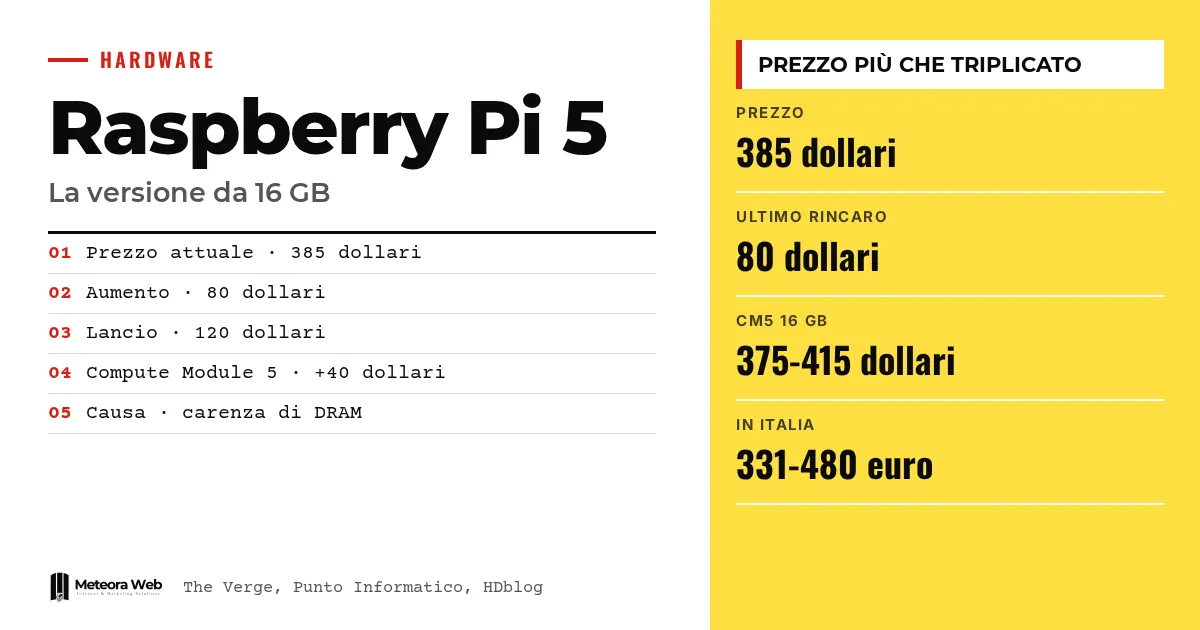
Raspberry Pi has raised prices once again. The Raspberry Pi 5 with 16 GB of RAM now costs $385, $80 more than before and more than three times the $120 launch price. The Compute Module 5 with 16 GB also rises by $40. The cause is a shortage of DRAM memory, and the increase hits those who use these boards in business projects, prototypes and dedicated systems.
A few terms before we get into the facts. DRAM is the working memory of devices, the one we call RAM. HBM (High-Bandwidth Memory) is an ultra-fast memory used in data centers for artificial intelligence. Compute Module is the modular version of Raspberry Pi, designed to be built into industrial products. Dev board is a development board, that is a tiny computer for building and testing projects. Raspberry Pi 500+ is the ready-to-use version, with keyboard, case and SSD.
How much does the Raspberry Pi 5 with 16 GB cost now?
According to The Verge, the 16 GB configuration costs $385 after an increase of $80. At launch it cost $120, so the price is now more than triple. HDblog also reports a list price tripled compared with January 2025.
The Compute Module 5 with 16 GB rises by $40 and now sits between $375 and $415, depending on the chosen configuration. In Italy, according to Punto Informatico, the board sells between 331 and 480 euros at Melopero, reicheIt and Kubii.
The Verge notes that at $385 the board comes close to the price of a mini desktop PC. That is the comparison that matters for those who have to choose.
Why do prices keep rising?
The reason given is the memory shortage. According to CEO Eben Upton, the increase depends on the lack of alternative suppliers for 16 GB DRAM, along with shortages of other components. Punto Informatico reports that Raspberry Pi looked for different suppliers without success and partly passed the higher costs on to users.
Still according to Punto Informatico, the root cause is demand for HBM for artificial intelligence data centers, which has reduced DRAM production and raised its cost. It is a topic we have already covered, for example in the summit between Samsung and Sam Altman in Yongin.
HDblog adds that the problems concern not only RAM but also other more expensive components and materials.
How many times has the Raspberry Pi 5 already gone up?
Punto Informatico speaks of the fifth increase within a year. The timeline it reports is this.
- Early October 2025, first increase for Compute Modules 4 and 5.
- About two months later, increases for Raspberry Pi 4 and 5 and the arrival of the 1 GB variant.
- Early February 2026, new increases for the 2, 4, 8 and 16 GB variants.
- Early April 2026, the 3 GB variant arrives together with another increase.
- One month ago it was the turn of the 2 GB version, today the 16 GB one.
There is a difference between the sources worth noting. Punto Informatico writes that the price a year ago was $145, while The Verge and HDblog give $120 at launch. These are two different figures, one is the launch price and the other probably a later list price, but the sources do not explain this.
What does Eben Upton advise buyers?
Upton admits the discomfort. As The Verge reports, he said "Even though these increases are unavoidable, we know they are unwelcome news for our customers. We invite you to make sure you are not paying for more memory than you need." He suggests boards with less memory or older Pi models.
Punto Informatico adds a tip, optimizing applications. Upton also urges caution toward sellers charging inflated prices or offering counterfeit products. According to the same source, this is one of the reasons the RAM upgrade was blocked.
If you want to understand how much memory you really need, our guide to the Raspberry Pi 5 setup and use cases for SMEs is a good starting point.
Limits to know
The causes mentioned come from company statements and press reconstructions, not from independently verified market data. We do not know when prices will fall. Upton describes the situation as temporary, but HDblog reports that some believe previous levels will not return. The launch price cited by the sources does not match in every case. Finally, prices in Italy vary from one retailer to another and can change quickly.
What changes for those who work with digital tech
If you use Raspberry Pi as a lightweight server, control node or prototype, your budget changes. At $385, the 16 GB version is no longer the default choice. Before ordering, it is worth measuring how much memory you really need, since a smaller configuration is often enough. For sensor and automation projects, where the board is just one component, it helps to look at IoT architectures for SMEs and evaluate less expensive models. Anyone preparing quotes should include a clause on component prices, because a price list valid today may not be valid in two months.
Our take
The Raspberry Pi case clearly shows how the artificial intelligence race pushes its costs onto those who have nothing to do with it. A board born to be cheap and accessible now costs as much as a small complete computer. Upton is transparent, and that deserves recognition, but the promise to reverse course has no date. Even the discussions on the role of RAM in PCs according to Altman show the direction the industry is heading. We would not take for granted a return to the old prices.
Frequently asked questions
How much does the Raspberry Pi 5 with 16 GB cost today?
It costs $385, $80 more than before. At launch it cost $120. In Italy, according to Punto Informatico, it sells between 331 and 480 euros.
Why has Raspberry Pi raised its prices?
Because of the DRAM memory shortage and the lack of alternative suppliers for 16 GB chips. According to Eben Upton, other components have also become more expensive.
Has the Compute Module 5 gone up too?
Yes, the 16 GB version rises by $40. According to The Verge, it now costs between $375 and $415, depending on the configuration.
Will prices come down again?
Upton says yes, but does not say when. He describes a difficult but temporary situation and promises to reverse the increases when memory costs fall.
What can someone buying a board do?
They can choose a variant with less RAM or an older model, as Upton suggests. It also helps to optimize applications and to be wary of sellers with inflated prices or counterfeit products.
The signals to watch in the coming months on memory prices
The price of Raspberry Pi depends on the price of DRAM, and for now the direction is unclear. It is worth watching a few signals.
- Check the price lists of Italian retailers every few weeks, because prices differ widely from one shop to another.
- Follow Raspberry Pi announcements on the 1, 2 and 3 GB variants, which may become the most sensible alternative.
- Watch whether Upton announces a first price cut, which would be the real sign that the memory crisis is easing.