Ing. Calogero Bono
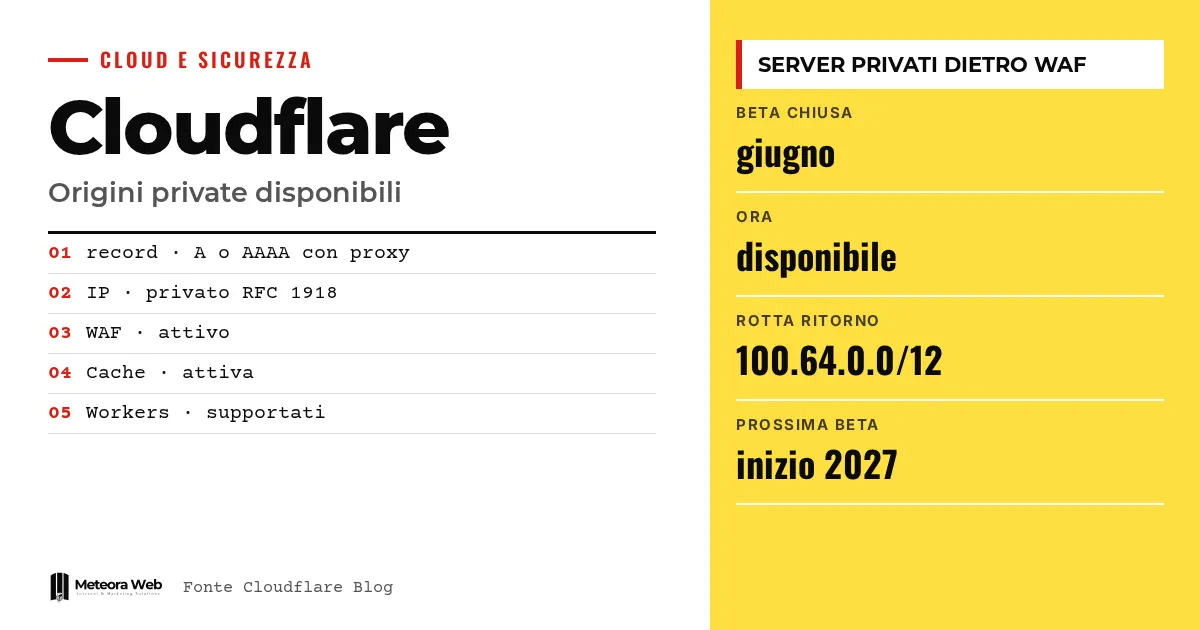
Cloudflare has made support for private origins generally available, after launching it in closed beta in June. A proxied DNS record can now point to a private IP, and traffic reaches the server through the existing Cloudflare One connection. For those who manage internal APIs, AI agent backends or operations tools, this means applying WAF, caching and bot management without exposing the server to the Internet. What remains to understand is which requirements really matter.
A few terms before we get into the facts. Origin is the server that hosts the application, behind Cloudflare. WAF is the web application firewall that filters malicious requests. Cloudflare One is the company's private connectivity platform, with tunnels and networks. RFC 1918 defines private IPv4 addresses, such as 10.0.0.50. CGNAT refers to the shared addresses in the 100.64.0.0/10 block, used by carriers.
What has Cloudflare released?
According to the official Cloudflare blog, during the closed beta access was reserved for eligible customers, who requested it from their account team. Now access opens beyond that group.
You point a proxied A or AAAA record to a private IP, and the application tools work as they do for public origins.
- WAF and managed rules
- Bot management
- Rate limiting
- Caching
- Transform and rewrite rules
- Workers
What problem does it solve?
Cloudflare says it has often heard the same problem. Internal APIs, AI agent backends, MCP servers and operations tools were not built to live on the Internet, but they must accept requests from partners, customers or agents.
Before, putting Cloudflare in front of these services required a public IP, an open port on the firewall or cloudflared next to the server. Often private applications went without the same protections as public ones.
Those working on private networks can explore our guide on private subnets and security groups on AWS.
How does private routing work?
You create a proxied record pointing to the origin. For the supported private ranges, the private routing option activates on its own. If the origin has a public IP reachable only from the private network, you enable it manually.
The setting is automatic for RFC 1918 addresses, for the RFC 6598 CGNAT block and for RFC 4193 local IPv6. For these ranges it cannot be disabled, and attempting it via API returns an error.
Via API it is enough to set the private_routing attribute on the DNS record. When the proxy sees it, it passes the request to the private network layer, which uses the existing connectivity, among IPsec, GRE, Cloudflare Tunnel, CNI or Cloudflare Mesh. With Cloudflare WAN no connector is needed on the origin. With Mesh a connector in the network can serve multiple origins.
What is needed to activate it?
There are some requirements indicated by Cloudflare.
- The Private Origins entitlement on the account, to be requested from the account team.
- Cloudflare One connectivity with IPsec, GRE, CNI, Tunnel or Mesh.
- Unified Routing enabled, except with Tunnel.
- With WAN or Mesh, a return route for Cloudflare's source ranges, 100.64.0.0/12 for IPv4 and 2606:4700 – cf1:5000 – – /64 for IPv6.
Cloudflare warns that the missing return route has been the most frequent configuration error. If requests time out and nothing reaches the server, check that first.
Limits to know
There are still limitations. Argo Smart Routing and dedicated CDN egress IPs are not supported, and origin health checks require Load Balancing. The full list is in the developer documentation. We have no pricing and no independent verification, and activation goes through your account team. Traffic between private networks is still in progress.
What changes for those working in digital
If you expose APIs to partners or AI agents, you can keep the server without a public IP and without open ports, reducing the attack surface. A server with clear access rules still needs to be configured carefully at the Linux network level. WAF rules, caching and bot management already in use apply to the hostname without further changes. For small businesses the constraint is commercial, since it requires a Cloudflare One infrastructure and contact with the sales team.
Our take
The step is useful, because it brings public-facing protections to places where people previously gave them up for convenience. But the hidden cost is dependency. Protecting a private service means tying networking, DNS and filtering to a single vendor, with requirements that go through the account team. For companies already using Cloudflare One it makes sense; for others, it is worth comparing simpler solutions before committing.
Frequently asked questions
What are Cloudflare private origins?
They are servers with a private IP, reached by Cloudflare through your Cloudflare One connection. They remain unexposed on the Internet. WAF, caching, bot management and Workers work as they do for a public origin.
Do I need to open a port on the firewall?
No. According to Cloudflare, the origin keeps its private IP and no inbound exception is needed on the firewall. With Cloudflare WAN you do not even need a connector on the server.
Which connections are supported?
Cloudflare lists IPsec, GRE, CNI, Cloudflare Tunnel and Cloudflare Mesh. Unified Routing works on all of them except Tunnel.
Why do requests time out?
Almost always the return route is missing. Cloudflare says it was the most common error during the beta. With WAN or Mesh, configure routes for 100.64.0.0/12 and 2606:4700 – cf1:5000 – – /64.
Does it also work between private networks?
Not yet. The release covers public traffic to private origins. Cloudflare aims for a closed beta for traffic between private networks in early 2027.
The move to private network traffic, expected in 2027
Cloudflare's next declared step is to bring WAF and rate limiting also between private networks. For now it is an ambition, with a closed beta expected in the first months of 2027.
- Read the up-to-date list of limitations in the documentation before planning a migration.
- Ask your account team about the access conditions for Private Origins and the upcoming private beta.
- Inventory which internal services really need to receive requests from outside, to know where this protection is needed.