 Ing. Calogero Bono
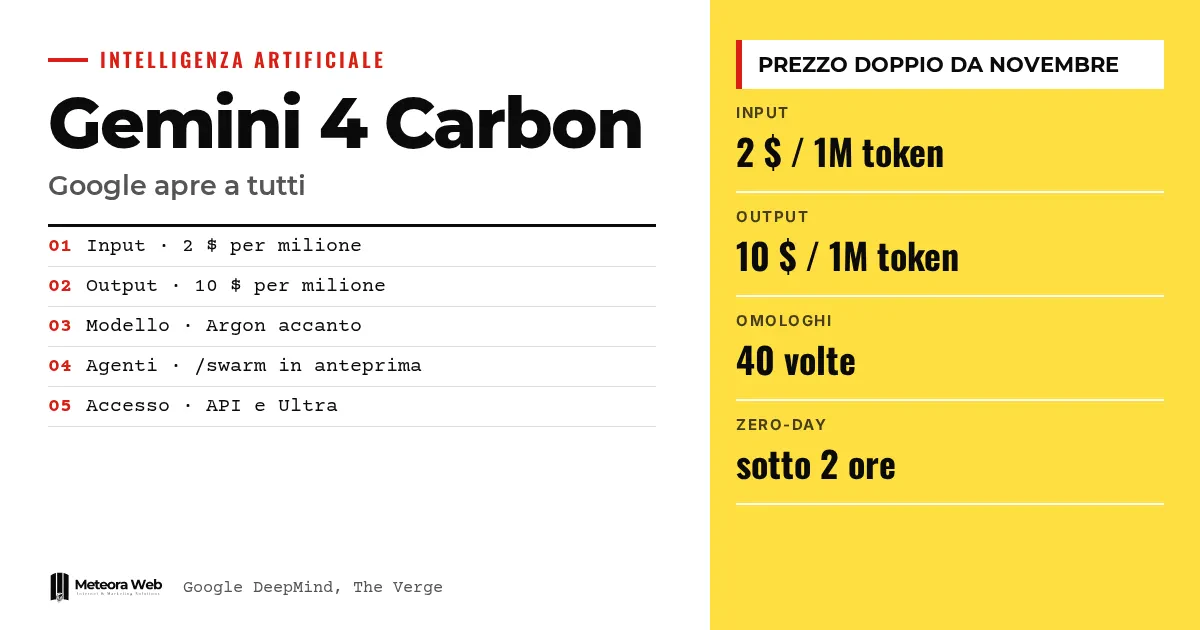
Google has made Gemini 4 Carbon available to developers, businesses, scientists and consumer users, two weeks after its release to a group of cybersecurity experts. According to Google, it is its most powerful model, designed for long and complex tasks. The introductory price is the same as Gemini 4 Argon. For those who develop software or use AI in the business, what changes is how you choose between models, not just how much you spend.
A few terms before we get into the facts. Token is the unit in which models read and write text, and pricing is calculated on it. An agent is an AI system that carries out multi-step tasks using tools. Long-horizon refers to long jobs with many connected steps. Zero-day is a vulnerability still unknown to those who should fix it. Benchmark is a standard test used to compare models.
What is Gemini 4 Carbon and how does it differ from Argon?
According to Google DeepMind, Carbon is the most powerful model in the family, with frontier performance in cybersecurity and in long-running agentic workflows. Argon, released shortly before, remains for Google the ideal choice for most development and knowledge work.
Carbon, instead, is designed for the tasks that test the model, such as complex multi-step debugging and open-ended scientific research. To do this it uses more tokens than Argon, explores in depth and carries out long verification cycles. The Verge explains this too. We have already covered the limited debut in this article.
How much does it cost and where can it be used?
API access is available in Google AI Studio and Gemini for business, for all paying developers and businesses. The introductory price is 2 dollars per million input tokens and 10 per million output, the same as Argon. Google AI Ultra subscribers also find it in Antigravity, the Gemini app and AI Mode in Search.
According to The Verge, the price is about a fifth of OpenAI's GPT-6 Astra and a quarter of Anthropic's Fable 5.2. Costs double at the end of November, when the introductory period ends. The price per token does not, however, reveal the real cost, because models use different amounts of tokens for the same task. If you want to try it, Google AI Studio is the starting point.
What is Antigravity's swarm feature?
Google previews /swarm in Antigravity, its agent-based development platform. It turns a single prompt into a coordinated team of agents, which you can follow in real time.
According to Google, Carbon takes on the roles that require more reasoning, such as architecture design, coordination and audit. Faster and lighter models work alongside it, in isolated and parallel workspaces, with adversarial verifiers that test every change. To understand how Google's AI is used in code, see our guide on code generation and review.
What results does Google claim in security and science?
These are claims from Google and its partners. In the internal Project Fortify system, Carbon achieved 100% recall in scanning and 95% precision in selection, on an internal benchmark. With Wiz's Scan for Good program it found zero-day vulnerabilities in two major SaaS vendors in under two hours.
In science, Google cites the formal verification of Signal's cryptographic protocol code, in weeks instead of the years expert teams would need. In protein structure prediction, across seven protein families, Carbon recovered on average 40 times more homologs. Google notes that broader tests are still ongoing.
Limits to know
Almost all the results come from Google and selected partners, often on internal benchmarks or pre-release evaluations. The Verge points out that companies pick the most favorable results, and that Carbon trails Fable 5.2 on most metrics. It is not clear if or when the model will reach lower-tier subscribers or free users. The real cost per task still needs to be measured, and prices double at the end of November.
What changes for those working with digital tools
If you develop software, you now have two models from the same family at the same price, and you need to decide where the more token-expensive one is truly needed. For everyday tasks, Google itself points to Argon. Carbon makes sense for migrations, investigating the causes of a bug, and security reviews. For those integrating AI into products, it is better to measure the cost per task rather than stopping at the price per token. Those starting from scratch can use our Gemini API guide.
Our take
The move is strong on price, but price is the most fragile part. The doubling at the end of November arrives just when many companies will have built workflows around the model. The security results, while interesting, should be read for what they are. They are cases chosen by the company itself and its partners. What will be more useful is seeing how Carbon performs on real code from small businesses, not just on large open source projects.
Frequently asked questions
Is Gemini 4 Carbon free?
No. The API is for paying developers and businesses, at 2 dollars per million input tokens and 10 output. Google AI Ultra subscribers find it in Google products. It is not clear whether it will reach free users.
Is Carbon better than Argon?
It depends on the task. For Google, Argon remains the ideal choice for most development and knowledge work. Carbon is for complex multi-step tasks, and it consumes more tokens.
What is /swarm?
It is a preview feature in Antigravity. It turns a prompt into a coordinated team of agents, which you can follow in real time. Carbon can handle the design, coordination and audit roles.
Will this price stay the same?
No. According to The Verge the introductory price doubles at the end of November. It would still be lower than competitors per token, but not necessarily per task.
Where can I try it?
In Google AI Studio and Gemini for business, with the paid tier. Google also mentions Android Studio. Ultra subscribers also use it in Antigravity, the Gemini app and AI Mode.
What to watch after the introductory price ends in late November
The coming weeks will show whether Carbon holds up outside the tests chosen by Google. It also matters to see how the real cost changes after the doubling.
- Run the same real task with Argon and Carbon and compare tokens used and result quality.
- Mark the end-of-November date and calculate the monthly cost at the doubled price before building on it.
- Check whether Google extends Carbon to lower plans and whether it publishes independent benchmarks beyond its own.