Ing. Pietro Maiorana
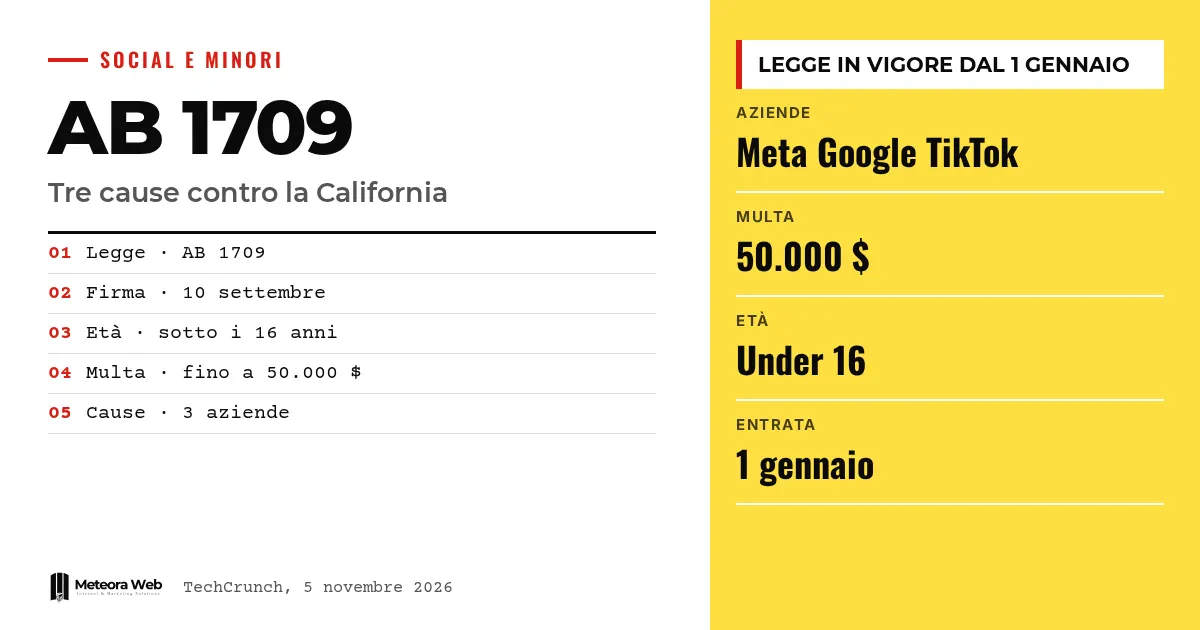
Meta, Google and TikTok have filed three separate lawsuits against California Attorney General Rob Bonta to block AB 1709. The law restricts features considered additive for users under 16 and is set to take effect on January 1. The companies argue it violates freedom of expression. It also matters outside the United States, because it weighs the protection of minors against the privacy of all users.
A few terms before we get into the facts. AB 1709 is the California law on minors and social media, signed by Governor Gavin Newsom. First Amendment is the American rule that protects freedom of expression. Section 230 is the federal rule that often shields platforms from liability for content. Autoplay is the automatic playing of videos. Personalized feed is a list of content chosen by algorithms based on the user's behavior.
What does the AB 1709 law provide?
According to TechCrunch, the law bans platforms from offering autoplay videos and personalized feeds to users under 16. If these users do not turn the features off, platforms must delete their accounts. Violations carry fines of up to 50,000 dollars for each minor involved.
The text, cited by Social Media Today, covers additive feeds, infinite scroll, autoplay and equivalent features that learn from behavior to extend use. Newsom signed the law on September 10.
Why are Meta, Google and TikTok suing?
The three companies argue that the law violates the First Amendment and is superseded by Section 230. Meta writes that the state cannot override its editorial choices. According to Engadget, the lawsuits were filed in different courts across California.
A TikTok spokesperson called the rule an unconstitutional restriction on curating content based on preferences, a practice also used by libraries, TV networks and streaming services. Google points out that on YouTube autoplay is already off by default for minors and that parents can disable Shorts.
What does adults' privacy have to do with it?
The Electronic Frontier Foundation criticizes the law from another angle. Rindala Alajaji argues that the rule forces platforms to collect more information from every user, because they need to determine who is under 16. For her it is a "functional ban" on social media for young people.
The issue is well known to digital security experts. Age verification can compromise the privacy of adults too. A similar debate has unfolded in Europe, as we cover in this article on Estonia and bans for minors.
In what legal context does the lawsuit arrive?
Platforms face many proceedings. According to Social Media Today, in March a California jury found that apps such as Facebook, Instagram and YouTube may have significant effects on young people's mental health. Engadget mentions thousands of lawsuits from individuals, schools, cities and public bodies.
Meta, TechCrunch writes, reportedly agreed to pay up to 18 billion dollars to settle claims from 29 American states. The company, Engadget notes, denies any wrongdoing. On the international front, Australia banned social media for under-16s in December 2025, while in France the supreme court annulled a similar law.
Limits to know
The lawsuits are still at an early stage and no judge has ruled yet. We do not know whether the law will take effect on January 1, or whether it will be suspended. The sources do not explain how platforms would verify age. The versions of the sum Meta agreed to pay differ in detail (up to 18 billion or more than 18 billion), and Bonta's office has only said it is reviewing the filings.
What changes for those who work in digital
If you work with apps, social networks or sites with young users, this is not only an American issue. Features such as algorithmic feeds, autoplay and infinite scroll become a regulatory risk. It is worth knowing where they sit in your products and whether they can be switched off by age group. Those who manage company pages should expect changes in how content reaches young people, as is already happening with Meta's parental alerts. Age verification also weighs on the data collected.
Our take
The problem is real, but the law bets on a fragile solution. If identifying who is under 16 requires more invasive checks, the privacy of everyone pays the price. The companies, however, defend legitimate principles with convenient arguments, since they built systems designed to hold attention. Defending freedom of expression does not erase the weight of lawsuits, rulings and settlements. The court will have to distinguish between content and the design of the service, and that is where the game will be decided.
Frequently asked questions
When does the AB 1709 law take effect?
On January 1, unless judges decide otherwise. The lawsuits aim precisely at blocking its enforcement before that date.
Which features does the law restrict?
Autoplay, personalized feeds and infinite scroll for users under 16. The text also includes equivalent features that learn from behavior to extend use.
What fines do platforms risk?
Up to 50,000 dollars for each user under 16 involved. This is reported by TechCrunch.
Why does the EFF criticize the law?
Because, according to the organization, it forces platforms to collect more data from all users. For Alajaji it also reduces young people's freedom of expression.
Does the law apply in Italy?
No, it is a California law. It does, however, show a broader debate on limits to social media for minors, with examples from Australia and France.
What to watch before January 1
The decisive date is close. The first court decisions will show whether the law goes ahead or is suspended.
- Follow whether a judge suspends enforcement of the law before the start of the year.
- Check whether platforms announce new age verification systems and what data they ask for.
- Watch whether other states or countries copy the AB 1709 model or follow the Australian one.