 Ing. Calogero Bono
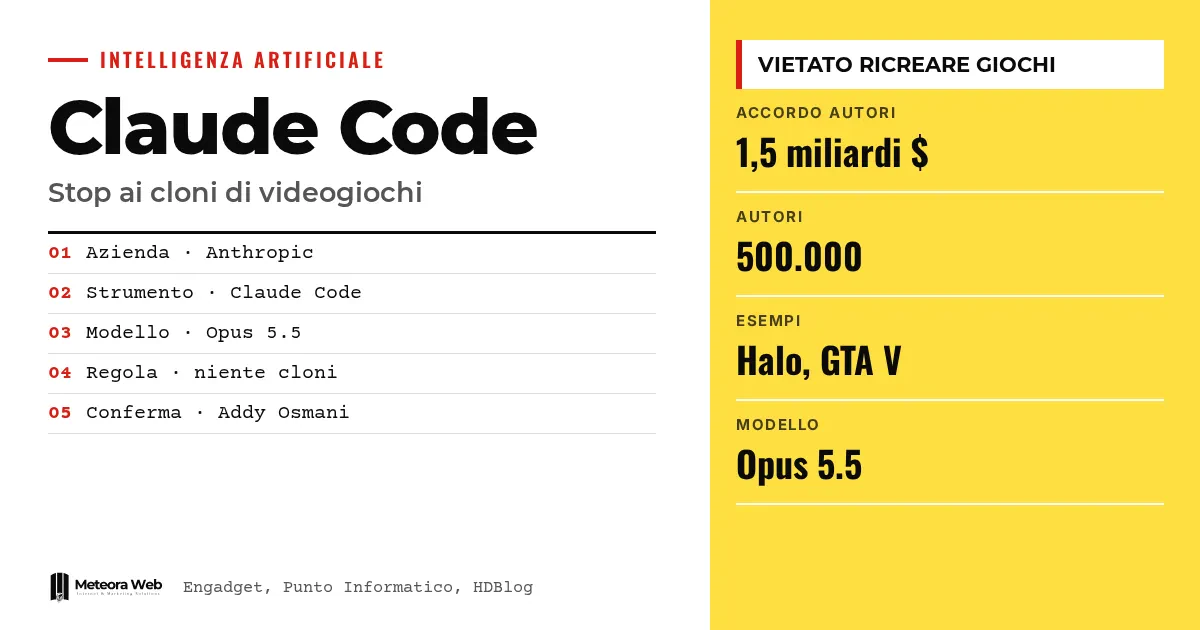
Anthropic has added a new rule to Claude Code. The assistant will no longer recreate a specific existing video game, even if it is renamed or presented as original. The change was spotted by a user on X and then confirmed by Addy Osmani, of the Claude Code team. It matters because today a single prompt can produce a playable prototype, and the line between inspiration and copying becomes a concrete issue for developers.
A few terms before we get into the facts. Claude Code is Anthropic's tool for programming with AI assistance. A prompt is the text instruction you give the model. A clone is a game that faithfully reproduces an existing title. Vibe coding is development driven by instructions, where the AI writes most of the code. IP stands for intellectual property, meaning the rights to works, trademarks and assets.
What does Claude Code's new rule say?
According to Engadget, the new lines of instructions say to create original games, games of a genre, and games based on the user's projects and assets. They then prohibit building the recreation of a specific existing game, even if renamed or declared original.
Punto Informatico reports that the rule is applied automatically when the user tries to do something similar. The outlet describes it as an instruction sent from Anthropic's servers. HDBlog specifies that the change concerns the Opus 5.5 model.
What did Anthropic confirm?
Addy Osmani confirmed the change on X. According to Engadget, he explained that the company wants to steer it away from "recreating someone else's specific game, because using Claude to infringe intellectual property goes against our usage policy".
Osmani clarified that original games, games of a genre, or games built from the user's own projects and assets should not be affected. He added that Anthropic will keep "iterating to make sure we strike the right balance". This last sentence is important, because it suggests the rule may still change.
Why is Anthropic stepping in now?
Engadget points to a rise in AAA games decompiled with AI help and made playable in the browser. Examples cited include Halo, Call of Duty and GTA V, presented as fan projects built with vibe coding. HDBlog confirms that clones have already appeared in recent months.
Punto Informatico offers another reading. With GTA 6 now approaching, it is easy to imagine attempts to rebuild it with AI. This is the outlet's hypothesis, not something Anthropic has stated.
What legal precedents does Anthropic have on copyright?
According to Engadget, last year Anthropic agreed to pay 1.5 billion dollars in a class action in which 500,000 authors accused it of using protected material to train its models. More recently, the heirs of Elvis Presley filed a lawsuit for similar reasons.
Punto Informatico recalls the complaint over Presley's songs, allegedly used in training. If you want to understand how Anthropic positions itself against its competitors, we have compared Claude and OpenAI on safety and practical differences.
To go further, Anthropic reveals Claude's hidden space while OpenAI aims for a super app – two faces of the same European dependence and Anthropic reveals Claude's 'hidden space' – transparency becomes a political problem for Europe.
Limits to know
We do not know the full text of the instructions or how Claude tells a copy apart from a game inspired by a genre. The sources do not say how effective the rule is, or whether it also blocks mods or amateur projects. Punto Informatico reports, citing a post on X, that there is no setting to turn it off, but we have not verified this directly. Anthropic itself talks about future adjustments.
What changes for those working in digital
If you develop games or prototypes with AI, avoid requests aimed at replicating a specific title. Briefs based on a genre or on your own assets work better. If you work for clients, always ask where the graphics, music and mechanics come from. More broadly, programming assistants are learning to refuse some requests for intellectual property reasons, and this applies to websites and apps too. It is worth documenting what you asked for and what you got.
Our take
The move is understandable, but incomplete. A rule written in a system instruction is easy to get around with indirect descriptions, and the boundary between genre and copy remains blurred. It does, however, have practical value, because it moves responsibility before abuse rather than after the fact. Given the company's legal history, it is also a cautious choice. What remains to be seen is whether the line will be applied consistently or only in the most obvious cases.
Frequently asked questions
Can Claude still create video games?
Yes. Claude can help with original games, games of a genre, or games based on the user's own projects and assets. The ban only concerns recreating a specific existing game.
Does renaming a clone get around the block?
No. The rule reported by the sources prohibits recreation even if the game is renamed or presented as original.
Which model is affected?
According to HDBlog, the change concerns the Opus 5.5 model in Claude Code. The other sources do not specify the model.
Who confirmed the news?
Addy Osmani, a member of the Claude Code team. He spoke on X after a user reported noticing the new instruction.
Why did Anthropic introduce the rule?
Because, according to Osmani, using Claude to infringe intellectual property goes against the company's usage policy. The context is a rise in clones of famous games playable in the browser.
How the clone ban will be applied in the coming months
Anthropic has said it intends to keep calibrating the rule. The key point will be seeing where it draws the line between genre and copy.
- Follow any updates to Anthropic's usage policy and its public clarifications.
- Watch whether other AI programming tool providers introduce similar limits.
- Keep an eye on the outcome of copyright cases involving Anthropic, since they may shape future rules.