 Ing. Calogero Bono
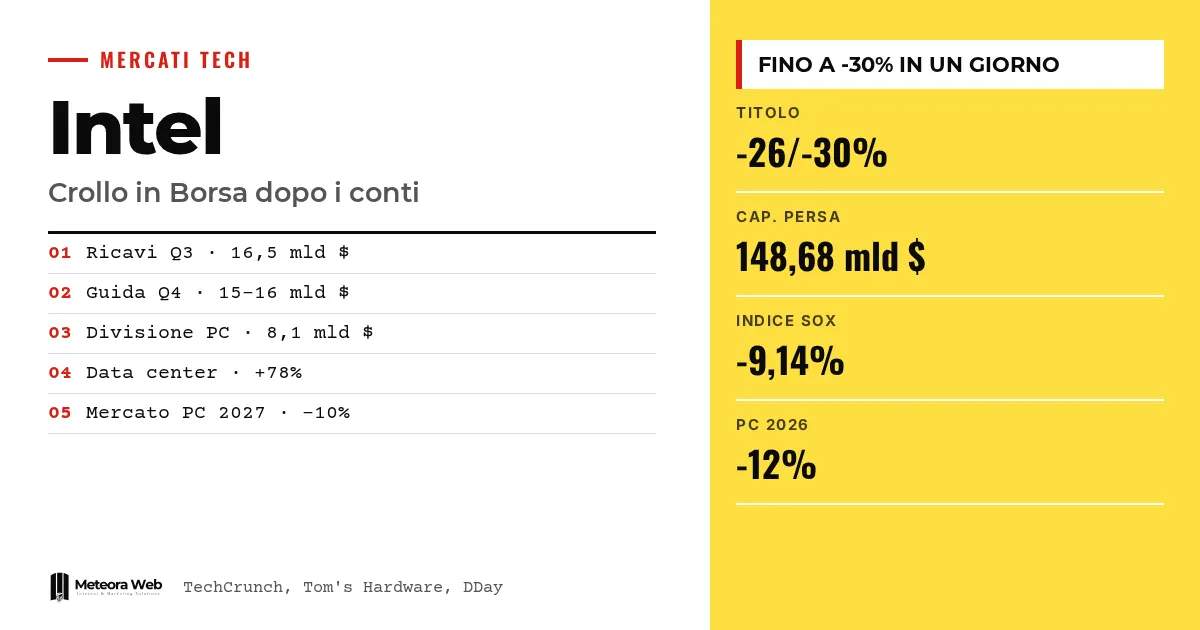
On Friday Intel shares lost between 26% and 30% depending on the moment of the session, after the company reported its third-quarter 2026 results. The quarter itself was good, but the forecast for the fourth was worse than expected. The reason is the PC market, slowed by memory prices. The sell-off dragged the entire semiconductor sector with it, and it affects anyone who buys or develops hardware and services.
A few terms before we get into the facts. Guidance is the company's forecast of revenue and margins for the next quarter. The gross margin shows how much is left from each dollar of sales after production costs. CCPG is the division that sells processors for PCs. A foundry produces chips on behalf of other companies. Market capitalization is a company's stock market value.
What happened to Intel on the stock market?
According to TechCrunch the stock fell about 28%, one of its worst days ever. For Tom's Hardware the loss was 30%, nearly 150 billion dollars of market capitalization in one day, the company's record negative.
Market capitalization dropped to 338.91 billion, almost 50% below the peak of 673.43 billion reached in mid-June. TechCrunch calculates that the decline removed 12 billion from the value of the 10% stake held by the US government. The stock is still up more than 70% since the start of the year.
Why did it fall if the results were good?
As DDay reports, the quarter closed with 16.5 billion in revenue, up 21% year on year, and earnings per share of 0.52 dollars against the 0.38 the company had indicated. Expectations are what weigh.
For the fourth quarter Intel expects revenue between 15 and 16 billion, while analysts had expected about 17. On gross margin the sources differ. TechCrunch reports a fall to 37% from 43%, DDay to 38% against the 44.1% just recorded. Intel also expects not to generate positive cash, given the size of its investments.
What do memory prices have to do with PCs?
It is the main cause indicated by Intel. Artificial intelligence absorbs memory and other components, PCs cost more, and budgets remain limited. CEO Lip-Bu Tan said, "Our customers have started to signal a slowdown in PCs tied to memory pricing and availability."
The client division brought in 8.1 billion, 9% less than the previous quarter, and a drop of over 20% is expected for the next one. Intel estimates the PC market will fall 12% in 2026 and another 10% in 2027. According to the finance chief, memory prices and availability will not improve in 2027, and the topic may come back in 2028, perhaps. PC makers, moreover, reportedly have warehouses full of processors bought in advance.
Can data centers offset it, and what happened to the others?
Not yet. Data center revenue grew 78% year on year, to 7.3 billion according to DDay, but Intel does not produce enough because demand exceeds capacity. A new factory in Arizona is operational, the next will not arrive before 2028. Intel Foundry lost 1.9 billion, with external revenue of about 411 million.
The SOX index lost 9.14% at midday. Arm dropped 12.68%, AMD 12.48%, Nvidia 5.66%, about 270 billion, more than Intel in absolute value. Dell and Oracle also fell, while Apple lost only 1.66%. Among the positive signals is the Wildcat Lake chip, sold out.
Limits to know
Figures vary between sources, both for the stock drop and the gross margin, and some are intraday estimates. We do not know how long the memory price increases will last, and the 2027 forecasts come from Intel itself. The outlook also depends on production capacity, which will only arrive in later years.
What changes for those who work with digital
If you need to renew computers for your studio or company, expect high prices and uncertain availability at least until 2027. It makes sense to plan purchases and extend the life of your devices. Developers can count on more server capacity, but rising hardware costs weigh on budgets. So, if you manage software or infrastructure, consider managed hosting instead of buying machines.
Our take
The crash reflects more the concern over the sustainability of the AI race than a disaster at Intel. A quarter with revenue up 21% should not produce a 30% loss, and this shows how stretched valuations were. There remains a real problem, though, because the core PC business is shrinking while factories for server chips are not enough. It is an uncomfortable situation, and the price of memory is not in Intel's hands.
Frequently asked questions
How much did Intel fall on the stock market?
Between 26% and 30%, depending on the source and the time. Tom's Hardware reports nearly 150 billion dollars of market capitalization wiped out in a single day.
Why are PC sales falling?
Because of memory costs. AI absorbs components, prices rise, and companies and households postpone purchases.
Did Intel close the quarter at a loss?
No, revenue was 16.5 billion, up 21% according to DDay. The problem is the forecast for the fourth quarter.
Will data centers save Intel?
They help, but are not enough for now. Revenue grows 78%, yet Intel does not have enough production capacity.
When will the PC market recover?
Intel does not expect improvements in 2027. Its finance chief said the topic may come back in 2028, perhaps.
What to watch at Intel between memory, servers and new factories
The coming months will show whether the drop in PCs is offset by servers. Memory prices and new production capacity matter most.
- Follow memory prices, since they determine how much PCs will cost in the coming quarters.
- Watch data center revenue in the next results, to see whether it offsets the PC decline.
- Keep an eye on production capacity, because Intel's next factory will not arrive before 2028.