 Ing. Calogero Bono
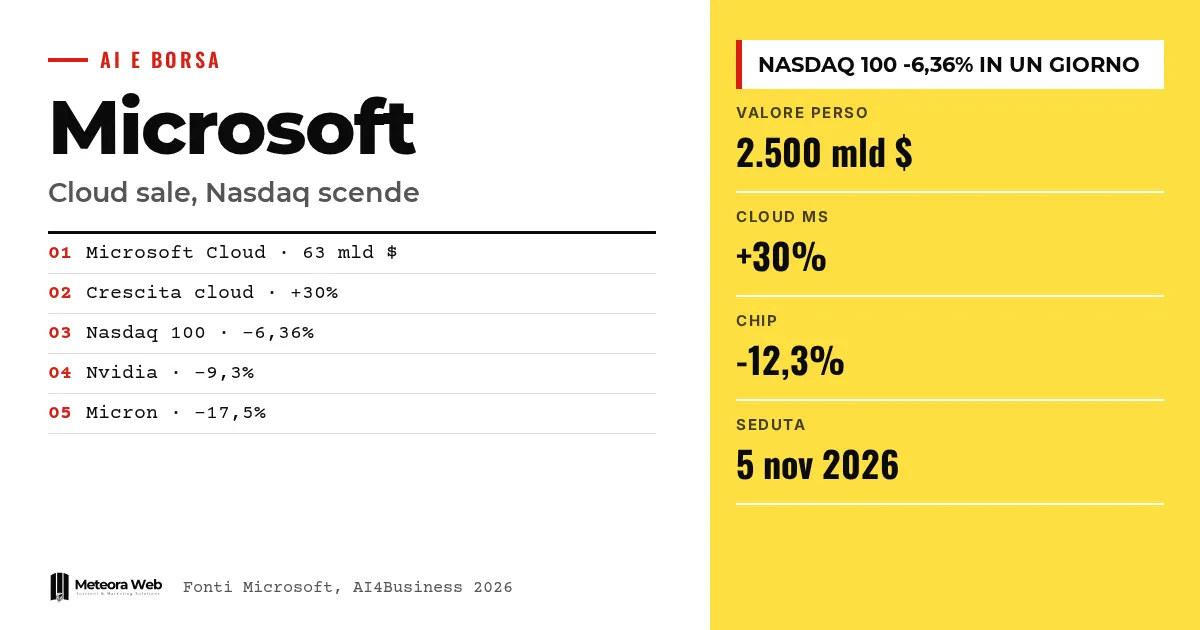
On 28 October 2026 Microsoft presented its first fiscal quarter results, with Microsoft Cloud revenue above 63 billion dollars and growth at 30 percent. A few days later, on 5 November, the Nasdaq 100 lost 6.36 percent in a single session, roughly 2,500 billion in market capitalization. The two pieces of news seem to contradict each other, but they point to the same question – how much it costs to build computing capacity for AI, and how much return it will bring.
A few terms before we get into the facts. Capex refers to investments in plants and infrastructure, here mostly data centers. Hyperscaler indicates the large cloud operators such as Amazon, Alphabet, Microsoft and Meta. Credit default swap is a contract that insures against the non-repayment of a debt, and its price measures the perceived risk. Moratorium is the temporary suspension of new permits. Copilot is Microsoft's AI assistant built into its products.
What did Microsoft say about the results?
On the earnings call Satya Nadella spoke of a fast start to the fiscal year. Microsoft Cloud passed 63 billion dollars, with growth accelerating to 30 percent a year. These are figures declared by the company.
Nadella describes Copilot as "the new operating system for work". According to Microsoft, daily active users rose by almost 50 percent over the quarter and customers with more than 50,000 seats grew more than eightfold over the year. Volkswagen announced adoption for more than 330,000 employees.
What happened on the stock market on 5 November?
According to AI4Business, the Nasdaq Composite lost 5.52 percent and the semiconductor index about 12.3. It was the worst day for the tech index since April 2025.
The hardest hits went to those who sell components and computing capacity. Nvidia lost 9.3 percent, AMD 17.3, Micron 17.5. Alphabet and Amazon fell 2.2. These are valuation changes, not money leaving companies' accounts.
Why do data centers have to do with elections?
The trigger, according to the source, is the midterm elections. In Texas the incoming governor Gina Hinojosa has promised a moratorium on new permits, pending guarantees on water, electricity and incentives.
An estimate attributed to UBS by Reuters indicates that about 30 percent of the new US capacity expected for 2028 could face delays. It is a risk assessment, not a count of cancelled plants. We also wrote about this in La bolla non è degli altri.
Can the RAM crisis end in 2027?
According to the analysis by Tom's Guide, which is an opinion and not a fact, there is no immediate relief. The 2026-2027 memory contracts are already locked in at high prices and the squeeze on consumers lasts until early 2027.
The author hypothesizes a price plateau in the second quarter and declines from mid-2027, only if orders from large operators really slow down. He also notes that a simple stock market drop is not enough.
The market reaction is not isolated. Even Intel had crashed after its fourth-quarter forecast, with the PC market under pressure.
Limits to know
Microsoft's figures are declared by the company and the available transcript is partial. The numbers on Alphabet, Amazon and Meta come from a secondary source. The risk on 30 percent of the 2028 capacity is an estimate, not a fact. The forecasts on RAM are an opinion and depend on orders, permits and regulations still to be defined. The rebound of 6 November was only initial.
What changes for those who work in digital
For a business, cloud remains in growth, but hardware and memory prices may stay high for months. If you need to renew PCs or servers, weigh the timing carefully and do not count on short-term discounts. Those who develop software with AI agents should keep an eye on usage-based costs, because Microsoft is moving from seat-only subscriptions to a model based on consumption. Even the race for coding agents has a bill to pay. If you manage infrastructure, managed hosting helps you avoid depending on market moods.
Our take
Talking about a bubble that is bursting is premature, but talking about everything being fine is just as wrong. Microsoft's results show real demand. The crash shows that investments are financed by confidence that can crack in a day, especially for those who rely on debt. The difference will be made by the ability to turn AI into revenue, not by stock market prices. We already discussed this in this editorial.
Frequently asked questions
Has the AI bubble burst?
It has not been proven. The Nasdaq is in correction, but cloud revenues keep growing. Sources speak of a revision of expectations, not of vanished investments.
How much did the Nasdaq lose on 5 November 2026?
The Nasdaq Composite lost 5.52 percent and the Nasdaq 100 lost 6.36. According to Reuters, the Nasdaq 100 wiped out roughly 2,500 billion in value.
How did Microsoft's cloud perform?
Microsoft Cloud passed 63 billion dollars, with growth at 30 percent. These are figures declared by the company on the 28 October 2026 call.
Why do the US elections matter for AI?
Because they could slow permits for new data centers. In Texas a moratorium on new permits has been promised, until guarantees on water and energy arrive.
Will RAM prices come down?
Not immediately. According to Tom's Guide the squeeze lasts until early 2027, with possible relief from mid-year. It is the author's opinion, not a certainty.
What to watch in the coming months across data centers and the stock market
The real signal will not be the next trading session, but the orders from large operators and local rules. These are the points to follow.
- Follow whether the Texas moratorium becomes law and whether other states copy it.
- Check the upcoming quarterly reports of the major cloud groups on investment and demand.
- Ask suppliers for long-validity price lists before signing contracts for hardware or cloud.