 Ing. Calogero Bono
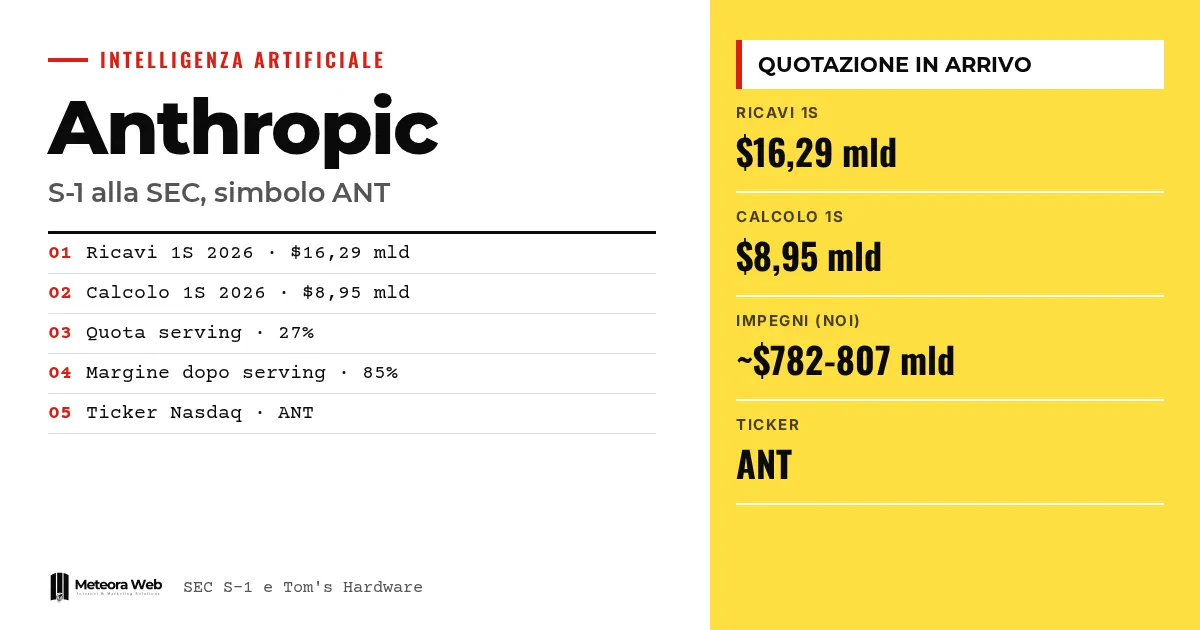
Anthropic has filed with the SEC, the US securities regulator, its Form S-1 for an initial public offering. The Class A common shares will be listed on the Nasdaq Global Select Market under the ticker ANT. The number of shares and the price range have not been set yet. The filing opens the company's books for the first time, the firm behind Claude, and shows how much it costs to run artificial intelligence. If you use the APIs or build products on these models, those costs will sooner or later show up in the price lists.
A few terms, before we get into the facts. The S-1 is the form with which a company asks the SEC to register securities before selling them to the public. Inference and «serving» refer to the computing work needed to answer customers, that is, running the already trained model. TPUs and GPUs are specialized chips, the first developed by Google, the second typically from Nvidia and AMD. «Compute» is the total computing capacity. Run-rate is annualized revenue, meaning the current pace projected over twelve months.
What Anthropic has filed
According to the official Anthropic announcement, the company is a PBC, a public benefit corporation, and has submitted the registration for the offering of Class A shares. The announcement specifies that the offering will be made only by means of a prospectus. Copies of the preliminary prospectus, when available, can be requested from Goldman Sachs and Morgan Stanley.
The registration has been filed but is not yet effective. Until it becomes so, the securities cannot be sold and no purchase offer can be accepted. The announcement is therefore not an invitation to buy.
The financial details instead come from the analysis that Tom's Hardware made of the document. The outlet writes that Anthropic's IPO could come before OpenAI's, which filed confidentially, while Sam Altman has said his own will not arrive this year, amid widespread doubts about an AI bubble.
Where does the compute money go?
In the first half of 2026 Anthropic reports revenue of 16.29 billion dollars, against 1.16 billion in the first half of 2025. Spending on compute and infrastructure rose from 2.33 to 8.95 billion. Of this, 2.38 billion goes to serving paying customers, less than a third of the total.
The rest goes to training, research and internal use of Claude, estimated at at least 5.93 billion, plus a maximum estimate of 640 million for free access. The breakdown estimates come from Tom's Hardware, because the company does not explain how it decides the split. According to the source, Anthropic treats compute as «a single, shared resource across all workloads».
The margin on the service
The cost of the service grew about 2.3 times, revenue 14 times. According to Tom's Hardware's estimate, Anthropic keeps about 85 cents for every dollar after serving costs, against 12 cents a year earlier. Adding partner commissions and marketing, the share drops to 66 cents. The item weighing most on the negative operating result is research and development, which grew about fivefold.
Why serving costs less
Anthropic states that since June its models have become cheaper for customers. Opus 5.5 would have cut the cost of tasks by about 40% compared with Opus 5, Fable 5.1 by about 25% compared with Fable 5, all while «preserving margins». Tom's Hardware notes another element, however. The company says it has operated in an environment where demand exceeds available compute, so serving costs may have been kept low also thanks to scarce supply. The original reads «consistently operated in a compute-constrained environment where customer demand exceeds available compute».
How heavy are the compute commitments?
Here the numbers are far larger than the revenue. The company uses different chips, namely Amazon's Trainium, Google's TPUs, Nvidia GPUs and AMD GPUs, without indicating percentage shares. The main contracts cited in the document are these.
- Broadcom, TPU rentals for about 161.2 billion dollars in fees, over five years.
- Google, at least 114.5 billion between April 2026 and July 2033, plus an estimate of 125-150 billion from 2028 to 2031.
- Amazon, at least 110 billion between May 2026 and April 2036.
- SpaceXAI, up to 120.5 billion for Nvidia GPUs, until 2029.
- Microsoft, at least 44.9 billion. Nscale, up to 44.6 billion. Lambda, about 41.3 billion. AMD, over 20 billion with no fixed commitment.
The tally is Tom's Hardware's. Adding up the named contracts gives about 782-807 billion dollars, while the document leaves the total blank. The five largest deals would cost on average about 103 billion a year at full run rate, more than double the revenue at the second-quarter pace, about 46 billion a year.
Minimum purchase commitments, excluding rentals, went from about 55 billion at the end of last year to about 265.6 billion at the end of the second quarter. Since then about 245 billion of new ones have been signed, rentals included. Anthropic warns that margins could shrink when new hardware arrives before the revenue it is meant to support.
Can Anthropic walk away from these contracts?
It depends on the contract. With Broadcom, Google, Amazon and Microsoft, exit is essentially possible only for the counterparty's default, and with Google and Amazon the minimum is owed regardless of use. With SpaceXAI, one can withdraw with 90 days' notice when the initial periods end, in January and March 2027. With Lambda, a 34.9 billion portion can be terminated by either party if the company does not obtain the facility contract in time.
Nvidia capacity, excluding Microsoft, is the easiest to detach from. Compute bought in advance, the company explains, is paid for and booked when it becomes available, and the base has not fluctuated with demand. For this reason revenue per dollar of compute rose from 0.40 dollars in the first quarter of 2025 to 2.08 in the second quarter of 2026, linked to capacity bought 12-18 months earlier. When it needs more, Anthropic buys short-term compute, which usually costs more.
Limits to know
The document has many blank spaces, including the total of commitments, the table of contractual obligations, third-quarter revenue and the run rate. An amended S-1 should fill them before pricing, but there is no date. The 103 billion a year estimate is linear, meaning it spreads each contract over its duration, except SpaceXAI at the full monthly pace, and it does not include the interest on the Broadcom rentals. Actual payments will grow as capacity arrives. Moreover, compute does not necessarily have to generate revenue, especially in research. Many figures on the cost breakdown are Tom's Hardware estimates and not official data.
What changes for those working in digital
In the short term, nothing changes in the price lists. But the numbers suggest that API prices depend on a chain of enormous commitments, and on a company that says it does not have enough compute. If you build products on these models, it is wise not to tie yourself to a single supplier. Those evaluating AI for their own business can start from our advice on how to adopt AI without wasting budget and from five uses that save time.
For developers the issue is architecture. A well-built integration lets you switch models without rewriting everything, as we explain in the guide to the Gemini API. If you need software that flexibly chooses its AI provider, you can look into custom software development. On the regulatory front, keep an eye on the EU AI Act, which also applies to those who use American models.
Our take
The most interesting fact is not the size of the contracts, but the gap between two stories. On one side, serving Claude today seems very profitable, with an estimated margin of 85% before commissions and marketing. On the other, commitments of nearly 800 billion require revenue that for now does not exist. It is the classic bet of the sector – buying capacity today while counting on tomorrow's demand.
The risk, in our view, is that the story of good margins rests partly on scarce compute, as the same source notes. When all the capacity arrives together, fixed costs will weigh. For developers it matters to know this, because a provider with enormous fixed costs has a strong incentive to sell more and to change prices. The same goes for security issues, as our piece on jailbreak and prompt injection shows, which no listing can solve.
Frequently asked questions
When will Anthropic be listed?
There is no date. The S-1 has been filed but is not yet effective, and the number of shares and the price are not set. The announcement only says that the securities cannot be sold before the registration becomes effective.
Under which ticker will it be listed?
The planned ticker is ANT, on the Nasdaq Global Select Market. It concerns the Class A common shares. The announcement gives no other details about the offering.
How much does Anthropic spend to serve customers?
In the first half of 2026, about 2.38 billion dollars out of 8.95 billion total compute. That is less than a third, and the full breakdown is a Tom's Hardware estimate. The cost rose 2.3 times while revenue rose 14 times.
What is the total value of the compute contracts?
About 782-807 billion dollars, according to Tom's Hardware's sum of the named contracts. The document leaves the total blank, so the figure is not official. It mixes minimums, caps and estimates.
Will Claude's prices change?
We do not know. The company reports cost reductions for tasks since June, but warns that margins may compress when new hardware arrives. No price list changes have been announced.
The dates that matter from now until January
The document's calendar is dense. The Microsoft minimum starts in November, full SpaceXAI delivery is expected in December, and non-cancellable periods end in January and March 2027. Next year brings more Broadcom capacity and the first AMD batch. After that, we will see whether revenue follows.
- Follow the amended S-1, since it should fill in the total commitments, third-quarter revenue and run rate.
- Make your software independent of any single AI provider, so you can switch models if prices move.
- Keep API costs under control in your projects, with a spending cap and monthly monitoring, including on the server where you host them, perhaps through managed hosting.