Ing. Calogero Bono
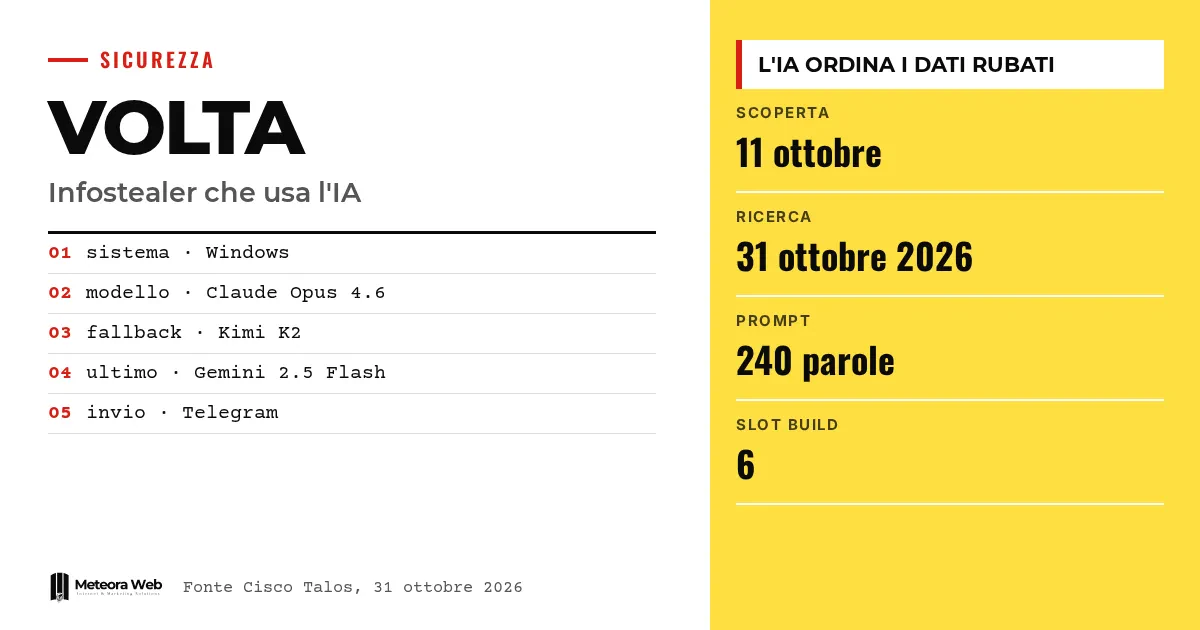
Cisco Talos has published its research on VOLTA-AUTODOXER, a Windows infostealer that uses a language model to rank stolen data by how easily it can be monetized. The sample was first spotted on October 11 and the analysis came out on October 31, 2026. The AI here does not open the door into the system, but decides what is worth exploiting after the theft. For companies and professionals, it changes how you assess the damage of a compromise.
A few terms before we get into the facts. Infostealer is malware that steals passwords, cookies and other data saved on the computer. LLM is a large language model, the kind of AI behind chatbots. OpenRouter is a platform that routes requests to models from different providers. App-Bound Encryption is Chrome's protection that encrypts browser data by tying it to the app. Token is a code that keeps a session open without asking for the password again.
What does VOLTA steal?
According to Cybersecurity360, which picks up Talos's research, VOLTA collects passwords saved in browsers, session cookies, card data, SSH keys, cloud credentials, Microsoft tokens, Wi-Fi passwords and cryptocurrency wallet information. It also searches for messaging and gaming sessions, configuration files and screenshots.
The list is largely standard for an infostealer. According to Tom's Hardware, what makes it dangerous is the next step, the enrichment.
How does it build a profile of the person?
Before querying the model, the malware uses the stolen sessions to dig deeper. It can search Gmail for Amazon and PayPal receipts to confirm the home address and check the order histories on Uber Eats and DoorDash. Talos describes a "structured body of evidence" about the person behind the machine, including location, address, employer, inferred birth year and the last four digits of cards.
On their own these pieces of information are of little use, but combined they identify the victim and their habits. It is the same principle we saw when AI made online anonymity fragile.
What does the AI do inside the malware?
VOLTA saves the data in a local file and sends it through OpenRouter to a model. The embedded instruction, 240 words long according to The Hacker News, asks the model to act as a forensic intelligence analyst. The result must list the assets to monetize with a low, medium or high rating and assess the victim's defenses, including password habits.
Talos sums it up this way – the model is the operator's triage analyst. The AI part is still optional, however. Without model credentials, the malware can send the dossier with no analysis at all.
Why does it use several AI models?
The configuration lists Claude Opus 4.6 from Anthropic as the first model. If the response contains refusal wording, it switches to Kimi K2 from Moonshot AI and then to Gemini 2.5 Flash from Google. Talos reads this as a way to get around the protections of individual models.
The code analysis does not prove that all three ran malicious requests, nor does it imply any role on the part of the providers. We covered the topic of model defenses in jailbreaks and prompt injection.
Limits to know
The research does not document a large-scale campaign, does not give the number of victims and does not identify any Italian organizations hit. The confirmed fact is how the sample works. The template-based structure suggests it could be sold to criminal customers, but it does not prove an established market. There is no data on revenue or success rates.
What changes for those who work with digital tools
Changing a single password after an infection is not enough. Cookies, tokens, cloud keys and wallet recovery phrases must each be handled, revoking any sessions still valid. Companies need to understand which identities were exposed and check authentication logs. Those who manage servers and services can restrict which processes launch Chrome in headless mode, which cuts off one theft route. If you use a hosting service with managed security updates, still verify who holds keys and access.
Our take
The case is useful because it debunks a comfortable idea, that offensive AI is just exploits written by a machine. Here it saves human effort by sorting an archive of stolen data. It is not a new way in, but it lowers the bar for less skilled operators. As Talos puts it, the advantage is not speed or scale but a shift in where the effort goes. It remains to be seen whether the project will actually be sold. In the meantime the weak point is always the same, the computer where secrets are kept in plain text.
Frequently asked questions
What is VOLTA-AUTODOXER?
It is a Windows infostealer discovered by Cisco Talos. It steals credentials and personal data and has an AI model analyze them to estimate which accounts and assets are worth the most.
Which AI models does it use?
The primary one is Claude Opus 4.6 from Anthropic. If it refuses, it tries Kimi K2 and then Gemini 2.5 Flash. The calls go through OpenRouter.
Are there victims in Italy?
None have been reported. The research does not give the number of victims or identify any Italian organizations hit. It describes how the analyzed sample behaves.
What should I do if I suspect an infection?
Before cleaning up, keep the volta_debug.txt file in the AppData folder, since it may show what was collected. Its absence does not rule out a compromise, however.
Is changing the password enough?
No. Tokens, sessions and cloud keys must be revoked too. If a recovery phrase was stored in plain text, Talos recommends moving the funds to a new wallet.
Where malware AI may go in the coming months
VOLTA uses AI in just one phase, but researchers see room for more. It is worth watching how model providers' resistance to refusals evolves.
- Follow Talos's upcoming reports to see whether VOLTA appears in real campaigns and whether it expands to other phases of the attack.
- Check how model providers respond to abusive use of their APIs through routers such as OpenRouter.
- Keep an eye on signs of LLMjacking, meaning the use of other people's API keys, as in the NIK C2 case cited by The Hacker News.
Sources
- cybersecurity360.it, VOLTA, il malware che usa l’AI per valutare il valore delle vittime
- thehackernews.com, New VOLTA Infostealer Uses Claude, Gemini, and Kimi AI to Rank Victims by Financial Value
- tomshardware.com, New AI-driven Windows malware feeds stolen data to Claude to rank victims’ assets by value, then deletes itself