 Ing. Calogero Bono
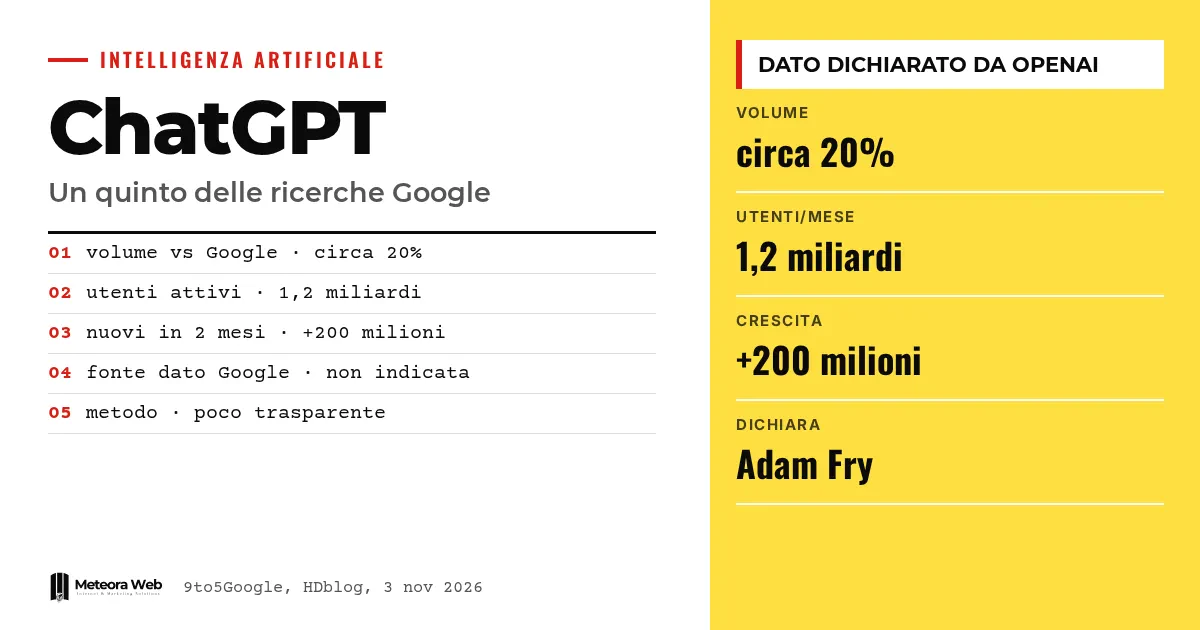
OpenAI claims that ChatGPT now handles roughly a fifth of Google's search query volume. The claim came from Adam Fry, head of ChatGPT's consumer product, in a conversation with journalist Alex Kantrowitz of Big Technology at the start of November. The number is making waves, but the method behind it is unclear. If you run a website or work in online marketing, understanding what the figure actually measures will help you avoid drawing the wrong conclusions.
A few terms before we get into the facts. Query is a request sent to a search engine, a word or a phrase. SERP is the results page Google returns. Search volume is the number of requests over a period, which is different from market share, the measure of who controls the market. AI Mode is Google's mode that answers with artificial intelligence. Monthly active users are accounts that use the service at least once a month.
What did OpenAI actually say?
According to 9to5Google, Fry confirmed during a press event that search volume in ChatGPT is "about a fifth (20%) of Google's query volume". Punto Informatico reports the same statement, made in the interview with Big Technology.
It is therefore a figure declared by the company, not an independent measurement. None of the sources cites a third-party study confirming it.
How does OpenAI count a search?
For OpenAI, a search is a question that leads ChatGPT to search the web. Fry describes it this way, in the translation by 9to5Google "Every time you ask a question and perform a web search, that is a search".
HDblog notes that messages that do not trigger a search, such as a rewrite or a translation, are excluded. Punto Informatico observes that Fry does not clearly explain whether the equivalent of a Google query is a single question.
Conversations, moreover, include follow-up questions. We do not know how these are counted.
Are volume and market share the same thing?
No. HDblog stresses that reaching 20% of Google's volume does not mean holding 20% of the search market. The first is a comparison between two quantities, the second would require considering the entire market on consistent criteria.
Moreover, as 9to5Google points out, the source of the volume attributed to Google was not disclosed. The one-fifth ratio therefore rests on an unknown denominator. It does not even tell us how many people have replaced Google with ChatGPT.
How fast is ChatGPT growing and how is Google responding?
Punto Informatico reports growth of 200 million users over the last two months, up to 1.2 billion monthly active accounts. This too is a number provided by OpenAI.
9to5Google recalls that Google is pushing AI into search and admits it must face "lower monetization". Fry said, according to The Verge, that "most people do not seem to mind the ads" in ChatGPT, and that "we could do more of that". On the subject of bots and scraping you can also read about the single signal in robots.txt adopted by the big AI companies.
Limits to know
The counting method, the source of Google's figure and any external verification are all missing. We do not know how follow-up questions within the same conversation are treated. We also do not know how many ChatGPT searches actually replace Google searches and how many are new. The user numbers are declared by the company and could change with more precise data.
What changes for those working in digital
If you run a website, traffic may also come from AI-generated answers, not only from the SERP. It is worth checking your analytics to see whether visits from assistants appear and how they behave. For those selling online or looking for local customers, clear and verifiable content remains the foundation, as we explain in our guide on JavaScript SEO and rendering. Anyone investing in ads should also think about search intent, as in our article on keywords for Google Ads.
Our take
The figure is useful as a signal, not as a measurement. A company that reports its own growth has an interest in choosing the most favorable comparison, and a ratio with an unknown denominator proves nothing about shares. That said, ignoring the change would be a mistake. The fact that Google admits lower monetization with AI in search suggests the pressure is real. The real question is whether generated answers will still send traffic to websites. On that, the sources say nothing.
Frequently asked questions
Does ChatGPT have 20% of the search market?
No, the claim is about volume, not market share. The 20% is a comparison with Google's volume, whose source was not disclosed. The whole market has not been measured.
Who made the claim?
Adam Fry, head of ChatGPT's consumer product at OpenAI. He made it in an interview with Alex Kantrowitz of Big Technology, reported by HDblog, Punto Informatico and 9to5Google.
What counts as a search in ChatGPT?
A question that leads ChatGPT to search the web. Requests such as rewriting or translating are excluded. How follow-up questions are counted has not been clarified.
How many users does ChatGPT have?
According to Punto Informatico, 1.2 billion monthly active accounts, with 200 million added in the last two months. The figure comes from OpenAI.
Is Google in trouble?
The sources do not say so directly. Google is pushing AI into search and, according to 9to5Google, admits lower monetization. It remains the most used search engine.
What to watch to see whether search is really changing
OpenAI's figure will only become credible with verifiable numbers and data on the real traffic of websites. In the coming months, three signals matter.
- Check whether OpenAI or third parties publish the counting method for searches and the source of Google's figure.
- Follow Google's updates on AI Mode and on links to websites, which 9to5Google lists among the new features.
- Watch whether ChatGPT introduces more ads, as Fry hints, because that would change how companies appear there.